

◦ HIPAA compliant servers
◦ GDPR-ready
The state of digital trust in 2025: what consumers expect now
Executive summary for the informed business leader:
In the digital world, trust is no longer a soft metric – it’s a business-critical KPI. Consumers are evaluating brands at every digital touchpoint, and if a site feels untrustworthy, they’re walking away.
Nearly 7 in 10 Americans have abandoned a transaction for that very reason. Another 60% admit to using fake names, burner emails, or alternate accounts to interact with websites they don’t trust.
Digital trust has moved beyond regulatory checkboxes. It’s now a direct driver of conversion, loyalty, and brand equity.
As digital ecosystems grow more complex and AI-driven tools reshape how consumers assess credibility, companies and stakeholders must evolve how they earn – and maintain – that trust.
This report presents real-world findings from a national survey of over 1,000 Americans and explores how attitudes toward data privacy, cybersecurity, platform transparency, and brand validation are changing. It also outlines actionable steps for leaders to strengthen digital trust through secure infrastructure, user-first design, and credible online signals.
Key findings
- 69% of Americans (nearly 7 in 10) have abandoned a transaction due to distrust.
- 60% use fake personal information when a site seems untrustworthy.
- 1 in 3 Americans now use AI tools like ChatGPT to vet brands.
- Gen Z is checking TikTok before buying – 1 in 10 vet brands on TikTok before purchasing from them.
- Only 14% of consumers feel confident that their data is being handled responsibly.
- PayPal (45%) is the most trusted major brand for handling personal data. Meta is the least trustworthy, according to 56% of Americans.
Trust by industry and brand
Americans are selective about who they trust with personal data like their email address, phone number, and payment information.
Our survey results reveal which industries and brands people feel handle their data responsibly, and which ones struggle to earn that trust.
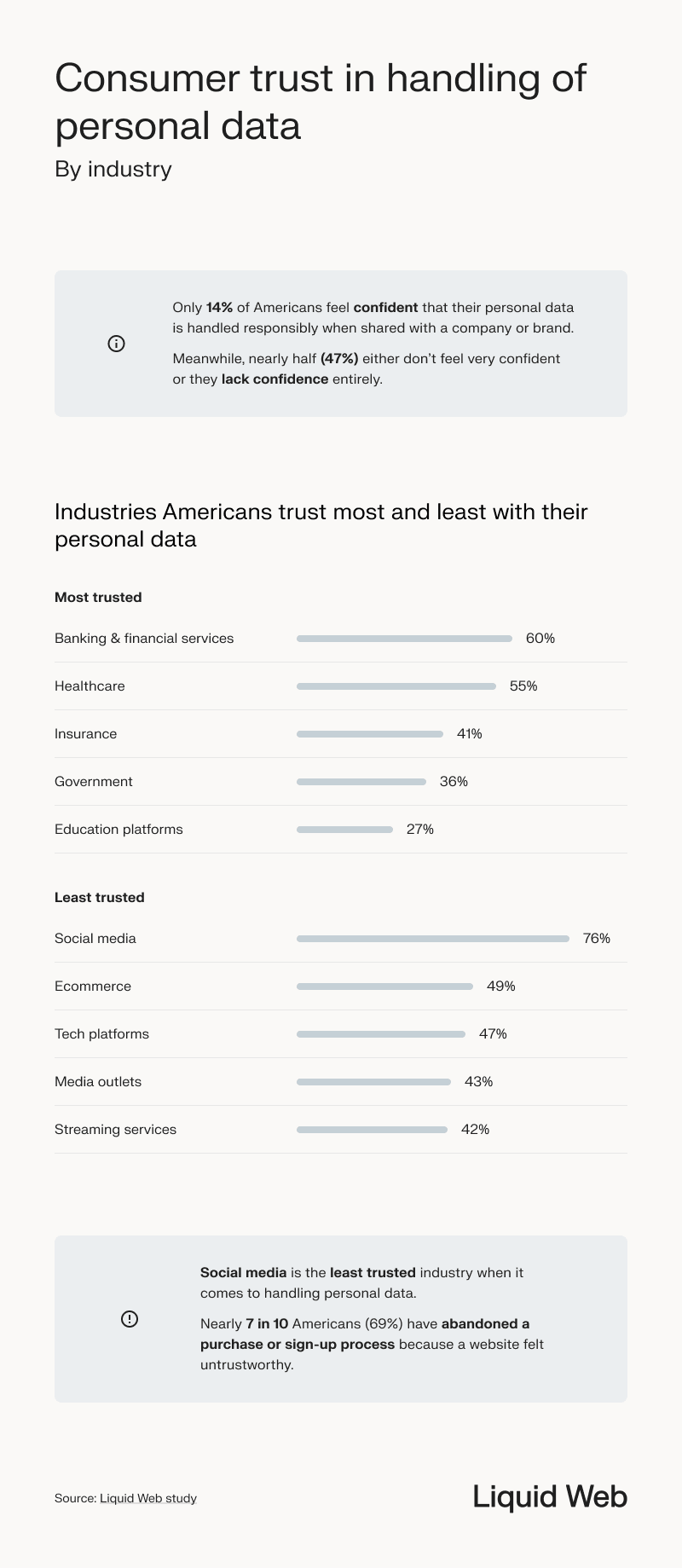
Only 14% of Americans felt confident their data was handled responsibly when shared with a company. Millennials were the most likely to feel secure about it, while 51% of Gen Z respondents either didn’t feel very confident or lacked confidence entirely.
That lack of trust can affect user behavior: 69% of respondents have walked away from a purchase or sign-up when a site seemed untrustworthy.
As for specific brands, we asked respondents to select the companies or platforms they trust to handle their personal data responsibly. They could choose multiple brands from a curated list of widely used consumer-facing companies that regularly collect personal or financial data, including contact details, payment information, and location.
The list included major names across sectors like tech, finance, telecom, ecommerce, and mobility. Overall, PayPal ranked highest in perceived trustworthiness.
Here are the top 10 most trusted providers:
- PayPal: 45%
- Capital One: 32%
- Chase: 30%
- Amazon: 28%
- Apple: 26%
- Venmo: 22%
- Zelle: 22%
- Google: 22%
- Amex: 20%
- Microsoft: 20%
We then followed up by asking respondents to select the brands they trust the least with their personal data.
Based on their responses, the 10 least trusted brands are:
- Meta: 56%
- X: 45%
- TikTok: 44%
- Google: 24%
- Amazon: 22%
- DoorDash: 17%
- McDonald’s: 17%
- Uber Eats: 16%
- Netflix: 15%
- Microsoft: 15%
Healthcare organizations fared better than many sectors: 55% of respondents said the industry handled personal data responsibly. This higher level of trust may stem from the sector’s strict compliance requirements around data protection.
Regulatory frameworks like HIPAA set clear standards for how patient information must be stored and accessed, often requiring secure, audited environments such as HIPAA-compliant hosting.
Still, skepticism ran deep across the broader digital services supply chain – especially for social platforms, followed by ecommerce and media outlets.
More than half of consumers said they needed a combination of clear data policies, trust badges, and brand reputation before they felt safe handing over their information online.
What digital trust looks like in key industries
Consumer expectations vary by sector, but a few industries stand out (for better or worse) in their ability to earn trust. Here’s what best-in-class execution looks like when digital trust is done right:
- Healthcare. With stringent standards like HIPAA, health care organizations benefit from compliant infrastructure and patient-first data protocols. HIPAA-compliant hosting helps providers demonstrate their commitment to safeguarding sensitive information.
- Ecommerce. Leading brands like Amazon and PayPal build trust by minimizing friction and showcasing strong security cues at checkout. Trust signals like HTTPS encryption, lock icons, and satisfaction guarantees reduce hesitation and improve conversion rates.
- Finance. Financial institutions such as Capital One and Chase score high on digital trust through user-friendly authentication flows and transparency during data breaches. Real-time alerts and required two-factor authentication reinforce security and accountability.
To earn and maintain consumer trust, brands must prioritize the fundamentals of a secure and transparent digital experience. Customers expect clarity, consistency, and safeguards that signal a site is safe to engage with.
Key elements include:
- Clear data privacy policies that explain how information is collected and used
- Recognizable trust badges that indicate verified security practices
- A strong and consistent brand reputation across platforms
- Secure, intuitive website design that reduces friction and confusion
- Reliable authentication methods that protect user accounts
These elements give people the confidence to share their information and keep coming back. When a website feels secure, transparent, and easy to use, it sends the right signals. People notice when brands make an effort to protect their data, and they notice when they don’t.
How to audit your digital trust posture
To help leaders assess their organization’s trust readiness, we’ve developed a four-tier digital trust maturity model. This framework maps where your brand stands today, and how to evolve.
Digital trust maturity model
Level
Description
Examples
Level 1: Baseline compliance
Meets regulatory minimums like SSL, GDPR
SSL, opt-in checkboxes, terms of service
Level 2: Privacy-driven UX
User-friendly data controls and clear privacy policies
Granular cookie opt-outs, easy-to-read privacy policy
Level 3: Integrated trust signals
Trust is visible across CX, branding, and performance
Consistent UX, verified trust badges, uptime guarantees
Level 4: AI and social trust readiness
Optimized for AI-driven validation and social proof
Presence on GPT, TikTok content, digital reputation monitoring
Trust signals and behaviors
People pay close attention to the signals a brand sends online, and those signals often determine whether they trust a site enough to engage.
This research sheds light on the behavioral workarounds consumers have used to guard their personal information and how companies could improve the digital experience.

Over half of Americans (60%) have used a fake name, email, or burner account to interact with a site they don’t fully trust. Transparency matters, too: 87% said it was very or extremely important for companies to disclose past data breaches.
Trust around digital authentication was mixed. Even though verified testimonials are meant to reassure customers, only 48% of Americans said reviews actually improve their trust in a brand. The rest (52%) have been skeptical, suspecting the reviews were fake or curated.
These findings suggest that improving user experience requires more than surface-level design.
It depends on real protection, including data privacy safeguards, secure authentication practices, and clear communication about trust-building initiatives. These initiatives can include public breach disclosures, transparent privacy policies, and giving users control over how their data is collected and used.
It also requires strengthened interoperability between trust signals. That means all the elements that indicate security – like SSL certificates, login protections, user reviews, and visual badges – need to work together in a consistent, visible way.
When these signals align, they reinforce each other and help users feel more confident engaging with a brand.
“The fact that 60% have resorted to burner emails, speaks volumes about the growing sophistication of consumers. Trust is no longer a soft metric.”
Ryan MacDonald
Chief Technology Officer at Liquid Web

Third-party validation sources
Consumers are turning to AI-powered tools and digital platforms to validate a brand’s credibility before engaging. From GPT-based search engines to social media vetting, tech-driven brand research is becoming a standard part of the decision-making process.
To build trust, brands must prioritize transparency, strengthen data privacy, and meet audiences within the digital ecosystems they prefer to use.

Nearly 1 in 3 Americans (29%) have used ChatGPT search or a similar tool powered by artificial intelligence to assess a brand’s credibility. This highlights a growing shift in how consumers use digital technologies to make informed decisions online.
Among generations, Gen X (30%) and millennials (29%) were the most likely to rely on AI-based tools for credibility checks. Gen Z (27%) and baby boomers (27%) were the least inclined to use AI algorithms in this way.
Gen Z showed a distinct digital behavior: 1 in 10 said they vet brands on TikTok before buying.
The rise of AI in shaping brand credibility
Trust isn’t just earned through your website anymore. It’s being vetted through third-party AI platforms and algorithms your brand doesn’t control, but can influence.
Key findings about behaviors shaping this shift include:
- 29% of Americans use ChatGPT or similar AI tools to assess brand trust.
- Gen Z checks TikTok to determine brand credibility before making purchases.
- Millennials and Gen X are adopting AI-based validation tools at scale.
What this means for brands
To compete in this new landscape, brands must go beyond surface-level messaging and build credibility that resonates with both humans and machines.
Here’s how:
- Make trust signals machine-readable. AI tools rely on structured, semantically clear information – including schema markup, accessible privacy policies, and publicly indexed security certifications.
- Expect AI to analyze your entire digital footprint. These tools pull from user reviews, breach disclosures, UX performance, and brand sentiment across platforms.
- Recognize that trust now begins off-site. Your presence in AI-generated results, review aggregators, and social validation platforms increasingly shapes perception before users ever land on your domain.
To win trust in 2025 and beyond, brands must optimize not just for users – but for the algorithms that guide them. The future of digital trust will be defined by credibility that can stand up to AI scrutiny and meet consumers wherever they search.
Digital distrust is growing
Digital interactions are central to daily life, and thus, so are concerns about how personal information is handled online. From data breaches to misleading reviews, consumers are more aware of the vulnerabilities – like malware, phishing attempts, and insecure data storage – that come with using digital platforms.
Building and maintaining consumer trust requires more than surface-level assurances. It demands transparency, accountability, and secure data practices.
To build digital trust, brands need to safeguard user information and continuously align their practices with evolving consumer expectations.
“Trust isn’t just built through encryption. It’s reinforced through every interaction, especially now that users are validating brands through AI tools and social platforms before making decisions.”
Ryan MacDonald
Chief Technology Officer at Liquid Web
Digital trust in action: a leadership playbook
To help leaders turn insight into impact, we’ve outlined a five-step checklist for operationalizing digital trust inside your organization:
- Conduct a UX audit for trust signals. Are privacy policies accessible? Are trust badges visible and up to date? Is SSL present across all pages?
- Align your reputation footprint with AI environments. Check how your brand shows up in tools like ChatGPT, Perplexity, and TikTok. Optimize for consistency and credibility.
- Implement breach transparency protocols. Don’t just have an incident response plan – make it part of your public trust narrative.
- Add trust metrics to product and marketing OKRs. Make digital trust a performance metric, not just a compliance goal.
- Train every team to embed trust. From design to support, empower employees to recognize and reinforce trust-building behaviors.
Digital trust isn’t a side initiative. It’s a strategic enabler of conversion, retention, and long-term brand equity. This checklist offers a practical way to embed trust at every level and turn it into a competitive advantage.
Questions to uncover gaps and strengthen your digital trust strategy
Trust is not the responsibility of a single department – it’s a shared organizational mandate. Use these targeted questions to spark internal conversations across IT, product, marketing, and leadership teams.
Questions for IT and security leaders:
- Are our data protection protocols clearly communicated to users – not just enforced behind the scenes?
- Have we implemented secure authentication methods that balance security with usability?
- Do we disclose data breaches transparently, and is our incident response process part of our public trust story?
Questions for product and UX teams:
- Where in the user journey are we losing trust, and can we track abandonment linked to perceived security gaps?
- Are our trust signals — like SSL badges, policy links, and user controls — visible, intuitive, and consistent across devices?
- Have we tested how different generations, especially Gen Z, interact with our platform and respond to trust cues?
Questions for marketing and growth teams:
- Is our brand reputation visible and accurate in AI platforms like ChatGPT, Reddit, and TikTok search?
- Are we shaping our digital reputation through proactive content, social proof, and third-party validation?
- Do we treat digital trust as a measurable KPI tied to conversion rates, customer loyalty, and lifetime value?
Fair use statement
This content is based on proprietary research conducted by Liquid Web and is shared here under fair use for educational and informational purposes. If you reference any part of this article, please provide proper attribution with a link back to the study so your readers can see the findings in their entirety.
Share this content
<a href="https:www.liquidweb.com/white-papers/digital-trust-report/" target="_blank" rel="noopener noreferrer">Liquid Web study on the state of digital trust 2025.</a>
Learn more about this study
Built for total protection
Get dedicated hosting plus add-ons tailored to safeguard your most critical assets.
