◦ Low-latency network
◦ Secure and compliant
What 1,000 IT leaders revealed about VPS vs dedicated hosting in 2025
Today’s infrastructure decisions are shaping tomorrow’s innovation. In this study of 1,000 IT leaders, three priorities emerged when selecting between VPS and dedicated hosting:
- Cost control remains critical – especially for lean teams and early-stage product launches.
- Dedicated infrastructure is performance insurance – a must for high-traffic, compliance-heavy, or customer-facing operations.
- Support and scalability are now C-suite concerns, with nearly half of respondents experiencing delays or outages due to infrastructure gaps.
For CTOs and growth leaders, the choice between VPS and dedicated hosting isn’t just technical – it’s strategic.
This report arms you with data and insights to align infrastructure decisions with your business’s goals for growth, resilience, and innovation.
Key findings
- Over a third of IT leaders (36%) have experienced a business-impacting outage due to a lack of support, with shared hosting users being the most affected (42%).
- Cost is the top priority for VPS users (50%), significantly higher than for dedicated server users (33%).
- Dedicated server users prioritize performance (38%) and security (31%) than VPS users (35% and 15%, respectively).
- 79% of IT leaders say 24/7 technical support is either extremely important (35%) or a strong consideration (44%) when choosing a hosting provider.
- 42% of IT leaders have delayed a product launch because their infrastructure wasn’t ready.
What’s the biggest factor in your hosting decision?
Infrastructure decisions hinge on many variables, but cost, performance, and reliability remain top of mind.
Respondents shared how their current server environment reflects their priorities and how hosting plans must align with changing business demands.
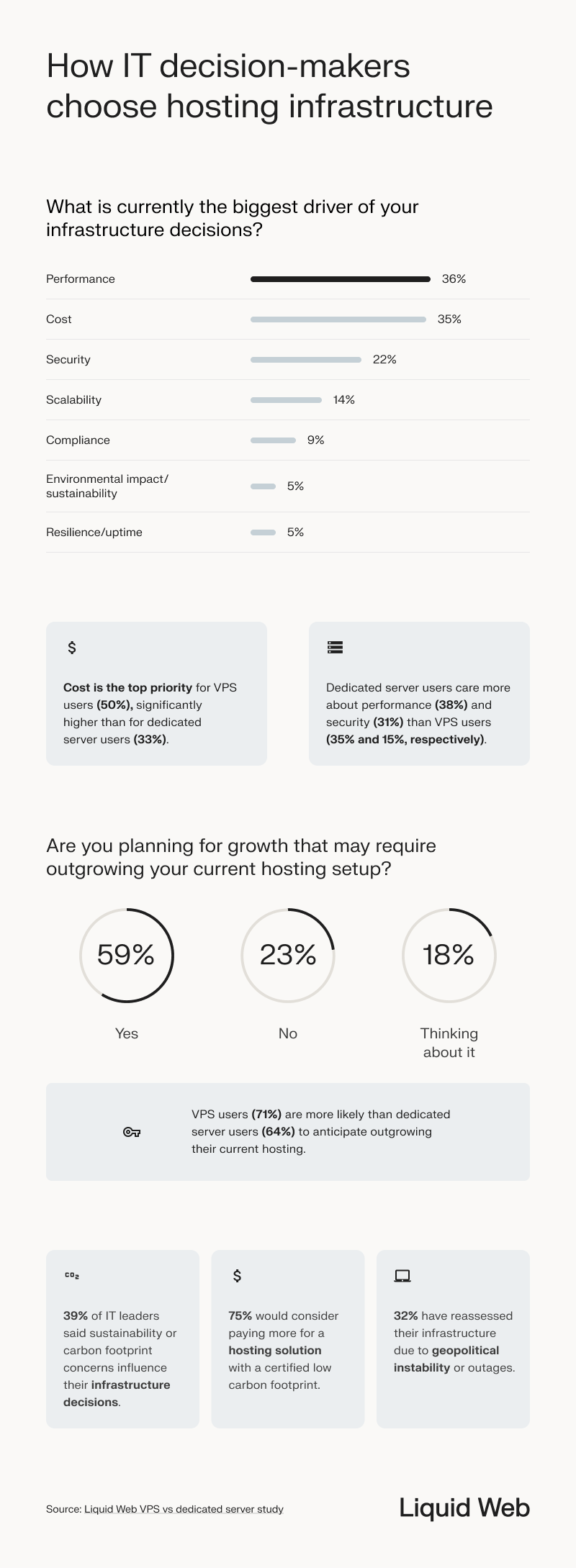
Cost considerations ranked highest among VPS hosting users, with 50% naming price as the top driver when choosing infrastructure. In contrast, only 33% of dedicated server users prioritized cost.
More dedicated server users factored in better performance (38%) and enhanced security (31%) than VPS users did (35% and 15%, respectively). This reflects the demand for dedicated resources and physical servers among businesses that need consistent speed and protection, especially those managing sensitive data or handling high-traffic websites.
VPS hosting vs. dedicated hosting features
Criteria
VPS hosting
Dedicated hosting
Cost
Lower up-front and monthly
Higher total cost
Performance
Shared resources, moderate
Full resources, high
Security
Virtual isolation, sufficient for moderate workloads
Physical isolation, higher
Control
Root access, limited tuning
Full control, OS/hardware
Scalability
Easy to scale up
Requires provisioning planning
Use cases
SMBs, staging, agile dev
Ecommerce, databases, gaming
Nearly half of the respondents (46%) said they have switched hosting providers due to scalability issues or infrastructure that couldn’t handle traffic spikes. A third of IT leaders changed their hosting environment in the past year, with cost concerns (39%) being the leading reason.
These results show that VPS plans appeal to businesses prioritizing affordability, especially those with lighter workloads or tighter budgets. However, for teams managing resource-intensive workloads or running ecommerce platforms, the need for better performance and security often drives the move toward dedicated server hosting.
As hosting needs change and traffic demands increase, aligning infrastructure with performance and scalability requirements becomes critical.
What’s the key difference between VPS and dedicated?
The line between VPS hosting and dedicated server hosting often comes down to control, performance, and workload requirements. While both offer more power than shared hosting or basic cloud hosting, they serve different use cases.
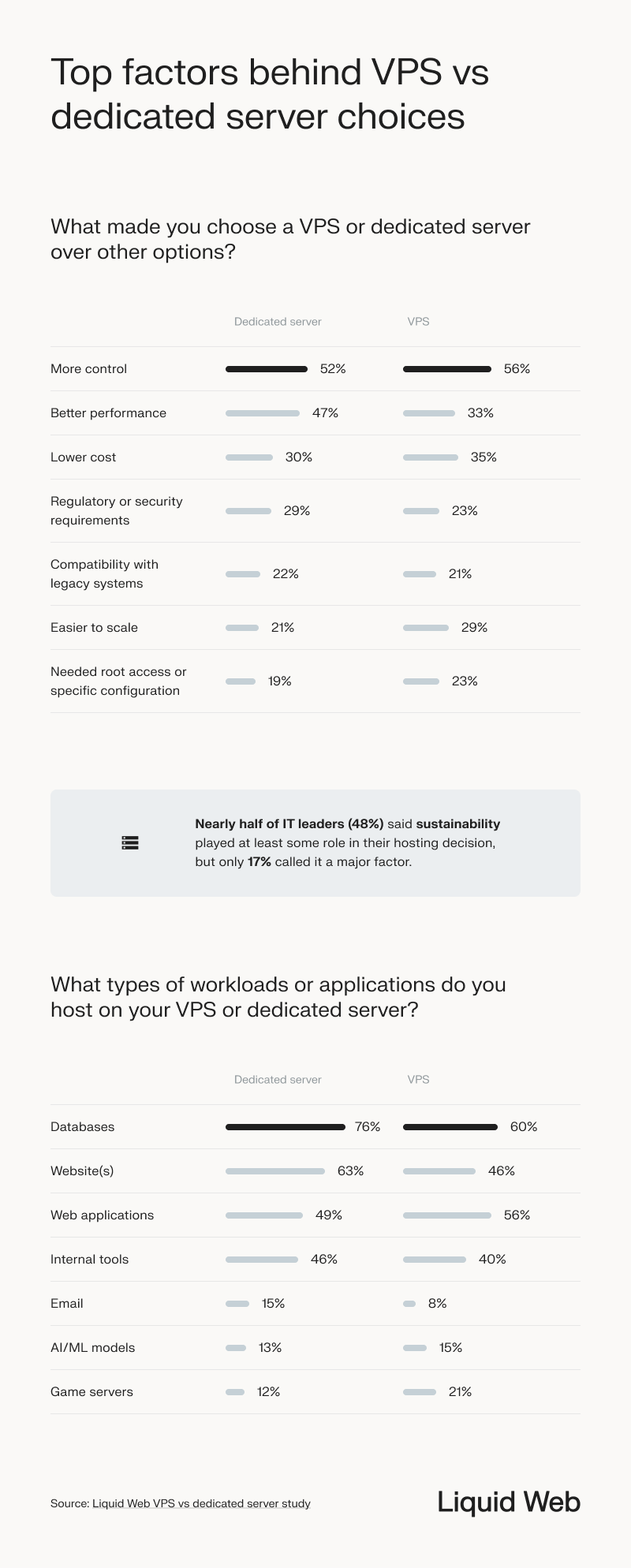
Control was the leading reason for choosing both VPS (56%) and dedicated servers (52%), suggesting that users across the board are seeking more autonomy than what shared hosting typically provides.
Many IT leaders are also open to tradeoffs, as 75% said they would be willing to sacrifice some CPU performance on a dedicated server if it meant simplifying migration to a virtual private server.
Performance also plays a major role in platform selection. Nearly half of dedicated server hosting users (47%) cited better performance as a key reason for their choice, compared to 33% of VPS users.
In contrast, VPS hosting users were more likely to prioritize price (35%) than those using dedicated servers (30%), highlighting the importance of affordability for many VPS adopters.
When asked about the biggest differences between VPS and dedicated server hosting, respondents pointed to performance and speed (25%), cost (24%), and resource isolation (19%).
In other words, dedicated servers typically deliver faster speeds and more consistent performance because resources aren’t shared with other users. VPS environments, while more affordable, involve sharing physical hardware, which can lead to variability in performance and less isolation between workloads.
Strategic trends for 2026: Where hosting is headed
IT leaders aren’t just choosing between VPS and dedicated servers; they’re planning for the next generation of infrastructure demands. The most forward-looking teams are optimizing their environments to meet:
- AI and ML workloads that require consistent compute power and fast local storage
- Edge deployments to reduce latency and improve real-time user experiences
- Compliance readiness amid tightening global data privacy and security regulations
Looking ahead, IT leaders are planning infrastructure with those tradeoffs in mind. Private cloud (36%) and hybrid infrastructure (33%) were the most popular future hosting options, far ahead of VPS solutions (13%) and public cloud services like AWS or Azure (9%).
As these trends intensify, dedicated servers and hybrid infrastructure are becoming critical for organizations that need higher levels of control, stable performance, and geographic data isolation.
An important takeaway: VPS offers cost-efficient scalability and elasticity, but dedicated environments are better suited to support long-term goals like AI adoption, compliance, and global infrastructure performance.
How important is 24/7 support?
Technical support has become a dealbreaker for many organizations. As server environments grow more complex, timely and reliable support is key to maintaining uptime and trust in a hosting provider.
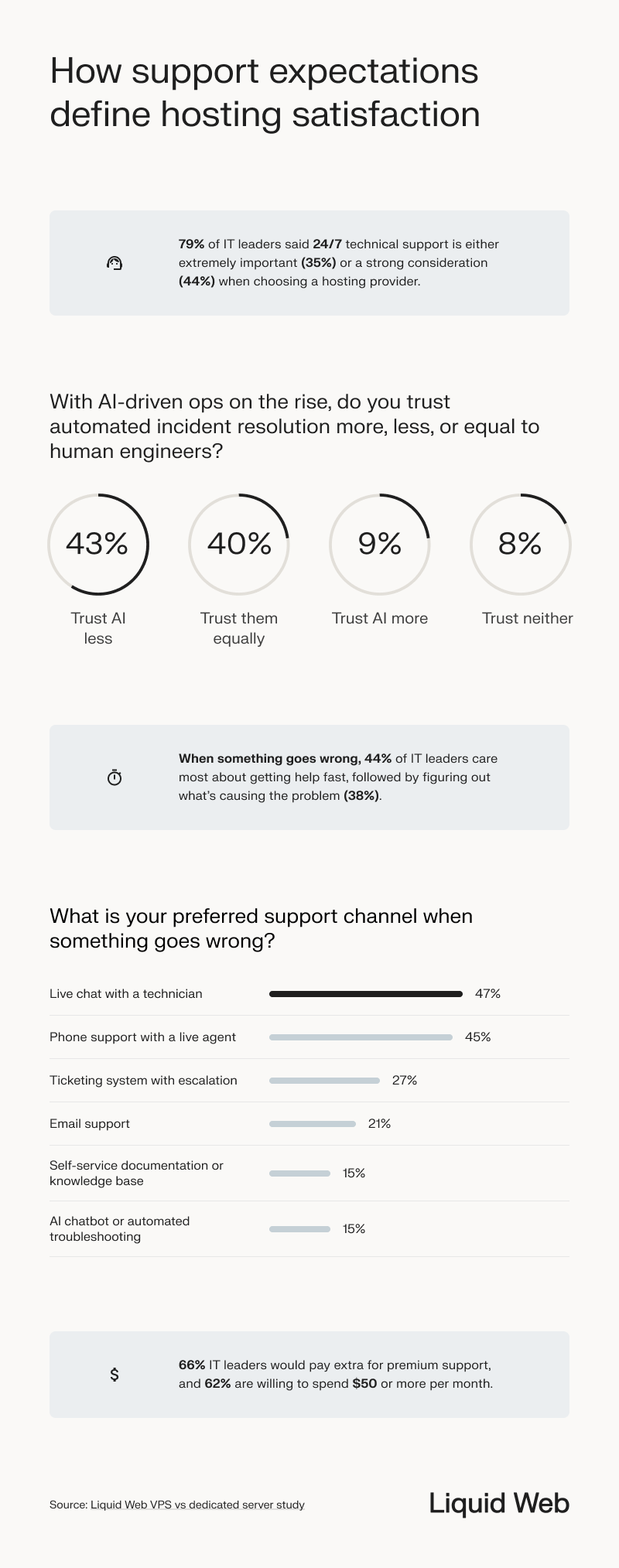
Nearly 8 in 10 IT leaders said 24/7 technical support is either extremely important or a strong factor when evaluating hosting services. This around-the-clock help is especially important for teams managing critical workloads, game servers, or ecommerce sites where downtime can directly impact revenue.
Most respondents said they’re using managed hosting solutions, including managed cloud (31%), managed dedicated servers (26%), and managed VPS hosting (17%). Only 17% rely on unmanaged hosting options.
Support shortfalls also lead to provider churn. In the past 6 months, 23% of IT leaders changed hosting providers due to poor support.
More than a third (36%) had experienced a business-impacting outage because of limited or delayed support. Those on shared servers were hit hardest (42%), while VPS hosting users were least likely to report this (27%).
Downtime is more than a tech issue; it’s a business risk. A 30-minute outage during peak ecommerce hours can cost tens of thousands in lost revenue, not to mention customer churn and lasting damage to brand trust.
As hosting infrastructure becomes increasingly integral to user experience and product delivery, 24/7 support is no longer just a nice-to-have; it’s a core pillar of enterprise continuity.
“Don’t underestimate the value of around-the-clock support, it’s the safeguard that turns tech challenges into uptime victories.”
Carrie Wheeler
President of Liquid Web

Is your infrastructure ready for growth?
Hosting needs can change fast. We asked IT leaders what their infrastructure will need most in the next year and what steps they’re taking to prepare.
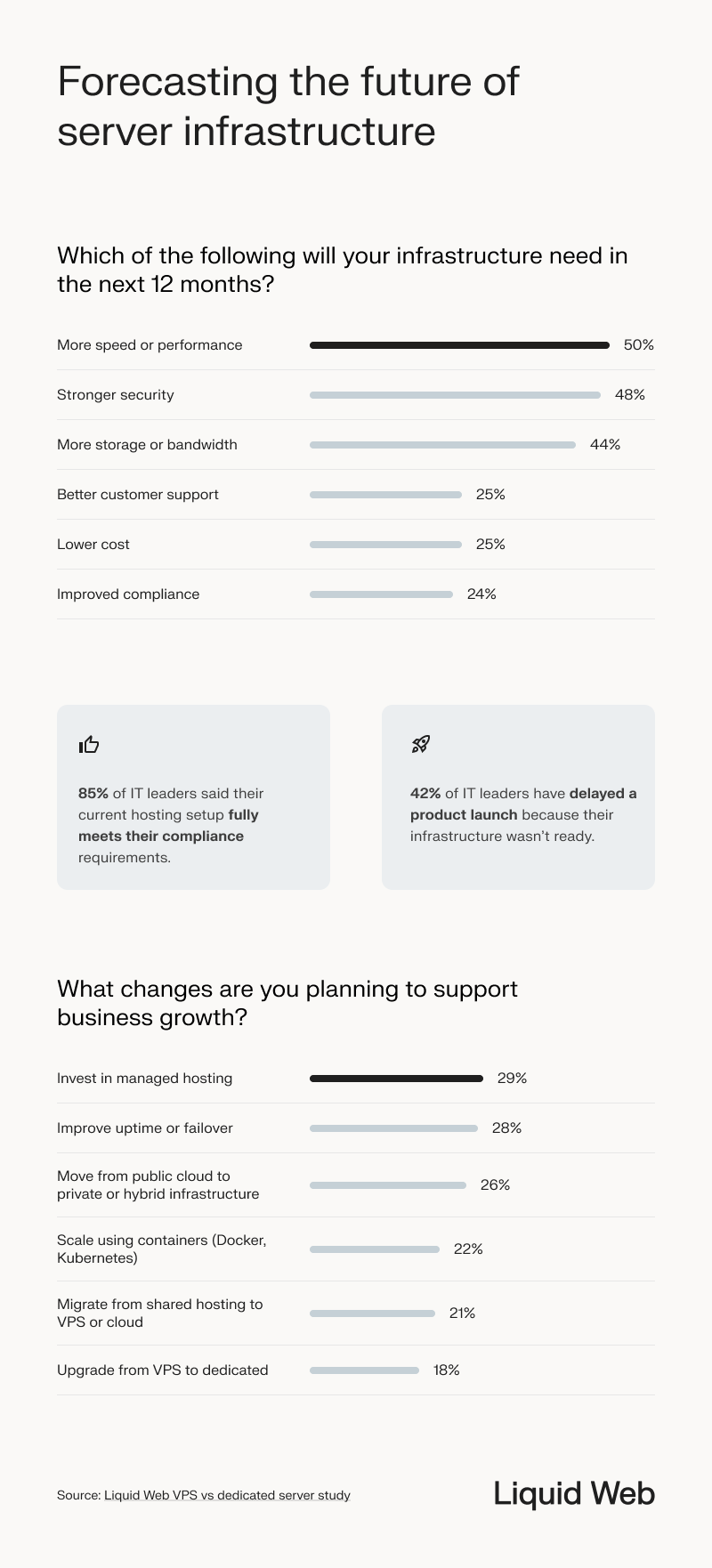
More than 2 in 5 IT leaders (42%) said they’ve delayed a product launch because their infrastructure wasn’t scalable or couldn’t deliver the performance they needed. Whether it’s allocating disk space, upgrading firewall configurations, or managing virtualization technology, these challenges show how critical a flexible, high-performance hosting solution is to staying on track.
To meet growing demands, nearly half of IT leaders expect to make a major infrastructure change within the next year, including 30% within 7–12 months and 14% in the next 4–6 months.
Organizations using VPS hosting or dedicated server hosting should regularly assess bandwidth, server resources, and specific needs to avoid future delays or outages.
Growth readiness checklist: What to review before scaling
Before launching a new product or migrating environments, CTOs and infrastructure leaders should assess:
- Traffic patterns and load balancing needs
- Storage and backup planning
- Compliance or geographic restrictions
- DevOps toolchain compatibility
- Support coverage during weekends and peak hours
- Disaster recovery plans and SLA-backed uptime guarantees
Proactive hosting decisions can prevent costly rebuilds, reduce downtime risk, and unlock faster time-to-market.
Conclusion: What’s driving hosting decisions in 2025?
IT leaders aren’t just thinking about specs. They’re choosing hosting solutions that support growth, control costs, and keep critical systems running.
VPS hosting is a go-to for teams that need flexibility – whether that means spinning up environments quickly, managing unpredictable traffic, or testing and deploying new products without long provisioning cycles – all without breaking the budget. Dedicated servers remain the top choice for performance, security, and full control.
If you’re deciding between VPS and dedicated servers, it comes down to what your business needs most, like room to scale, complete control, or a more affordable starting point.
The right choice depends on your workloads, your team, and how much performance you need now versus what you’ll require in the coming months or as your business scales over the next few years.
“Infrastructure choices clearly reflect business priorities. Whether you use VPS or dedicated servers, the data proves that infrastructure isn’t just a technical decision, it’s a strategic one.”
Ryan MacDonald
Chief Technology Officer at Liquid Web

FAQ: Understanding website hosting features and options
Web hosting comes with a lot of technical terms and options. This FAQ covers common questions about VPS, dedicated servers, and the features that impact performance, scalability, and cost.
What is the difference between a VPS and a dedicated server?
Both options give you more control than shared hosting, but they allocate resources differently. VPS hosting uses a virtual environment to divide one physical server into multiple virtual machines, each with its own operating system, IP address, and resource allocation.
Dedicated hosting enables you to access an entire physical server, offering full root access, stronger isolation, and more flexibility to optimize for performance and security.
Is VPS hosting shared or dedicated?
VPS hosting is a middle ground. It runs on a shared physical server, but your virtual environment is isolated from others. You get dedicated slices of hardware resources, including RAM and CPU, along with your own operating system and control panel access. It offers more privacy and control than shared hosting, without the higher cost of dedicated hardware.
Is VPS better than shared web hosting?
In most cases, yes. VPS offers better resource allocation, faster load times, and more control over the operating system and software. It’s a solid upgrade from shared website hosting for projects that need more stability, customization, or room to grow, without jumping to the cost of a single server.
What’s the purpose of a VPS server?
A VPS server gives developers, teams, and businesses more control and consistency than shared hosting. It’s often used to host websites, applications, databases, or staging environments where you need dedicated resources, root access, and the ability to manage server configurations directly.
What’s the role of control panels in hosting?
A control panel like cPanel or Plesk simplifies server management. It allows you to handle domains, files, databases, email, SSL, and more without needing command-line access. It’s especially useful in managed VPS or reseller hosting setups.
Does data center location affect performance?
Yes. Choosing a data center near your target users can reduce latency and improve load times. Many providers offer regional options to help you serve distributed audiences more efficiently.
What is reseller hosting, and who uses it?
Reseller hosting lets agencies or small businesses sell website hosting services under their own brand using the provider’s infrastructure. Whether leveraging VPS reseller hosting or dedicated server options, it’s a cost-effective way to build recurring revenue without managing physical servers.
How important is DDoS protection?
Reseller hosting lets agencies or small businesses sell website hosting services under their own brand using the provider’s infrastructure. Whether leveraging VPS reseller hosting or dedicated server options, it’s a cost-effective way to build recurring revenue without managing physical servers.
Do SSDs improve hosting performance?
Yes. Hosting plans with SSD storage offer faster load times, more efficient data handling, and greater reliability compared to traditional hard drives. Most high-performance hosting options now include SSDs by default.
Fair use statement
This content is based on proprietary research conducted by Liquid Web and is shared here under fair use for educational and informational purposes. If you reference any part of this article, please provide proper attribution with a link back to the study so your readers can see the findings in their entirety.
Share this content
<a href="https://www.liquidweb.com/white-papers/vps-vs-dedicated-server-trends/" target="_blank" rel="noopener noreferrer">Liquid Web study on VPS vs dedicated servers.</a>
Learn more about this study
Launch fast with Liquid Web
Provisioned in as little as 5 minutes, cloud VPS is your private, performance-ready environment.
