◦ Root access
◦ 100% uptime SLA
VPS in 2025: Key trends driving migration and growth
Executive summary for hosting providers and technical decision-makers:
VPS hosting is no longer a niche solution. It’s becoming the preferred infrastructure for developers, IT teams, and growing digital businesses in 2025.
As shared hosting limitations and dedicated server costs push users to seek alternatives, VPS offers a middle ground with greater control, scalability, and performance.
To understand what’s fueling this shift, we surveyed 951 decision-makers and technical users across industries. Respondents included developers and IT professionals (50%), small business owners (SBOs) and freelancers (31%), and technical hobbyists (19%).
Their feedback reveals why adoption is accelerating, as well as how expectations around customization, support, and cost are shaping the next generation of VPS solutions.
“For IT leaders, the shift to VPS isn’t just about cost savings. It’s about ensuring scalable, resilient infrastructure that supports innovation at speed,” says Ryan MacDonald, Chief Technology Officer at Liquid Web.
Key findings
- 27% of non-VPS users plan to migrate to VPS within the next 12 months.
- Those using shared hosting (44%) are most likely to migrate to VPS in the 12-month time period.
- Over 1 in 4 respondents (26%) use VPS hosting to run an ecommerce website.
- 80% of VPS users say full admin control (root access) is the most important feature.
- 27% of respondents run ecommerce sites or online stores as side projects on VPS, separate from their primary jobs.
- 90% of users would recommend VPS hosting or have already done so.
See how Liquid Web VPS can future-proof your business infrastructure and explore why our VPS hosting plans are recommended by developers, IT teams, and business owners alike.
Top use cases by user type
VPS adoption is accelerating across technical and business audiences. Whether powering ecommerce storefronts, development environments, or game servers, users turn to VPS for performance, affordability, and control.
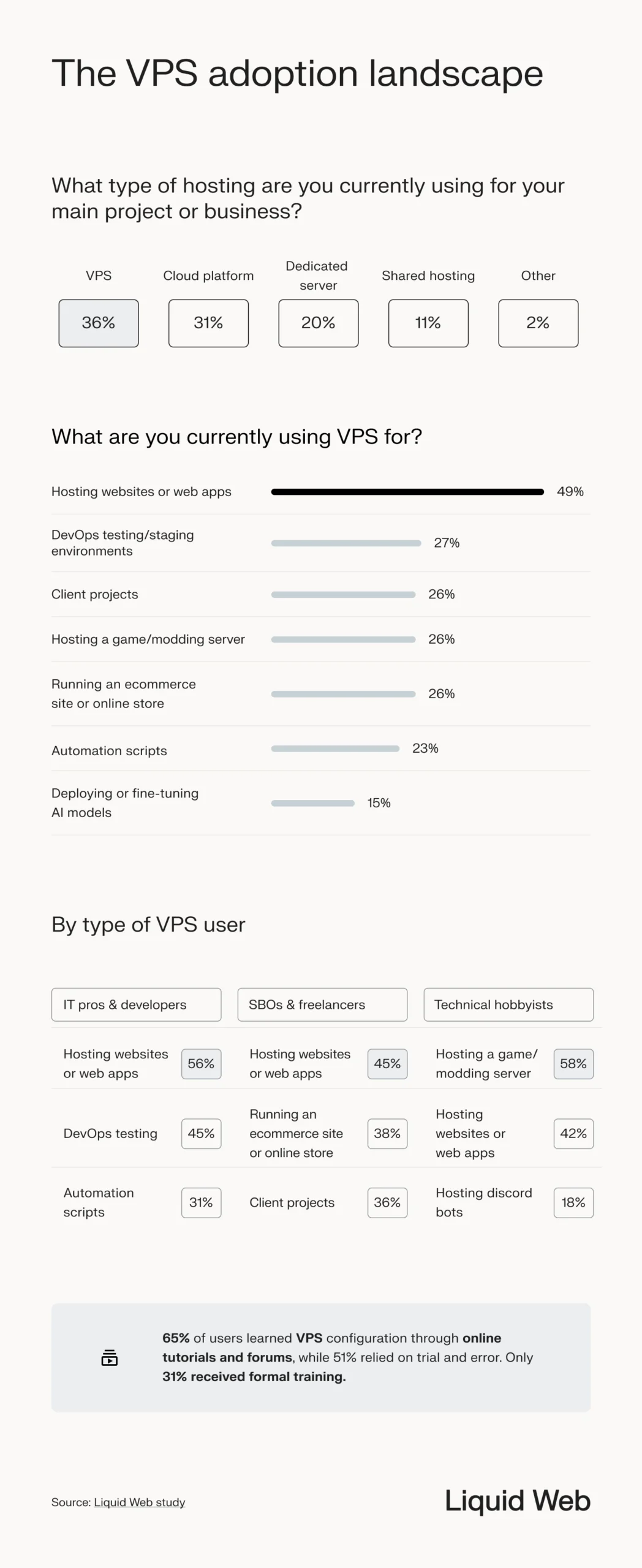
Over a quarter of online stores (26%) among respondents were running on VPS hosting at the time of this study. Windows Server was the most-used VPS operating system, preferred by 36% of respondents.
On the Linux side, Ubuntu led with 28%, followed by CentOS (9%), Debian (7%), and Arch Linux (6%). AlmaLinux, Red Hat Enterprise Linux (RHEL), Rocky Linux, and Alpine Linux rounded out the remaining distributions.
These preferences reflect the diverse workloads and user comfort levels shaping how VPS is deployed today.
Change is coming: 27% of non-VPS users plan to switch to VPS within the next year. Shared hosting users were the most likely to migrate (44%), followed by those on dedicated servers and cloud platforms (25% each). Their motivations included better performance (42%), lower cost (32%), and enhanced security (30%).
For leaders, this migration wave signals an opportunity to reassess infrastructure strategies and avoid falling behind competitors who are modernizing.
Top pain points by hosting type
We asked respondents about the biggest frustrations they’ve experienced with their current hosting setup. Their answers reveal why so many are shifting to VPS in 2025:
- Among current cloud platform users, the top frustrations were high prices (57%) and hidden/unpredictable pricing (30%).
- For those using dedicated servers, 43% cited high prices, while 36% pointed to poor performance or slow loading times.
- Among shared hosting users, the most common pain points were high prices (40%) and limited control/configuration options (38%).
For executives, these pain points reveal that infrastructure choice is no longer just an IT concern; it directly impacts cost management, customer experience, and brand trust.
See how Liquid Web VPS eliminates these pain points with transparent VPS hosting pricing and full control.
Support or bust
VPS users may be technically savvy – but they still expect strong support, reliable performance, and full control.
Without these, they’ll leave.
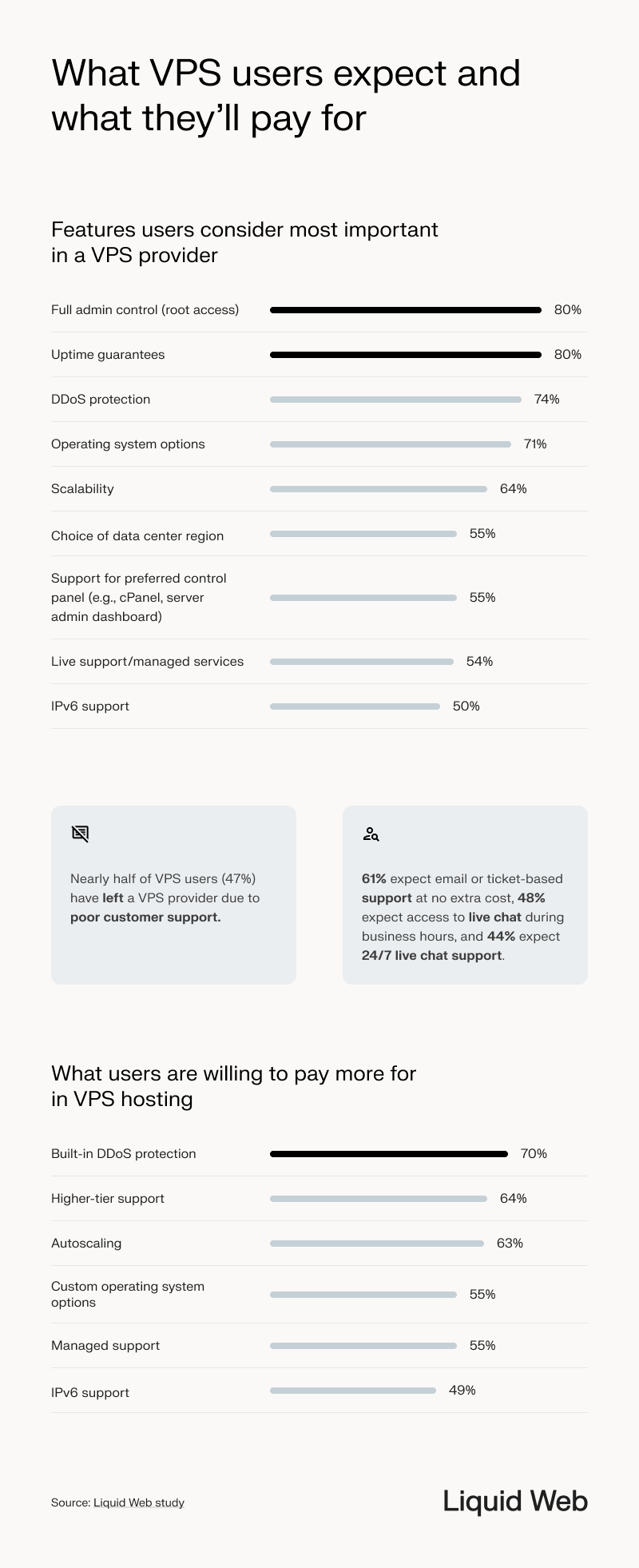
When asked what matters most in a VPS solution, users overwhelmingly pointed to root access (80%) and uptime (80%). Well over half of respondents also said DDoS protection (74%), operating system options (71%), and scalability (64%) were top features to consider when evaluating a VPS provider.
Nearly half (47%) had previously left a VPS provider due to poor customer support, while 40% cited lack of control or customization, and 37% noted outdated admin tools.
For leaders, this highlights support as a competitive differentiator. Even technical users won’t stay if service quality lags.
Talk to our team to learn how Liquid Web delivers 24/7/365 expert support.
Top VPS features by user type
IT professionals and developers prioritized the following in a VPS hosting provider:
- Uptime guarantees: 81%
- Full admin control: 80%
- DDoS protection: 76%
Small business owners and freelancers prioritized:
- Full admin control: 80%
- Uptime guarantees: 78%
- DDoS protection: 73%
Technical hobbyists prioritized:
- Uptime guarantees: 80%
- Full admin control: 80%
- Operating system options: 71%
Even experienced users won’t tolerate bad support, limited control, or outdated tooling. Providers that fail to deliver on the basics risk losing their most informed customers.
“Leaders should view this report as a clear signal to prioritize VPS as a default offering. Investments in support, root access, and tooling directly align with demand.”
Chris La Nasa
Sr. Director of Product Marketing at Liquid Web

From side projects to shared hosting showdowns
VPS isn’t just powering business-critical workloads. It’s also fueling side projects, creative tools, and hobbyist infrastructure.
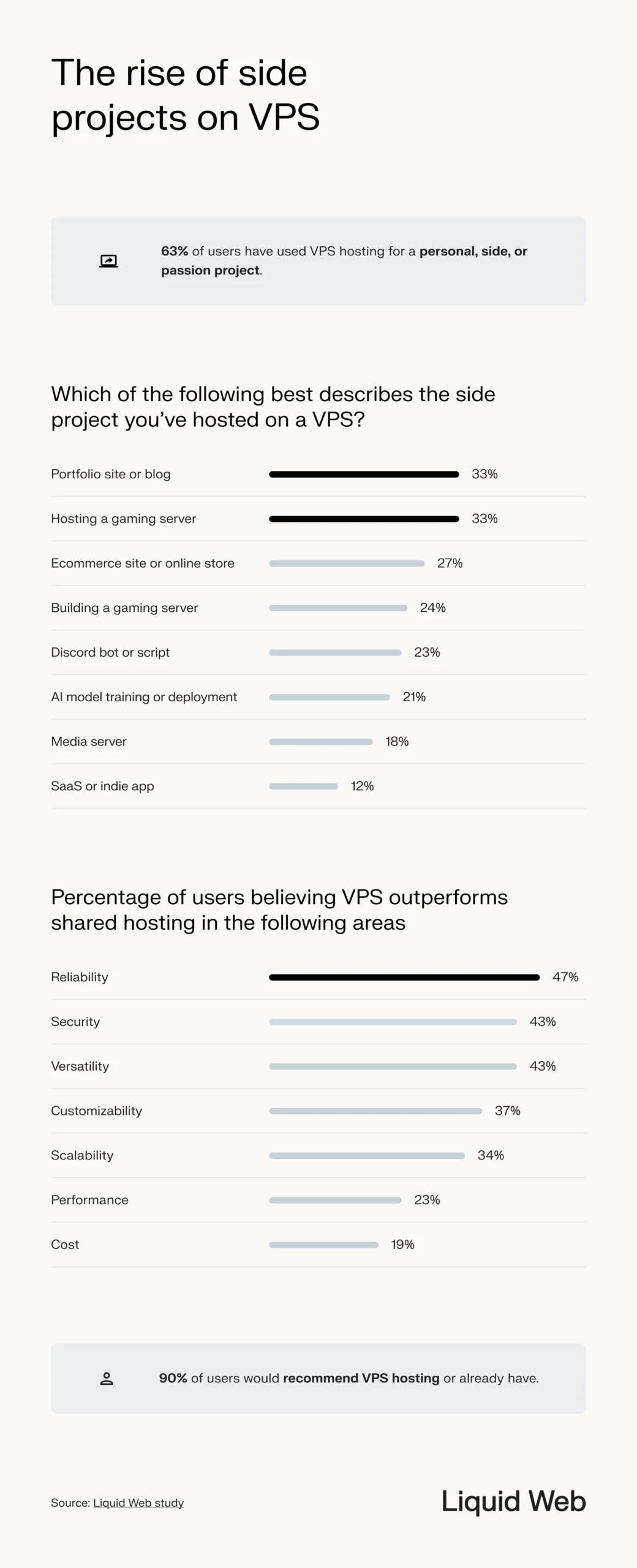
Among all VPS users surveyed, 27% said their side projects involved ecommerce stores. For decision-makers, this shows how VPS enables lean innovation, supporting both side projects and enterprise-grade storefronts on the same flexible infrastructure.
Performance was top of mind: 35% of users said it’s the area they most want to improve. Customization (17%) and user interface (16%) followed.
Gamers have also shaped VPS trends in 2025. Over half of technical hobbyists (54%) have used a VPS to host a gaming server. Another 33% used one to build a gaming server from scratch, and 22% used VPS to host Discord bots. These insights reflect how flexible and powerful VPS hosting has become for real-time, high-interaction use cases.
The growth of VPS is further amplified by advocacy.
A full 90% of users have either recommended VPS or would do so. Among those who already have, 61% recommended it to non-technical friends – proof that today’s VPS offerings are more accessible than ever.
Only 10% said they feel VPS isn’t suited for non-technical users.
See Liquid Web case studies about how businesses of every size use VPS for innovation.
Where VPS stands in 2025
VPS hosting has evolved into a default solution for users seeking performance, control, and scalability without the costs of dedicated infrastructure.
As ecommerce grows and shared hosting limitations become more apparent, the move to VPS is accelerating across industries and user types.
From powering side hustles to supporting high-traffic storefronts, VPS is driving the future of hosting in 2025 – and it’s only just getting started.
Compare VPS plans today and see why businesses are migrating in 2025.
“The future of hosting is about delivering the affordability of shared, the control of dedicated, and the scalability of cloud. VPS is the bridge, and leaders who invest now will be best positioned for growth.”
Ryan MacDonald
Chief Technology Officer at Liquid Web

Fair use statement
This content is based on proprietary research conducted by Liquid Web and is shared here under fair use for educational and informational purposes. If you reference any part of this article, please provide proper attribution with a link back to the study so your readers can see the findings in their entirety.
Share this content
<a href="https:www.liquidweb.com/white-papers/vps-trends-report/" target="_blank" rel="noopener noreferrer">Liquid Web study on VPS trends.</a>
Learn more about this study
Fully managed VPS hosting
Enjoy full root access, predictable pricing, and proactive support — without the complexity of VPS management.
