88% of businesses are using AI to optimize hosting budgets
As cybersecurity threats and compliance demands grow, businesses are adjusting their hosting budgets to meet these challenges head-on. Liquid Web’s latest study surveyed IT and cybersecurity leaders from small, midsized, and large companies to understand how they’re adapting to industry changes.
This report also explores how economic uncertainty is forcing trade-offs in performance and security, alongside insights into the challenges of hiring in-house DevOps teams versus turning to managed or freelance solutions.
From rising cybersecurity budgets to trends in hosting strategies, the findings reveal how businesses are preparing for an unpredictable future.
Key points
- On average, businesses allocate $64,500 toward hosting and $44,800 for cybersecurity tools annually.
- Nearly 9 in 10 businesses (88%) claim automation or AI plays a role in optimizing their hosting expenses, with 42% saying it plays a major role.
- Over 1 in 3 businesses (34%) don’t feel prepared for AI-driven cyberattacks.
- The biggest challenges businesses face when hiring in-house DevOps talent are high salary demands, limited talent pool, and difficulty retaining skilled employees.
- On average, freelance DevOps talent charges $39.40 an hour, with those based out of the U.S. charging the highest ($82.35).
How businesses are rebalancing hosting and cybersecurity budgets
As the demands of cybersecurity and compliance grow, businesses are adjusting their hosting budgets to prioritize tools and strategies that safeguard their operations.
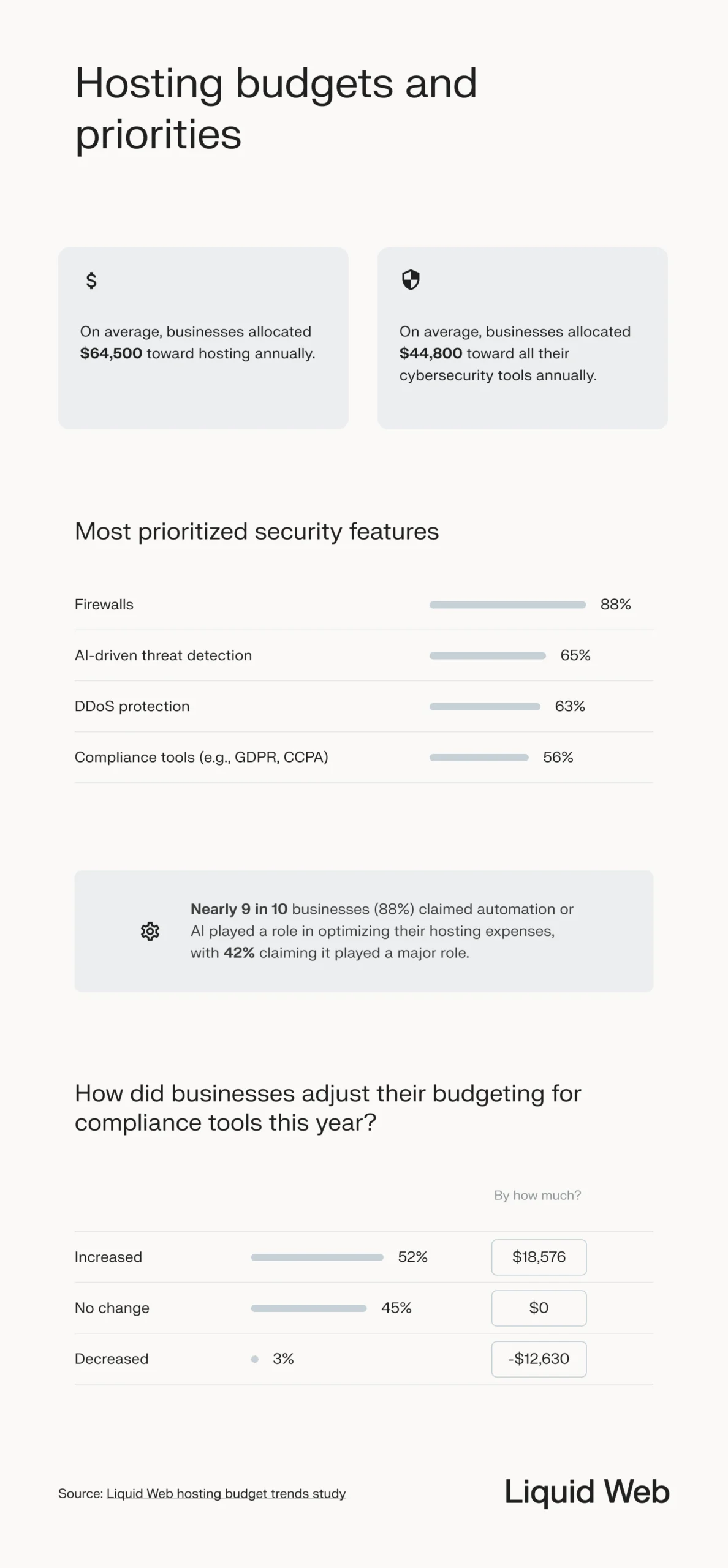
On average, businesses reported allocating $64,500 annually toward hosting and $44,800 for cybersecurity tools. For small businesses, hosting budgets were notably lower, averaging $23,100 annually.
Nearly 9 in 10 businesses (88%) reported using automation or AI to optimize hosting expenses, with 42% saying it plays a major role. Some are also exploring GPU servers to power their AI automation, particularly in efforts to strengthen cybersecurity.
Small businesses lagged slightly behind in adopting these technologies, with 81% utilizing automation or AI, the lowest among all company sizes.
“With 88% of businesses already leveraging automation technologies to optimize expenses, it’s clear that embracing AI is no longer optional but essential for staying competitive.”
Carrie Wheeler
President of Liquid Web

Compliance tools were another growing priority, with over 1 in 2 businesses (52%) planning to increase their compliance budgets this year by an average of $18,600. Small businesses were less likely to make these increases, with 41% planning to expand their budgets and the majority either keeping budgets unchanged (53%) or decreasing them (6%).
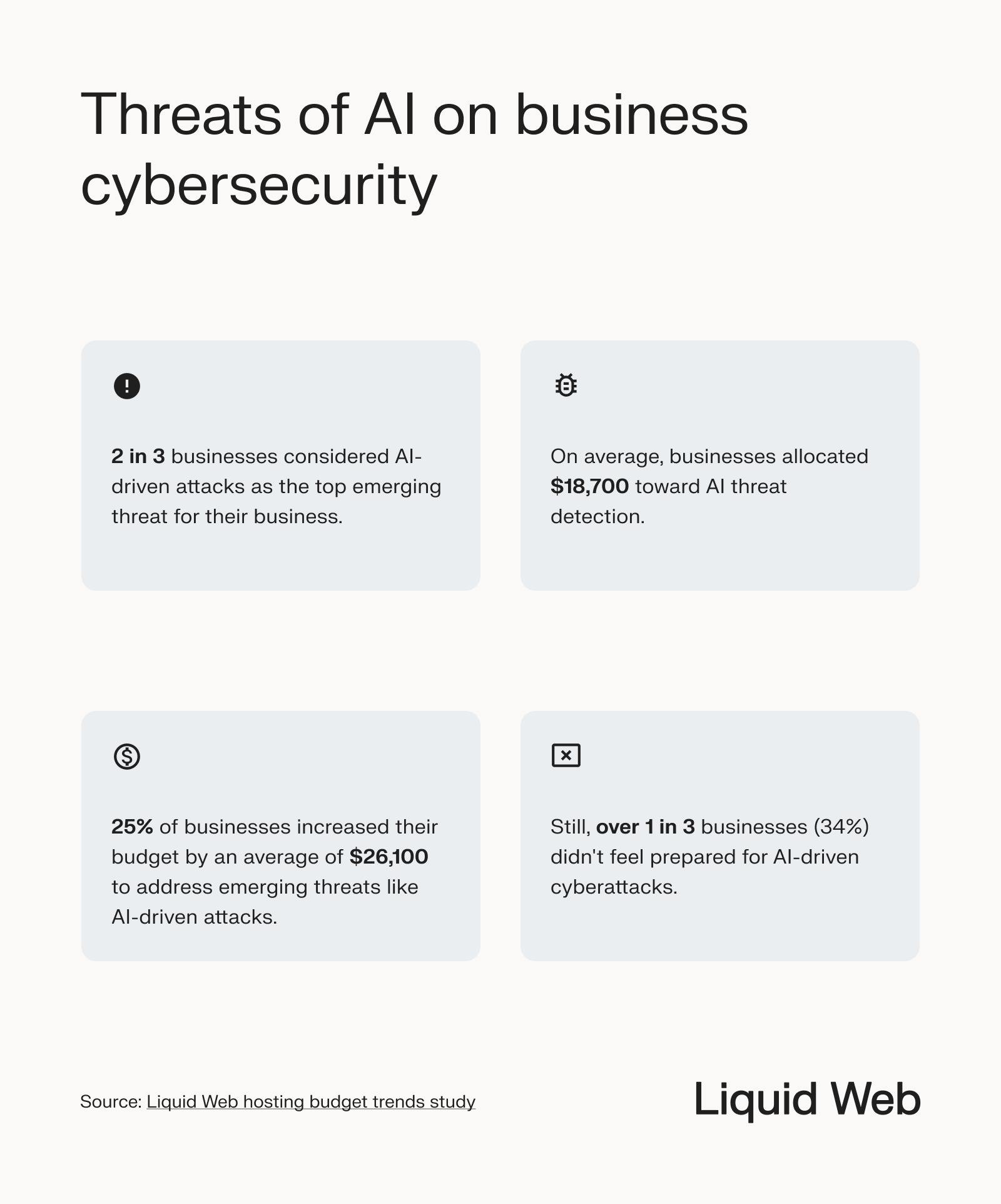
Emerging threats like AI-assisted cyberattacks are reshaping security priorities: 2 in 3 businesses identified these attacks as their top concern, dedicating an average of $18,700 toward AI threat detection. Small companies were the least likely to view AI-driven attacks as a significant threat (53%).
In response to these risks, 25% of businesses increased their budgets by an average of $26,100. But preparedness remains an issue for some. More than 1 in 3 businesses (34%) admitted they don’t feel ready to defend against AI-driven cyberattacks.
“Escalating concerns over AI cyberattacks highlight a necessity for robust cybersecurity measures. Businesses must prioritize threat detection and employee training to safeguard their operations.”
Carrie Wheeler
President of Liquid Web
How economic uncertainty is shaping hosting budgets
Economic challenges are prompting businesses to reassess their hosting budgets, leading to trade-offs that impact performance and security.
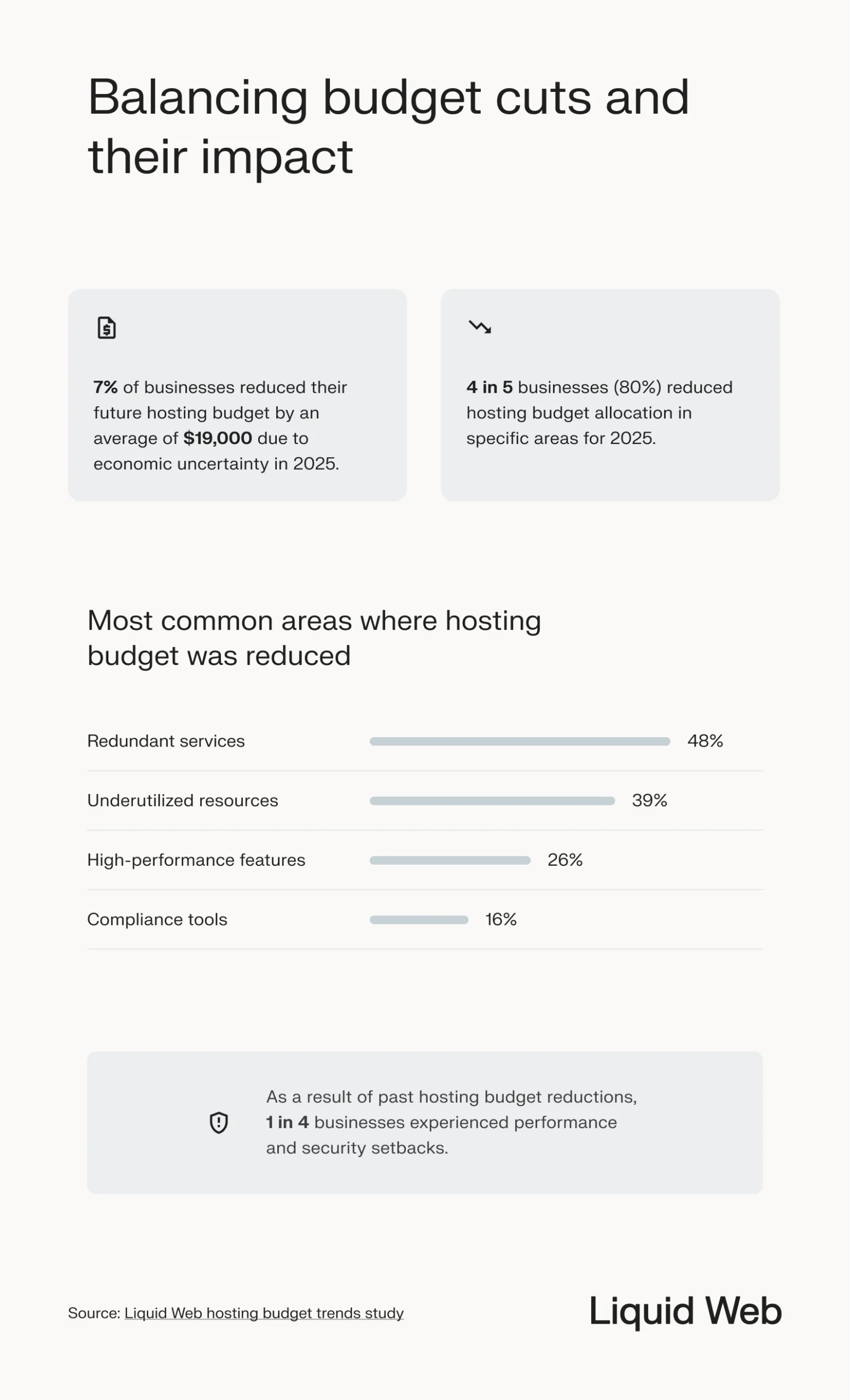
A small but significant portion of businesses (7%) reported reducing their hosting budgets for the coming year, cutting an average of $19,000 due to economic uncertainty. However, these cuts come with consequences.
Among businesses that reduced their hosting budgets previously, 1 in 4 experienced security and performance setbacks.
Choosing the right DevOps solution
Businesses face critical decisions when determining how to manage their DevOps needs, which involve practices that streamline software development and IT operations for faster, more reliable application delivery.
These decisions often come down to selecting the right model for implementation: in-house DevOps teams, managed services, or freelance DevOps professionals.
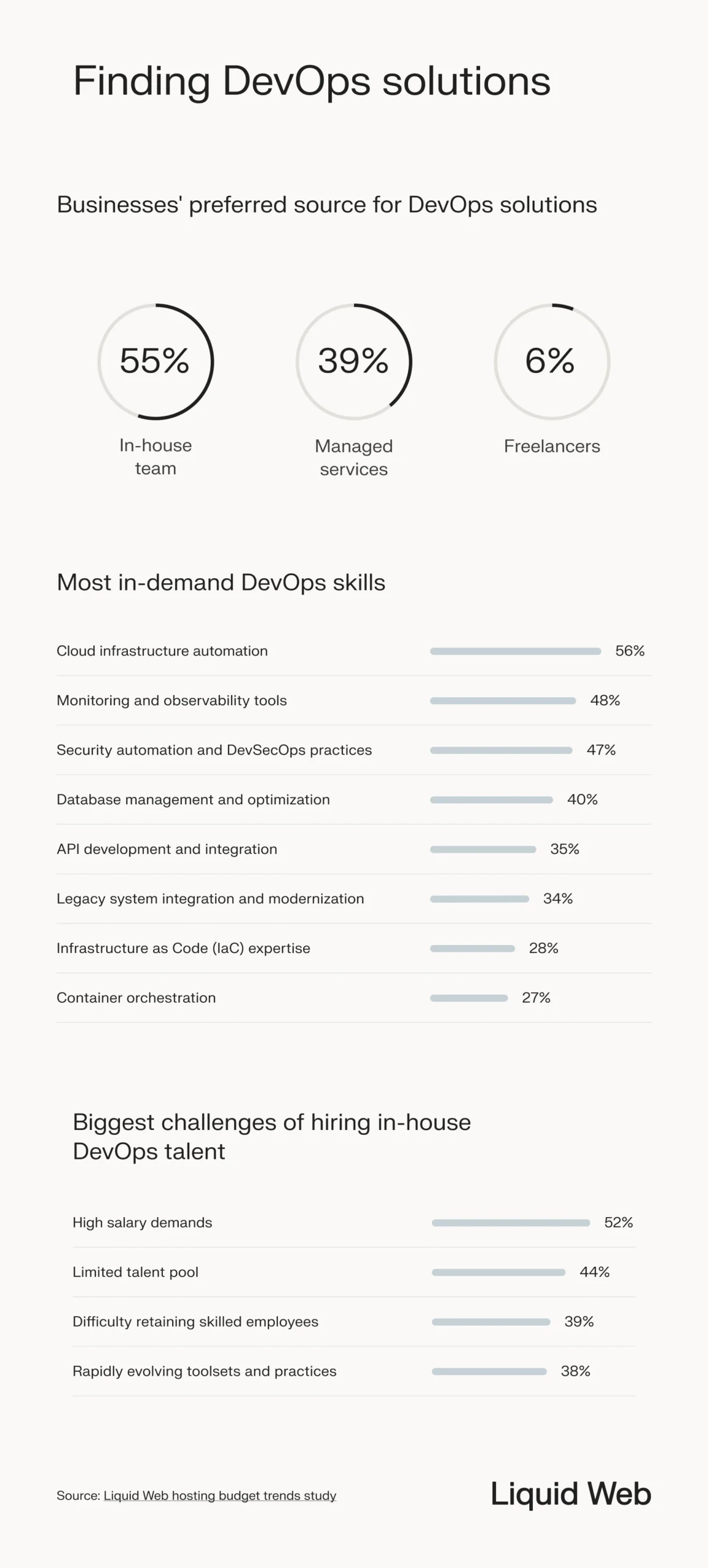
The majority of businesses (55%) prefer to maintain an in-house DevOps team, valuing the control and direct oversight it provides.
Yet, this choice isn’t without challenges. Many businesses reported difficulties in hiring and retaining skilled DevOps professionals due to high salary demands, a limited talent pool, and difficulty retaining employees in a competitive job market.
- 39% of businesses opted for managed solutions, which provide expert support without the complexities of hiring and managing a dedicated team.
- Freelance DevOps solutions were the least favored option, with only 6% of businesses choosing this route.

For those considering freelance DevOps talent, the cost can vary widely depending on location. On average, freelancers charged $39.40 an hour, with rates ranging from $26.34 for professionals in India to $82.35 for those in the U.S.
While freelance solutions may offer flexibility and cost savings in certain cases, their limited adoption, in comparison to in-house teams and managed services, suggests concerns about consistency and reliability for many organizations.
Preparing for the challenges ahead
Businesses are leveraging AI to optimize hosting budgets and tackle emerging threats, with many prioritizing cybersecurity and compliance spending. However, economic uncertainty has led some organizations to reduce hosting budgets, creating performance and security risks.
DevOps decisions further highlight the balancing act between cost, expertise, and operational needs. As businesses face growing demands and rapid technological shifts, their ability to adapt will be key to staying secure and competitive in 2025.
Adapting to trends requires innovative approaches, such as exploring managed services or upskilling existing teams. This fosters resilience and success in an increasingly complex digital landscape.”
Carrie Wheeler
President of Liquid Web
Fair use statement
You’re welcome to share this content for noncommercial purposes. When referencing or sharing, please credit Liquid Web and include a dofollow link to the original article.
Share this content
<a href="https://www.liquidweb.com/white-papers/hosting-budget-trends-study/" rel="dofollow">Hosting budget trends study</a>
Learn more
Find hosting in your price range
Find the perfect hosting solution for your requirements with our sales team.
