◦ PCI compliant ready
◦ WooCommerce or Magento
Black Friday may be a single day on the calendar, but for ecommerce businesses, it represents months of behind-the-scenes planning and infrastructure preparation. From load testing servers to launching targeted ads, many retailers are deep into strategy long before consumers begin searching for deals.
To understand how ecommerce businesses approach this critical season, Liquid Web surveyed 220 business owners, 90% of whom run ecommerce operations. The findings reveal when they begin preparing for Black Friday, how they align with consumer behavior, and the technical strategies they deploy to stay online and profitable during one of the year’s most demanding events.
The study highlights that uptime, speed, and checkout reliability remain top priorities for ecommerce decision makers, areas where Liquid Web continues to innovate to support revenue-ready experiences.
Key points
- 43% of businesses begin planning for Black Friday in July or earlier, while 17% begin in August, 21% in September, 14% in October, and 5% wait until November.
- 39% of businesses see the first uptick in customer engagement related to Black Friday in October.
- 69% of businesses believe website speed is essential for their expected Black Friday revenue.
- 30% of businesses have experienced checkout errors, major slowdowns, and/or complete site crashes during Black Friday, with nearly 4 in 5 (77%) experiencing these issues multiple times.
- 46% of businesses conduct website stress tests ahead of Black Friday, but only 9% run a full-scale traffic simulation.
Strategic planning begins in the summer
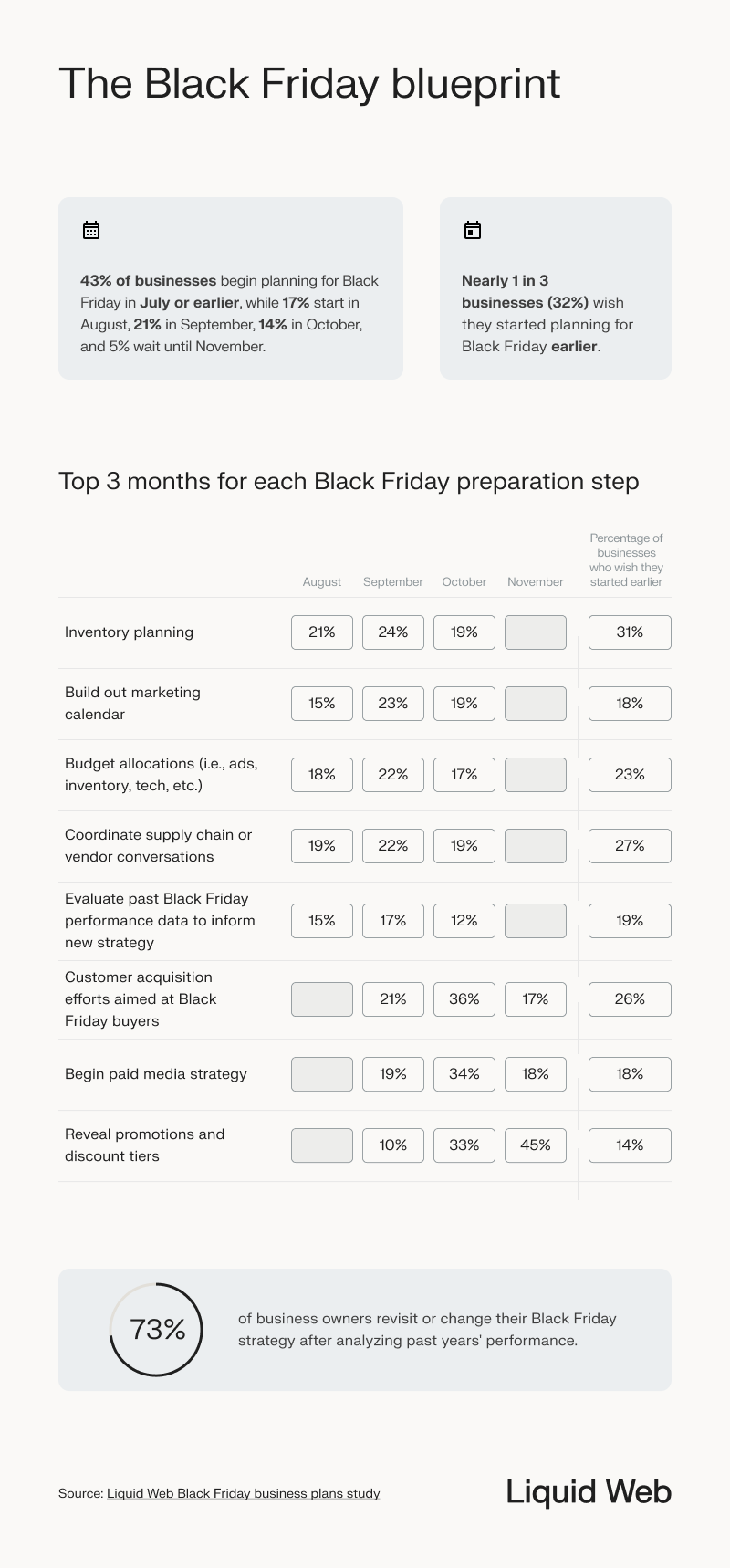
When businesses begin planning for Black Friday:
- July or earlier: 43%
- August: 17%
- September: 21%
- October: 14%
- November: 5%
Many teams start by July, a signal that early coordination on inventory, partners, and acquisition sets the pace for fourth quarter performance. To prepare for variable demand, many leaders also explore cloud VPS hosting for elastic performance planning that scales with seasonal traffic.
- Nearly 1 in 3 businesses (32%) wish they started planning sooner, especially when it comes to inventory planning, coordinating supply chain or vendor conversations, and customer acquisition efforts aimed at Black Friday shoppers.
- 73% of business owners revisit or change their Black Friday strategy after analyzing past years’ performance
Top Black Friday preparations businesses make by month
September
- Inventory planning
- Building out marketing calendar
- Budget allocations
- Coordinating supply chain and vendor conversations
- Evaluating past Black Friday performance data to inform new strategy
October
- Customer acquisition efforts specifically aimed at Black Friday buyers
- Begin paid media strategy
November
- Reveal promotions and discount tiers
Aligning campaigns with consumer behavior
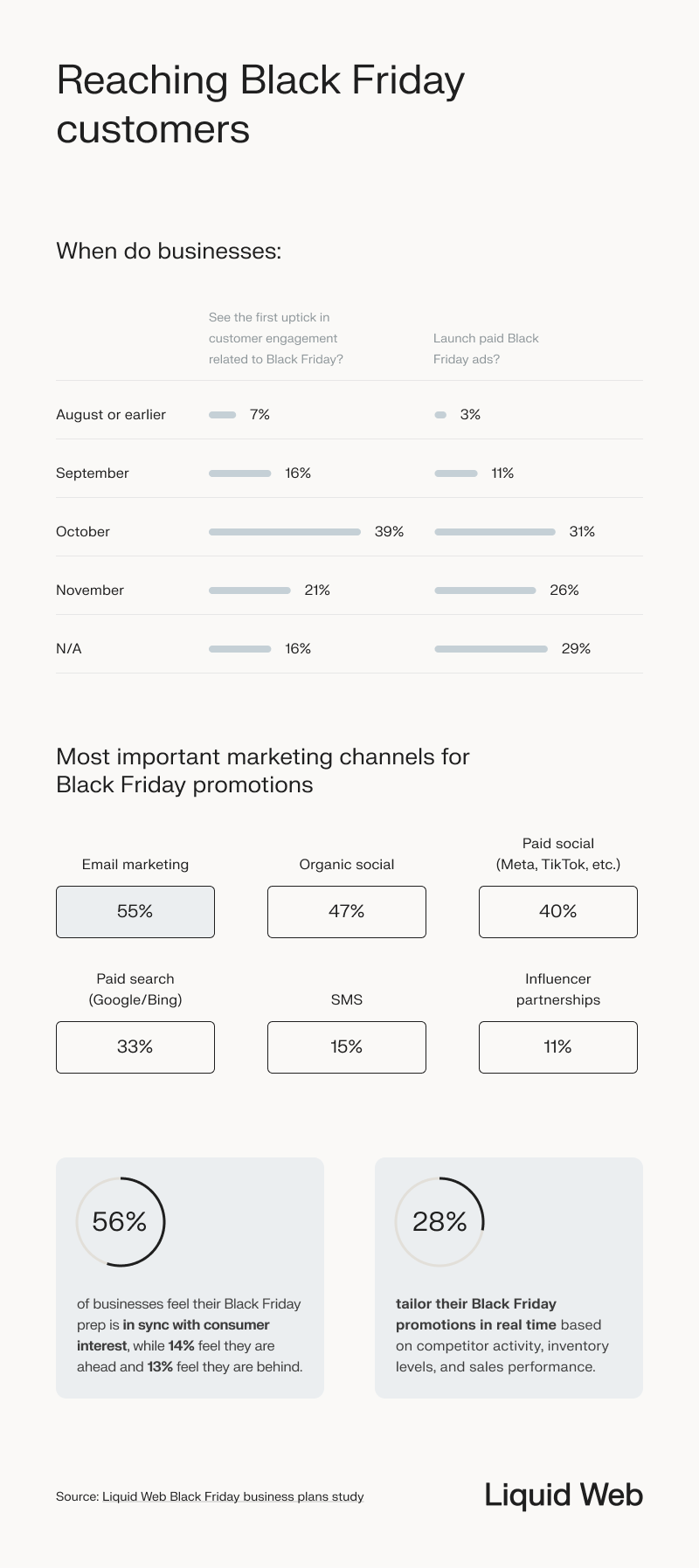
- In October, business owners are most likely to see their first uptick in customer engagement related to Black Friday (39%) and launch their paid ads for Black Friday (31%).
- According to business owners, email marketing is the most important channel for Black Friday promotions.
- 56% feel their Black Friday preparation aligns with consumer interest, while 14% feel ahead and 13% feel behind.
- 28% tailor their Black Friday promotions in real time based on competitor activity, inventory levels, and sales performance.
- Businesses say the top 3 important metrics when measuring Black Friday success are total revenue (70%), conversion rate (31%), and average order value (29%).
- 57% feel confident in their current Black Friday plan.
Email remains the anchor channel, but platform-specific optimizations also matter. For example, Managed WooCommerce and optimized Magento hosting ensure that promotional campaigns convert by pairing fast storefronts with the right offers.
Infrastructure stress: Black Friday’s technical pressure
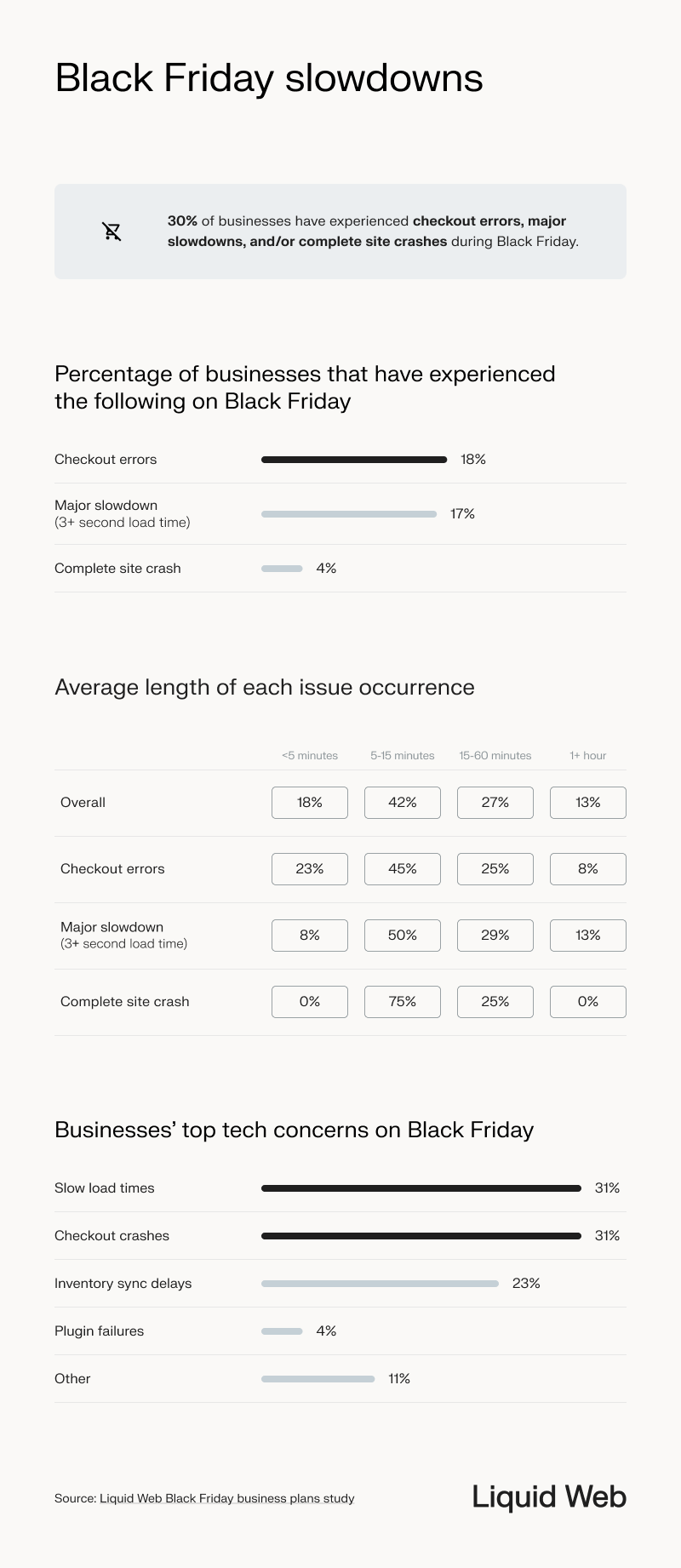
- 30% of businesses have experienced checkout errors, major slowdowns, and/or complete site crashes during Black Friday, with 18% experiencing checkout errors, 17% experiencing major slowdowns, and 4% experiencing complete site crashes.
Case study: Peak-season stability
A mid-market retailer using Liquid Web dedicated hosting scaled for Black Friday by load testing early and deploying redundant checkout systems. As a result, their site remained stable during a 4x traffic surge while competitors experienced outages. This demonstrates how proactive infrastructure decisions translate into real-world revenue protection.
- 77% of businesses that have seen checkout errors, major slowdowns, or complete site crashes have experienced these issues multiple times.
- 13% of businesses with a website issue on Black Friday say it lasted an hour or more.
- Businesses are most worried about slow load times and checkout crashes on Black Friday.
Three in ten businesses report checkout errors or slowdowns on Black Friday, which signals a clear opportunity to harden checkout and scale capacity before peak demand. Options like dedicated servers or bare metal deliver predictable performance under sustained traffic.”
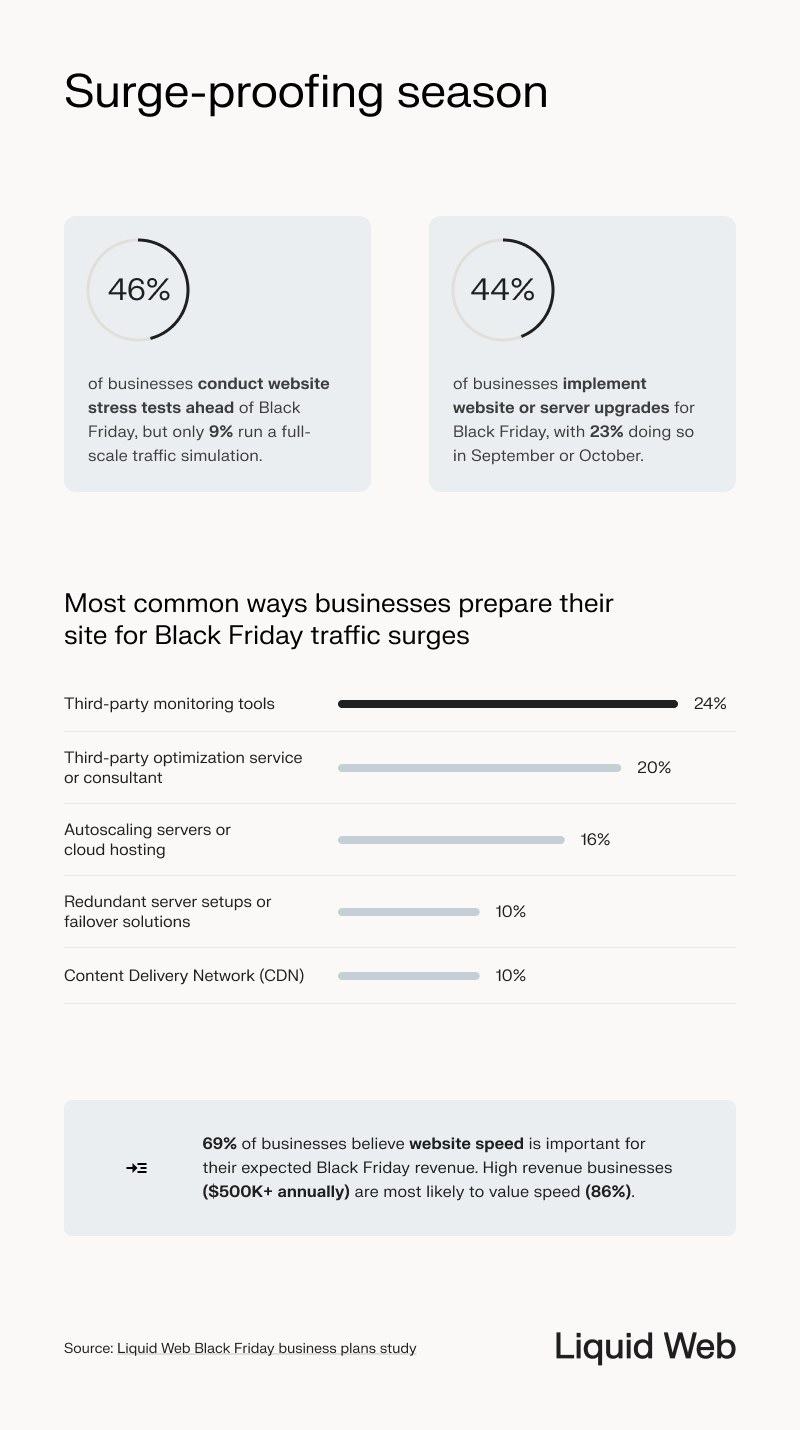
- 46% of businesses conduct website stress tests ahead of Black Friday, but only 9% run them through a full-scale traffic simulation.
- 44% of businesses implement website or server upgrades in anticipation of Black Friday, with 23% doing so in September or October.
- Businesses are most likely to use third-party monitoring tools (24%) and third-party optimization services or consultants (20%) to prepare their site for Black Friday traffic surges.
- 69% of businesses believe website speed is important for their expected Black Friday revenue. High-revenue businesses ($500K+ annually) are more likely to value speed (86%) than lower-revenue businesses (under $500K annually) (64%).
Methodology
This report builds on our Every Second Counts research series, which explores the business impact of speed and reliability across ecommerce. For this study, Liquid Web surveyed 220 business owners about their Black Friday planning and strategies. Among respondents, 90% run an ecommerce business. Additionally, 37% report their annual revenue is under $50K, 16% report their annual revenue from $50K to $100K, 25% report their annual revenue from $100K to $500K, and 22% report their annual revenue is over $500K.
About Liquid Web
Liquid Web is a comprehensive hosting provider specializing in scalable solutions like cloud VPS, managed VPS, and dedicated servers. Their portfolio supports a wide range of digital needs for businesses, from high-performance bare metal infrastructure to WordPress optimized hosting and ecommerce hosting.
For online retailers, Liquid Web provides fully managed solutions includingoptimized Magento hosting, and flexible managed WooCommerce hosting, built to scale with customer demand and site complexity.
With Black Friday web hosting deals around the corner, it’s an ideal time for businesses to upgrade to infrastructure built for speed, security, and reliability.
Fair use statement
This content is based on proprietary research conducted by Liquid Web and is shared here under fair use for educational and informational purposes. If you reference any part of this article, please provide proper attribution with a link back to the study so your readers can see the findings in their entirety.
Share this content
<a href="https://www.liquidweb.com/white-papers/black-friday-business-plans-study" target="_blank" rel="noopener noreferrer">Liquid Web study on ecommerce business owners' Black Friday business plans.</a>
Ready to get started?
Grab a free copy of the Black Friday Success Guide for month-by-month checklists and guidance.
