

◦ Comprehensive security
◦ 24/7 support
HIPAA → Program Basics
The 7 basic elements of a HIPAA compliance program
Ensuring that your organization remains HIPAA compliant is a straightforward matter. Straightforward doesn’t necessarily mean easy, but at least areas of confusion or complication have greatly been mitigated.
The Office of the Inspector General for the Department of Health and Human Services has a guide entitled The Seven Fundamental Elements of an Effective Compliance Program.
Here’s a look at each of the seven basic elements of a compliance program and how each one applies to your hosting environment.
Get HIPAA-compliant hosting
Standalone servers in private data centers with industry-leading security
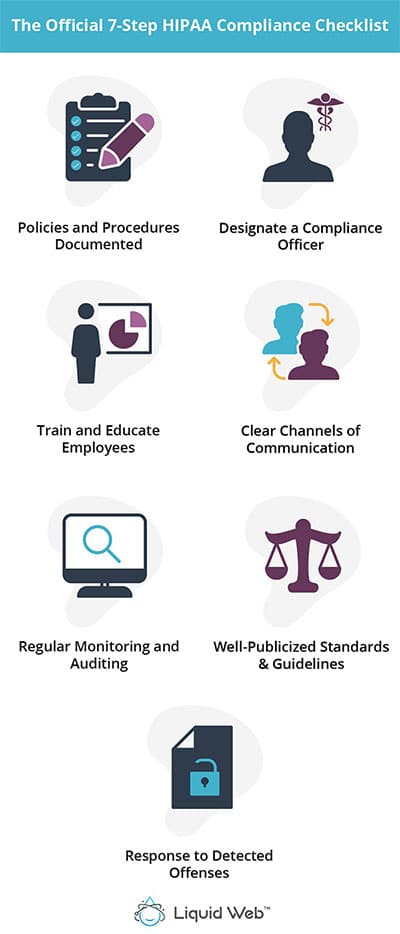
1. Implement written policies, procedures, and standards of conduct
For starters, HIPAA compliance must be outlined and documented. From allowable employee behaviors, to what to do in the event of a data breach, HIPAA requires documentation around practices or business activities that fall under the purview of the law.
Application to Web Hosting: Make sure your hosting provider is HIPAA audited and has policies and procedures documented around who can access your infrastructure, why, and how.
2. Designate a compliance officer and compliance committee
It is critical that individuals within a HIPAA compliant organization be named and held responsible for HIPAA compliance.
Application to Web Hosting: Make sure your web host is prepared to coordinate any issues or HIPAA related challenges directly with your in-house compliance officer. If a HIPAA issue arises, it is critical that your in-house compliance issue is brought into the conversation as quickly as possible.
3. Conduct effective training and education
HIPAA compliance requires that team members protect PHI. To do so in a way that meets the HIPAA standard, it is crucial that HIPAA compliance training be provided to staff. Ignorance is not a valid defense in the event of a HIPAA violation.
Application to Web Hosting: For your hosting provider to support your HIPAA initiatives, it is important that their support and technology staff are also trained on HIPAA requirements. It is prudent to confirm that your hosting provider does indeed have an understanding of HIPAA requirements, related audits, and how to best serve you.
4. Develop effective lines of communication
Health practitioners and their teams must have clear channels of communication not just for training and in the event of a data breach, but also as part of the day-to-day operation of handling private information. From the handling of medical records to the discussion of patient care, communication is critical across all levels and in all departments.
Application to Web Hosting: A HIPAA audited hosting provider should have multiple avenues of communication available to address not just your HIPAA needs, but also other matters of support. From phone and email, to live chat and ticketing systems, your HIPAA environment needs the highest level of support you can find.
5. Conduct internal monitoring and auditing
As with many policies and procedures, regular verification and reporting are essential to maintaining HIPAA compliance. As part of HIPAA is protecting against reasonably anticipated threats to private health information, it is crucial that HIPAA-compliant businesses test their environment regularly for potential weak spots or areas of vulnerability.
Application to Web Hosting: Your hosting provider should keep logs of who accesses your infrastructure and regularly monitor that access. Allowing your servers to be accessed by anyone can be a violation of HIPAA and put your organization at risk of penalty.
6. Enforce standards through well-publicized disciplinary guidelines
Team members across the organization must understand the possible legal ramifications of HIPAA violations not just to the business, but to the individual as well. The seriousness of HIPAA is hard to overstate, and it is incumbent upon business owners and operators to ensure staff members know what is at stake.
Application to Web Hosting: Your hosting provider shares responsibility in making sure your infrastructure is HIPAA-auditable. Their engineers and support staff should be aware of the penalties for non-compliance.
7. Respond promptly to detected offenses and undertake corrective action
Protecting PHI is certainly the goal of every HIPAA organization. However, it would be silly to behave as if mishandling or unauthorized access to private data never happens. In the event of an intrusion or error, HIPAA regulations mandate that immediate corrective action be taken.
Application to Web Hosting: Your hosting provider should not only communicate any potential intrusions or points of concern as they relate to your HIPAA needs, but they should also be prepared to provide you with Corrective Action Reports in the event of an incident.
How infrastructure plays a role in HIPAA compliance
Protecting PHI is certainly the goal of every HIPAA organization. However, it would be silly to behave as if mishandling or unauthorized access to private data never happens. In the event of an intrusion or error, HIPAA regulations mandate that immediate corrective action be taken.
Application to Web Hosting: Your hosting provider should not only communicate any potential intrusions or points of concern as they relate to your HIPAA needs, but they should also be prepared to provide you with Corrective Action Reports in the event of an incident.
Next steps
Whether you’re in the midst of a digital transformation or are just starting to investigate digitizing your medical organization, having the right partner at your side is critical.
Not only is it important that your IT service and infrastructure providers understand the importance of HIPAA in your business, it is also critical that their own policies, procedures, and guidelines align with the HIPAA requirements to which your business is bound.
That’s where Liquid Web comes in.
Liquid Web is HIPAA audited by independent accounting firm UHY LLP, an internationally trusted auditor with extensive experience. We are also compliant with other relevant standards including SSAE-16 and Safe Harbor, providing assurance to companies in the healthcare industry and their business associates.
Click through below to learn more or start a chat with one of our HIPAA-compliant hosting experts right now.
HIPAA compliant hosting solutions
Standalone servers
Private data centers
Uninterruptible power supplies
Additional resources
What is HIPAA-compliant hosting? →
A complete beginner’s guide
Scaling a compliant cloud →
How to scale up without compromising security
HIPAA guide for small business →
A complete resources for medical SMBs

Jerry Vasquez brings decades of leadership experience to his role as Product Manager at Liquid Web, focusing on networking and security products. When not working or sleeping, Jerry can usually be found eating and having a good conversation with good people.