◦ Comprehensive security
◦ 24/7 support
HIPAA → Compliance Drift
Compliance drift and the hidden dangers it creates for health tech brands
Compliance drift isn’t a sensational breach or a major ransomware attack. It’s quieter and far more insidious. Drift happens slowly, behind the scenes, until a routine audit or security incident exposes how far your systems have strayed from their baseline.
While compliance drift is a challenge for every industry, it carries outsized risks in health tech. Patient trust, regulatory fines, and reputational credibility hinge on keeping systems aligned with HIPAA and other standards. For CISOs, CTOs, and compliance leaders, understanding and managing compliance drift is critical.
Get HIPAA-compliant hosting
Standalone servers in private data centers with industry-leading security
What is compliance drift?
Compliance drift occurs when an IT system’s actual configuration diverges from its approved, documented, or regulated state. It’s not a one-off misconfiguration; it’s the gradual accumulation of small, undocumented changes that eventually create a significant gap between intended and actual environments.
Most drift is unintentional. Teams roll out hotfixes, make “temporary” adjustments, or apply patches without documenting them. Over time, those small changes become the new normal … until they put compliance at risk.
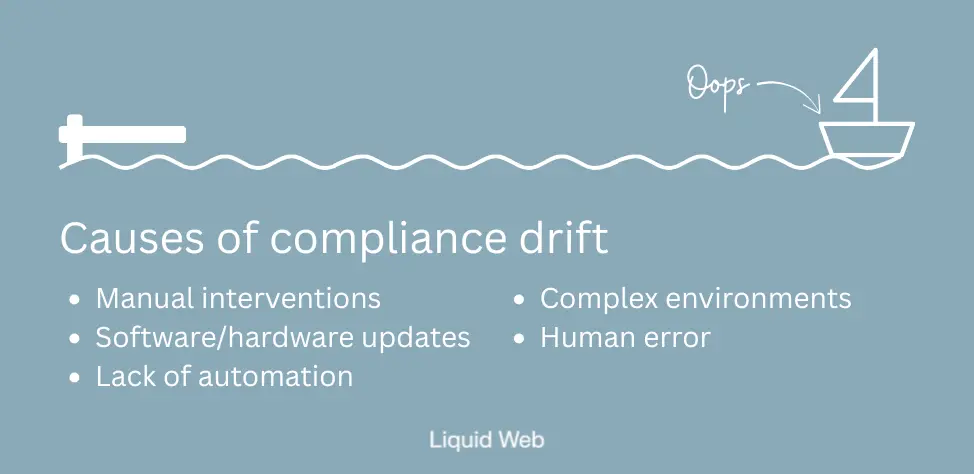
What causes compliance drift?
Drift builds up for a variety of reasons, most of which stem from the fast pace of modern IT environments. Even small tweaks can become big problems when they go undocumented.
- Manual interventions: Quick fixes, hot patches, and troubleshooting steps often bypass standard change management processes, introducing inconsistency.
- Software and hardware updates: Patches, version upgrades, and hardware replacements alter system baselines in ways that may not align with compliance controls.
- Lack of automation: When deployments and configuration tracking rely heavily on human effort, errors and inconsistencies are almost guaranteed.
- Complex environments: Multi-cloud, hybrid hosting, and microservices expand the attack surface and complicate oversight, making it easier for drift to sneak in.
- Human error: Even well-intentioned changes can go untracked when teams lack training, clear documentation or communication protocols.
Imagine a DevOps engineer pushes a quick firewall rule change to allow a new API integration during a late-night deployment. The change works, the system stays up, and the fix is considered a success. But nobody logs the modification, and the next automated compliance check is delayed.
Months later, auditors flag the open port as a HIPAA violation, and the team has no record of why or when it was introduced.
That’s compliance drift in action.
Why compliance drift matters for health tech brands
Unchecked drift has consequences that go well beyond IT hygiene. In health tech, the stakes include patient safety, regulatory fines, and brand credibility.
- Security vulnerabilities: Drift weakens or disables security controls in ways attackers can exploit. In healthcare, this could mean PHI exposure or lateral movement across clinical systems.
- Operational disruptions: When systems are inconsistent, troubleshooting becomes harder. A misaligned patch level across servers might cause an EHR module to fail intermittently, disrupting provider workflows.
- Regulatory exposure: HIPAA, HITECH, SOC 2, ISO, and GDPR require strict adherence to baselines. Drift undermines compliance audits and can result in fines, corrective action plans, and public penalties.
- Reputational damage: Providers, insurers, and partners expect consistent compliance. Even if drift never leads to a breach, an audit failure can cause reputational harm that lingers in RFP processes and client trust.
- Hidden costs: Preparing for audits or remediating drift consumes engineering time. Instead of focusing on product improvements, teams burn cycles digging through logs and rewriting documentation.
Compliance drift vs configuration drift
The terms often get used interchangeably, but they’re not the same. Configuration drift happens when the technical setup of a system changes from its documented baseline. Compliance drift happens when those technical changes put the system out of alignment with regulatory or organizational requirements.
In short: configuration drift is about technical state, compliance drift is about regulatory posture. The former may be inconvenient; the latter creates liability.
How to identify and measure compliance drift
Spotting drift requires ongoing vigilance. Organizations that only check at audit time are often blindsided by how far they’ve deviated from baseline.
- Continuous monitoring and automated compliance scanning: Real-time tools compare system state against policy baselines and flag deviations as they occur.
- Baseline comparisons: Using gold images, CIS benchmarks, or Infrastructure as Code templates gives teams a “single source of truth” to compare against.
- Centralized documentation: Every change, including hotfixes, should be logged in a central system of record to prevent blind spots.
- Internal audits and compliance “health checks”: Periodic self-audits catch drift before regulators do.
- SIEM/SOAR integration: Feeding drift detection into security operations makes compliance part of incident response, not an afterthought.
How to prevent and eliminate compliance drift
Preventing drift requires a proactive, automated approach. Manual processes can’t keep up with the scale and pace of modern health tech environments.
- Automate deployments with Infrastructure as Code: Templates enforce consistency across environments, eliminating “snowflake” servers.
- Use configuration management and policy enforcement tools: These ensure that unauthorized or undocumented changes are blocked or rolled back.
- Automate audit reports and dashboards: Built-in reporting saves engineering time and provides leadership with visibility.
- Tighten change management workflows: Require approvals and documentation for every adjustment, no matter how small.
- Run regular internal audits: Benchmark systems against HIPAA, HITRUST, and SOC 2 standards quarterly or monthly, not annually.
- Train engineering and devops teams: Empower staff to recognize when a quick fix might trigger compliance drift and give them the tools to prevent it.
Compliance drift and hosting solutions
Hosting environments are one of the most common and overlooked sources of drift. Operating system updates, untested patches, or inconsistent security settings can quietly push systems out of alignment. This risk multiplies in unmanaged or multi-tenant hosting environments, where teams lack full visibility or control.
HIPAA-compliant hosting helps reduce drift by:
- Centralizing patch management and monitoring so all systems stay aligned
- Enforcing strict access controls and audit logging to deter unauthorized changes
- Providing built-in technical safeguards required by HIPAA
- Maintaining consistency across infrastructure layers, regardless of workload
HIPAA-compliant hosting helps reduce drift by:
HIPAA compliance drift FAQs
Next steps for managing compliance drift
Compliance drift is easy to overlook but dangerous to ignore. In health tech, even minor undocumented changes can snowball into HIPAA violations, audit findings, and reputational fallout. Leaders can’t treat drift as a one-time fix; it demands continuous monitoring and automated safeguards.
The first step is assessing your infrastructure. Is your hosting environment enforcing HIPAA-compliant baselines, or could drift already be creeping in?
That’s where Liquid Web comes in. We offer a wide range of compliance-ready hosting solutions, with seamless scalability, unbeatable speeds, and 24/7 support. Don’t have the time to monitor and maintain compliant servers? Our fully managed solutions can take care of it for you.
Click through below to learn more or start a chat with a HIPAA hosting expert to learn more.
HIPAA compliant hosting solutions
Standalone servers
Private data centers
Uninterruptible power supplies

Dominic Nixon is a Solution Architect for Liquid Web. He uses his past experiences and expertise to help clients make core architectural changes to their hosting, to achieve their long-term planning and business goals. He has a Bachelor’s degree in Cyber Security, and in his free time, he loves being outdoors or chilling with his dog, Ella.