
Skip to content
Search our site for answers
Login
  • Help Docs
  • API Docs
  • liquidweb.com
  • Hosting Services
    • Cloud VPS Hosting
    • Dedicated Servers
    • GPU Hosting
    • Hosting For WordPress
    • Hosting For WooCommerce
    • Email Hosting
    • VMware Hosting
    • Add-ons
  • Security & Compliance
    • SSL Certificates
    • Firewalls
    • Cloud Hosting
    • Two Factor Authentication
    • DDoS Protection
    • Compliance
    • Malware Protection
  • Domain & DNS
    • Domain Registration
    • DNS Settings
    • Nameservers
    • Subdomains
    • Domain Forwarding
    • Email DNS Setup
  • Account & Billing
    • Account Setup
    • Payment Methods
    • Billing Cycles
    • Refunds Cancellations
    • Invoices Receipts
    • Account Security
  • Email Hosting
    • Email Setup
    • Email Forwarding
    • Spam Protection
    • Microsoft 365
    • G Suite Setup
    • Account Security
    • Email Troubleshooting
  • Performance & Optimization
    • Server Optimization
    • Caching Strategies
    • Content Delivery Network
    • Database Performance
    • Image Optimization
  • Server Administration
    • Server Setup
    • SSH Access
    • Command Line Basics
    • Database Management
    • CRON Jobs
    • Apache Nginx Setup
    • Log Analysis
  • CMS & Applications
    • WordPress
    • WooCommerce
    • Magento
    • Joomla
    • Drupal
  • Backups & Recovery
    • Backup Strategies
    • Cloud Backups
    • Disaster Recovery
    • Restoring Backups
    • Raid Configurations
  • Reseller & Partner Support
    • Reseller Program
    • White Label Hosting
    • Partner Portal
    • Client Management
  • Policies & Compliance
    • Terms Of Service
    • Privacy Policy
    • GDPR Compliance
    • Acceptable Use Policy
Help Docs Control Panel Guides The Ultimate Guide to the WHM Control Panel (2025) Guide to the cPanel Control Panel Manage Email in cPanel Finding Your Email Client Configuration in cPanel

Finding Your Email Client Configuration in cPanel

You may want to use your cPanel email with an email client like Outlook, Mac Mail, or the email app on your phone. Before you can connect your email client to your cPanel email, you'll need your configuration settings. These include the mail server settings and your webmail username (email address) and password. This walkthrough will show you how to find these settings in cPanel. Luckily, cPanel does most of the work for you if you're configuring certain mail clients.
Account Control Panel cPanel Email
3 min read

You may want to use your cPanel email with an email client like Outlook, Mac Mail, or the email app on your phone. Before you can connect your email client to your cPanel email, you’ll need your configuration settings. These include the mail server settings and your webmail username (email address) and password. This walkthrough will show you how to find these settings in cPanel. Luckily, cPanel does most of the work for you if you’re configuring certain mail clients.

  1. Log into cPanel and click on Email Accounts in the Email section. (If you haven’t created an email address yet, do that first.)
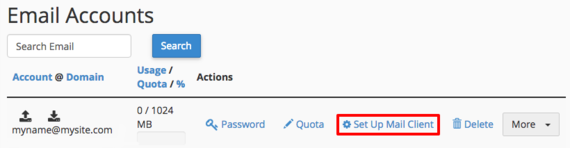
  2. Under Email Accounts, find the account you want to link to your email client and click Set Up Mail Client.
    set up mail client highlighted
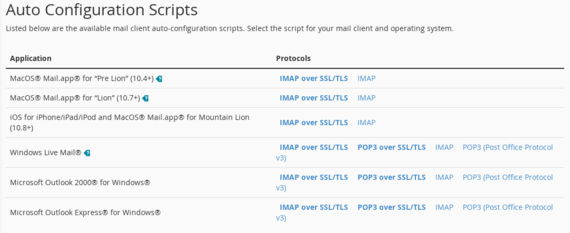
  3. cPanel provides many scripts that will automatically configure your email client for you! Click on the link that corresponds with your email client. A box should pop up explaining that you’ll use your email credentials to set up the mail client. Once you’ve read them, click Proceed.
    configuration scripts
  4. Click Open or Run to run the script and configure your email! The script will walk you through the process step by step.
But what if your email client isn’t in the list of scripts? cPanel still has all the information you need. All email clients require the same information to function, and once you know this information, you can set up almost any email client. This information is:

  • Incoming Server: The server that receives and stores messages sent to your email account, accessed by your email client via IMAP or POP3. Secure (SSL) connections use the server’s hostname and standard (non-SSL) connections use your domain name.
  • Outgoing Server (SMTP): The server that sends email from your account. Your SMTP server may require some additional security settings but these also are fairly easy to enable. Typically, if there is a checkbox or radio button labeled “My Server Requires Authentication” it will need to be checked. Secure (SSL) connections use the server’s hostname and standard (non-SSL) connections use your domain name.
  • Username and Password: Your email login credentials. You set these up when you created your email address. The username is the full email address, not just the part before the “@” symbol.

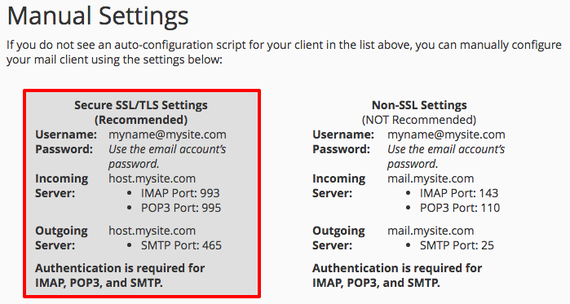
On the same page as the Auto Configuration Scripts, cPanel has this information under Manual Settings.

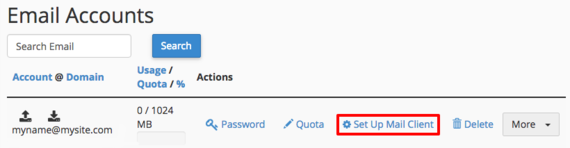
  1. If you’re back on the home page of cPanel, click on Email Accounts in the Email section, then find the account you want to use with your email client and click Set Up Mail Client.
    email client
  2. The Manual Settings section shows both the Secure SSL/TLS Settings and the Non-SSL Settings. It is always a good idea to increase security as much as possible, so you want to use the secure settings. settings

Tip

You may receive a warning about your SSL certificate when you set up your mail client. This is because you probably have a self-signed SSL certificate instead of a certificate signed by a recognized certificate authority. Your email will still be encrypted even if you have a self-signed SSL certificate. To see if a SSL certificate signed by a certificate authority is right for you, read What Is an SSL Certificate?

Now that you have your email configuration information, you can set up your email client.

Was this article helpful?
Thank you for your input.
Thank you for your feedback.
Essential hosting resources to help your business stay ahead
Get the guides
Related hosting content
  • Hosting Add-Ons
  • High-Speed Cloud Hosting Services
  • WordPress VPS Hosting

Hosting

  • Cloud Hosting
  • Dedicated Hosting
  • Email Hosting
  • GPU Hosting
  • Magento Hosting
  • Reseller Hosting
  • VPS Hosting
  • Hosting for WordPress

Additional Hosting

  • Add-ons
  • Agency Hosting
  • Application Hosting
  • Database Hosting
  • Ecommerce Hosting
  • Enterprise Hosting
  • Freelancer Hosting
  • High Availability
  • High Performance
  • HIPAA Hosting
  • PCI Compliant Hosting
  • Private Cloud Hosting
  • Server Clusters
  • Small Business Hosting
  • VPS Reseller Hosting
  • Windows Hosting
  • Windows VPS Hosting
  • Linux VPS Hosting
  • Ubuntu VPS Hosting
  • cPanel VPS Hosting
  • KVM VPS Hosting
  • WooCommerce Hosting

Servers

  • Bare Metal Servers
  • Cloud Dedicated Servers
  • Cloud VPS
  • Custom Servers
  • Dedicated Servers
  • Managed Cloud
  • Gaming Server
  • Windows Servers

Managed Hosting

  • Managed ExpressionEngine
  • Managed Craft CMS
  • Managed Cloud
  • Managed Hosting
  • Managed Hosting for WordPress
  • Managed Magento
  • Managed Servers
  • Managed VPS
  • Managed WooCommerce

Studies

  • Every Second Counts
  • Impact of Downtime
  • Hypergrowth Hosting

Resources

  • API
  • Hosting Coupons
  • Blog
  • Customer Stories
  • Ebooks
  • Help Docs
  • Migrations
  • Sitemap
  • SSL Checker
  • Webinars
  • Web Hosting Tools
  • White Papers
  • What is my IP

Hosting Basics

  • Bare Metal
  • Cloud Hosting
  • Dedicated Servers
  • Gaming VPS
  • GPUs
  • Private Cloud
  • VPS
  • Web Hosting

Partnerships

  • Hosting Affiliate Program
  • Partner Programs
  • Refer-a-Friend

Software & Design Solutions

  • GiveWP
  • IconicWP
  • Kadence WP
  • LearnDash
  • MemberDash
  • Modern Tribe
  • Restrict Content Pro
  • SolidWP
  • The Events Calendar

Get Help

  • Chat
  • Sales
  • Support

Company

  • About
  • Careers
  • Data Centers
  • Hosting Prices
  • News
  • Policies
  • Privacy Policy
  • Security
  • Terms and Conditions
  • Web Hosting Deals

Liquid Web, a web hosting company with 18 data centers globally

HostingAdvice.com logo
Liquid Web reviewLiquid Web review

© 2026 Liquid Web, LLC

Privacy Policy

* Promotions may be exclusively available to new customers and cannot be applied to existing accounts. Qualification is at the sole discretion of Liquid Web. Reach out with questions.

  • Solutions
    • Solutions by industry
      Ecommerce

      Secure, compliant infrastructure for regulated online sales

      Financial Services

      High-trust hosting built for security and compliance

      Agencies

      Fast, flexible hosting for high-traffic client projects

      Healthcare

      HIPAA-ready environments for protected health data

      Solutions by outcomes
      Compliance

      Hosting aligned with HIPAA, PCI, GDPR, and audit readiness

      Launch

      Configure a high-performance server in minutes

      Commerce Scale

      Infrastructure built to handle surges, orders, and growth

      Disaster Recovery

      Redundant, resilient systems for rapid recovery and uptime

  • VPS Hosting
    • VPS Packages
      Cloud VPS Hosting
      Windows VPS Hosting
      Linux VPS Hosting
      Add-ons & Backups
      View All VPS Hosting
  • Dedicated Servers
    • Bare Metal Packages
      Bare Metal Servers
      Cloud Metal Packages
      Managed Dedicated
      Gaming Servers
      View All Dedicated Servers

  • Managed Hosting
    • Managed Hosting
      Managed Servers
      Managed Applications
  • WordPress
    • Hosting for WordPress
      Managed Hosting for WordPress
      VPS for WordPress
      Dedicated WordPress
      WooCommerce Hosting
  • GPU Hosting
    • GPU Hosting
      NVIDIA GPU Hosting
      AI Training & Interface

  • Products
    • Compute
      Cloud Servers

      Scalable, high-speed compute

      Dedicated Servers

      Reliability, power, and control

      Private Cloud

      Isolated, enterprise-grade cloud

      GPU

      Accelerated for AI & ML

      Containers

      Portable workloads for any app

      Platform services
      Cloud Storage

      Storage for growing data needs

      Backups & DR

      Protection for critical workloads

      Global Private Fabric

      Unify networks across servers

      Security & Protection

      Advanced defense for data

      Load Balancing

      Optimized traffic distribution

      Applications
      WordPress

      Optimized for fast, secure sites

      WooCommerce

      Performance for scalable stores

      Magento

      Commerce-ready, built to scale

Log in
  • System status
  • Support | Get Help