◦ Optimized configs
◦ Industry-leading support
GPU → vs LPU
LPU vs GPU: What they are, how they’re different, and which is best for AI
LPUs (Language Processing Units) and GPUs (Graphics Processing Units) are specialized processors designed for highly parallelized processing tasks. They’re used to off-load certain compute-heavy tasks from a general-purpose CPU, and artificial intelligence often combines the strengths of both.
The main difference is in their specialized purposes and processing capabilities. LPUs are tailored for natural language data, enabling machines to understand, interpret, and generate human language. By contrast, GPUs are more versatile—originally designed for rendering graphics but now widely used across fields like deep learning, scientific simulations, cryptocurrency mining, and more.
What is an LPU?
An LPU (language processing unit) is a specialized component designed to process and understand human language, often utilizing natural language processing (NLP) techniques. It’s the foundation for enabling machines to interpret, analyze, and generate text or human speech. LPUs use algorithms and linguistic models to translate language, analyze sentiment, recognize speech, or enable conversational AI.
LPUs can efficiently analyze human language, because they’re based on neural networks and those natural language processing (NLP) frameworks. The architecture is made up of multiple layers, including:
- Embedding layers to convert text into numerical representations
- Transformer layers or recurrent units for contextual understanding
- Attention mechanisms to focus on relevant parts of the input
LPUs rely on parallel processing to handle large-scale data, using sophisticated models like BERT, GPT, or custom-designed systems optimized for specific tasks. Their architecture often includes training and inference pipelines, so they can learn from huge language datasets and generate responses, translations, or analyses with accuracy and speed.
Language processing units emerged fairly recently, in response to the growing demand for systems that can understand and generate human language—driven by advancements in AI and machine learning. The introduction of deep learning in the 2010s marked a big leap, enabling LPUs to handle complex language tasks with unprecedented accuracy.
What is a GPU?
A GPU (Graphics Processing Unit) is a specialized electronic circuit designed to rapidly process and manipulate computer graphics and image data. Originally developed to offload graphics rendering tasks from the Central Processing Unit (CPU), modern GPUs are utilized in various high-compute fields, including AI and machine learning, scientific simulations, cybersecurity, healthcare, and more.
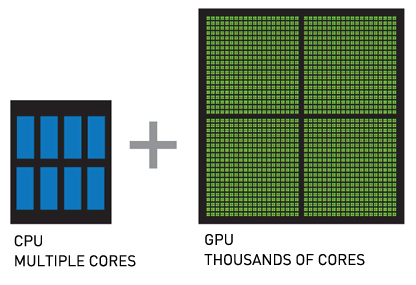
GPUs’ extreme efficiency is made possible by executing many parallel threads across numerous small cores. (In contrast to CPUs, which are optimized for sequential processing and feature fewer, more complex cores.) Their parallel processing capabilities make them well-suited for tasks like matrix calculations in machine learning, where large datasets are processed concurrently.
The evolution of GPUs began in the late 1980s with the introduction of 2D graphics accelerators that offloaded simple graphical tasks from the CPU. Over time, GPUs have evolved from fixed-function graphics processors to highly programmable units capable of handling a wide range of parallel computing tasks.
LPU vs GPU: Key differences
LPUs and GPUs are similar in a lot of ways, but their main differences—driven by divergent purposes—helps to clarify each one.
1. Architecture
LPUs were designed specifically for natural language processing tasks, so they feature optimized neural network layers, attention mechanisms, and memory modules tailored for text and contextual understanding.
GPUs were built for parallel computation, so they consist of thousands of small cores that process tasks simultaneously.
2. Storage requirements
LPUs require access to large amounts of pre-trained language model data and may include storage for model weights and embeddings. These systems need on-chip memory for managing sequence-heavy tasks efficiently.
GPUs need high-bandwidth memory (HBM) or GDDR memory for storing large datasets, textures, or models, especially in fields like AI training or 3D rendering.
3. Interconnects
LPUs depend on efficient interconnects between memory and processing units to minimize latency during complex sequential operations, such as sentence parsing or attention computation.
GPUs use high-speed interconnects like NVLink or PCIe to ensure rapid data transfer, crucial for managing large-scale parallel computations in applications like gaming or AI.
4. Strengths
LPUs are exceptional at understanding, processing, and generating human language with contextual awareness.
GPUs are outstanding at handling highly parallelizable tasks, such as rendering visuals, deep learning, and numerical simulations, with versatility across computational fields.
5. Weaknesses
LPUs are limited in scope outside of NLP tasks and depend on GPUs or other accelerators for broader machine learning computations.
GPUs are more versatile but not optimized for the sequential, context-heavy processing required for NLP tasks.
| LPUs | GPUs | |
|---|---|---|
| Architecture | Optimized neural network layers, attention mechanisms, and memory modules designed for text | Thousands of small cores that process in parallel |
| Storage | May include storage for model weights and embeddings; need on-chip memory | Need high-bandwidth memory (HBM) or GDDR memory |
| Interconnects | Depend on efficient interconnects between memory and processing units | Use high-speed interconnects like NVLink or PCIe |
| Strengths | Human language | Highly parallelizable tasks |
| Weaknesses | Limited use cases beyond NLP | Not efficient for sequential, context-heavy tasks |
Do I need an LPU or a GPU?
By now, it’s probably pretty clear if an LPU or GPU is better for your use case. If you’re developing an AI tool that needs language processing power, an LPU machine is your best tool.
If you need a lot of parallel processing power for a machine that doesn’t necessarily need to understand natural human language—because it will be working with engineers or other machines—a GPU will be able to handle a wider range of tasks. GPUs are able to handle a variety of AI/ML tasks along with AI image processing, such as AIs that generate images from natural language descriptions or even character animations from speech
Keep in mind that most applications use both. The LPU helps the program understand and communicate with human users, and the GPU works in the background to process data and images with remarkable speed and accuracy.
How to get a GPU server
When you’re ready to get started, there are a couple of ways to get access to a GPU server.
The first is to buy or build a machine. With the hardware on-premises, you have absolute control over customization, maintenance, and physical security. The downside is that a GPU server is an expensive purchase, and you have the responsibility of the maintenance and physical security of the hardware.
The other option is to rent a GPU server from an experienced, reputable hosting provider. Make sure you partner with a company that has a lot of experience with different types of server hosting, good reviews and ratings, and excellent customer support. Check on their hardware too; they should be offering NVIDIA or AMD GPU servers.
Additional resources
What is a GPU? →
What is, how it works, common use cases, and more
What is GPU memory? →
Why it’s important, how it works, what to consider, and more
Cloud GPU vs GPU bare metal hosting →
What’s the difference and which option is better for you?

Amy Moruzzi is a Systems Engineer at Liquid Web with years of experience maintaining large fleets of servers in a wide variety of areas—including system management, deployment, maintenance, clustering, virtualization, and application level support. She specializes in Linux, but has experience working across the entire stack. Amy also enjoys creating software and tools to automate processes and make customers’ lives easier.