◦ Optimized configs
◦ Industry-leading support
How GPUs are advancing the finance industry
GPU computing is quietly reshaping the financial sector. From ultra-low-latency trading strategies to AI-driven fraud detection and portfolio optimization, today’s finance workflows demand parallelism, speed, and scale that CPUs just can’t deliver.
Here’s how (and why) GPUs are taking center stage in the industry’s most data-intensive applications.
Get premium GPU server hosting
Unlock unparalleled performance with leading-edge GPU hosting services.
Why finance needs more compute power than ever
Financial data isn’t just growing: it’s exploding. Tick-by-tick market data, satellite imagery, ESG datasets, and social sentiment streams all feed into increasingly complex decision-making. AI/ML workloads are becoming the new normal in trading, credit scoring, and risk assessment.
Explosive data growth across financial services
- Real-time feeds from exchanges and alt data vendors
- Backtesting across thousands of potential scenarios
- Model training and inference in production, not just R&D
- Near-instant regulatory calculations for compliance and reporting
CPU limitations in modern finance workflows
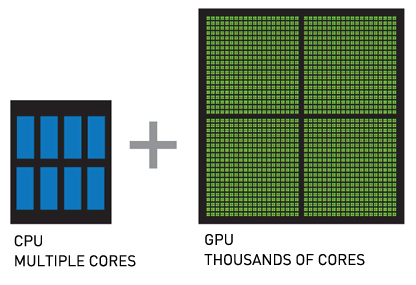
The traditional CPU-based stack is hitting a wall. Threading bottlenecks slow down real-time pipelines. Latency-sensitive workloads, like HFT or fraud detection, suffer under CPU concurrency models. And when power and cooling constraints kick in, scaling vertically stops being practical.
Key finance applications powered by GPUs
GPU acceleration isn’t just a lab experiment anymore. It’s running production workloads at some of the most sophisticated trading firms, banks, and fintech startups in the world.
High-frequency and algorithmic trading
In HFT, microseconds matter. Co-located GPU servers can handle real-time data ingestion, feature extraction, and trade signal generation in parallel, reducing end-to-end latency across the entire trading stack.
- GPU-powered backtesting engines simulating thousands of market scenarios in parallel
- Strategy optimization using reinforcement learning or genetic algorithms
- Hardware-level acceleration of time series processing and order book prediction
Fraud detection and anomaly monitoring
Deep learning models running on GPUs can identify subtle patterns in transaction flows, user behavior, or KYC data that rule-based systems miss.
- GPUs enable low-latency classification at point-of-sale or during login
- Training and deploying large-scale fraud detection models across massive transaction datasets
- Use of graph neural networks to detect collusion or synthetic identity fraud
Portfolio optimization and quantitative research
Quant teams are pushing past traditional models with GPU-accelerated Monte Carlo simulations and machine learning pipelines.
- Speed up historical simulation, scenario generation, and sensitivity analysis
- Accelerate research with Python-based GPU frameworks like RAPIDS or CuPy
- Reduce backtest runtimes from hours to minutes across large asset universes
Real-time risk management and stress testing
GPUs make it possible to run complex, real-time risk models intraday, not just overnight or post-close.
- Accelerated VaR and CVaR calculations
- Real-time liquidity analysis under adverse conditions
- Distributed GPU clusters handling firmwide stress testing in minutes, not hours
Blockchain and cryptography acceleration
GPU mining is still relevant for certain PoW chains.
- Faster cryptographic hashing and signature verification
- Zero-knowledge proof generation and SNARK/STARK computation
GPU server infrastructure vs. cloud GPU vs. GPU as a service
Bare metal GPU servers for financial institutions
Most enterprise finance teams prefer bare metal GPU servers for their mission-critical workloads. You get:
- Dedicated access to full GPU power
- Regulatory and compliance control over data locality
- Network tuning and latency optimization for colocated strategies
Cloud GPUs for scalable model training and testing
Cloud GPU platforms offer agility for experimentation but come with caveats:
- Great for early-stage research or sandbox environments
- Costs can spiral for persistent, high-performance use cases
- Data sovereignty and vendor lock-in risks for sensitive workflows
GPU as a Service for short bursts of compute
Startups or lean quant teams sometimes opt for GPUaaS for quick compute:
- Pay-as-you-go, ideal for occasional training jobs
- Limited control and customization
- May not support the performance needs of live production workloads
Real-world examples of GPU adoption in finance
Two Sigma
Two Sigma integrates AI and machine learning algorithms to analyze extensive financial data, identifying patterns that inform their trading strategies. By leveraging NVIDIA’s accelerated computing platforms, they enhance their investment insights and maintain a competitive edge in capital markets.
JPMorgan Chase
JPMorgan Chase has developed “NeuroShield,” an AI-powered fraud detection system that utilizes behavioral biometrics and real-time anomaly detection. This system has achieved a 40% reduction in fraudulent transactions during pilot testing, significantly enhancing the bank’s financial security measures.
Fintech startups and quant platforms
The flexibility and power of GPU acceleration are making advanced analytics accessible to smaller, more agile firms as well.
- GPU-based APIs for credit risk, pricing, and underwriting: Startups are launching AI-powered APIs that underwrite loans, score credit risk, and dynamically price insurance products—accelerated by GPU inference engines to deliver real-time decisions at scale.
- Use of open-source GPU frameworks like RAPIDS, XGBoost-GPU, and PyTorch: These tools let data scientists build and train models faster than CPU-based pipelines. RAPIDS enables pandas-like workflows on GPUs, XGBoost-GPU speeds up ensemble models, and PyTorch supports deep learning use cases like time-series forecasting and fraud detection.
- Custom quant research stacks accelerated with NVIDIA CUDA libraries: Fintech teams are developing proprietary platforms for signal generation, trade simulation, and alpha research, optimized with CUDA to leverage low-level GPU instructions and parallel compute resources efficiently.
Choosing the right GPU server for your finance workload
Specs that matter: NVIDIA L40S vs H100
Both the NVIDIA L40S and H100 are excellent choices for financial workloads, but they serve different purposes.
NVIDIA L40S
- Best for: Inference-heavy workloads, visualization, quant research
- 48 GB of GDDR6 memory, optimized for high throughput and mixed workloads
- Supports real-time analytics, large model inference, and complex rendering tasks
- Ideal for GPU-accelerated dashboards, real-time fraud scoring, and backtest engines
NVIDIA H100
- Best for: Large-scale AI training and model deployment
- 80 GB of HBM3 memory and 4.9 TB/s bandwidth
- Breakthrough transformer engine for faster deep learning model execution
- Essential for training deep learning models on massive transaction data, portfolio optimizations, and risk simulations at scale
For most quant teams, the L40S delivers plenty of firepower for daily research and production. But if you’re building proprietary AI models that require weeks of training—or deploying real-time models across thousands of endpoints—the H100 is hard to beat.
Compliance and security considerations
- Choose data centers with SOC 2, ISO 27001, and regional compliance (e.g., GDPR, FINRA).
- Encrypted storage, VLAN isolation, and firewall-level security are must-haves.
- Colocated or hybrid setups help maintain regulatory compliance while accessing GPU performance.
When to upgrade your existing infrastructure
- Your CPU-based pipeline can’t meet SLAs for risk or reporting.
- Training times are stalling innovation cycles.
- Your quant team is relying on shared or constrained compute clusters.
Rent or buy: Should you invest in on-prem GPU servers or partner with a hosting provider?
For finance teams scaling GPU infrastructure, the first big decision is build vs rent. On-premise GPU servers offer full control and low latency, especially valuable for colocated HFT strategies or compliance-heavy environments. But they also come with high upfront costs, longer deployment cycles, and ongoing maintenance demands.
Partnering with a trusted hosting provider gives you immediate access to enterprise-grade GPUs without the capital expense. You can scale up or down based on project needs, deploy globally, and maintain uptime SLAs with dedicated support.
For most quant research, fraud analytics, and AI modeling workflows, hosted GPU servers strike the right balance between performance, flexibility, and cost efficiency.
Next steps for adopting GPU infrastructure in finance
The finance industry thrives on speed, precision, and data. GPU servers enable modern financial institutions to meet these demands at scale, especially in AI, trading, and fraud prevention.
If you’re ready to modernize your compute infrastructure or explore GPU hosting for a specific financial use case, it pays to work with a provider who understands performance and compliance.
When you’re ready to upgrade to a dedicated GPU server—or upgrade your server hosting—Liquid Web can help. Our dedicated server hosting options have been leading the industry for decades, because they’re fast, secure, and completely reliable. Choose your favorite OS and the management tier that works best for you.
Click below to explore dedicated GPU server options or start a chat with one of our experts to learn more.
Additional resources
Best GPU server hosting [2025] →
Top 4 GPU hosting providers side-by-side so you can decide which is best for you
A100 vs H100 vs L40S →
A simple side-by-side and how to decide
GPU for AI →
How it works, how to choose, how to get started, and more