
 Liquid Web
 Containerization has significantly impacted how applications are built, deployed, and managed. In fact, over 60% of backend developers are now using containerization for building and deploying software, according to the Cloud-Native Computing Foundation.
This high adoption rate is no coincidence. Containerization enables consistent, efficient, and agile application development by encapsulating applications and their dependencies into portable, self-contained units. However, as containerized applications grow in complexity and scale, managing them effectively becomes more difficult.
Container orchestration plays a vital role in organizing the deployment and scaling of containerized applications, particularly in microservices-based architectures.
This article will provide an in-depth overview of the role of container orchestration and how it enhances the management of containers at scale. It will also cover advanced strategies and best practices, compare the features and use cases of leading orchestration tools beyond Kubernetes, and highlight the importance of mastering container orchestration in multi-cloud environments.
Key points
- Container orchestration automates deploying and managing containerized applications, enhancing scalability, efficiency, and consistency.
- Key features of container orchestration include automated deployment and management, resource optimization, scalability, high availability and fault tolerance, load balancing, service discovery and networking, multi-cloud and hybrid deployments, declarative configuration, monitoring and self-healing, and security and compliance.
- Mastering multi-cloud orchestration involves choosing the right platform, implementing a unified control plane, adopting infrastructure-as-code, ensuring portability, optimizing performance and cost, and developing a disaster recovery strategy.
Unlocking the power of container orchestration
Container orchestration automates many manual processes in deploying and scaling containerized applications. This includes provisioning and development, configuration, scheduling, resource allocation, scaling, load balancing, and health monitoring of containers.
To better understand the concept, imagine a large restaurant kitchen with many chefs preparing dishes simultaneously. Container orchestration is like having a super-efficient head chef who manages everything:
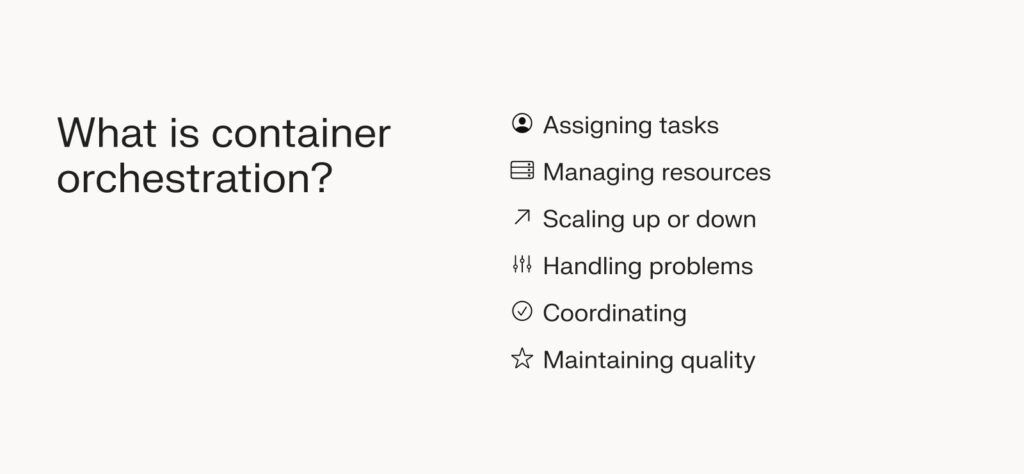
- Assigning tasks: The head chef (orchestrator) decides which chef (container) prepares each dish, making sure everyone is working efficiently.
- Managing resources: They ensure each chef has the right ingredients, utensils, and cooking space (computing resources) they need.
- Scaling up or down: If there’s a sudden rush of orders, the head chef quickly brings in more chefs or reassigns tasks. When it’s slow, they send some chefs home to save costs.
- Handling problems: If a chef gets sick (container fails), the head chef quickly reassigns their tasks to keep things running smoothly.
- Coordinating: They ensure dishes are prepared in order and quantity to meet customer demand.
- Maintaining quality: The head chef monitors the quality of each dish, ensuring consistency across the kitchen.
This automation is particularly crucial when dealing with large-scale applications that might use hundreds or thousands of containers. By streamlining deployment processes, container orchestration enables faster and more consistent application delivery, supporting agile development practices and DevOps workflows.
Container orchestration also allows you to deploy applications consistently across different environments, such as on-premises, public cloud, or hybrid cloud, without requiring redesigns. This flexibility is beneficial for managing microservices-based applications, as it enables easier scaling and management of individual components.
Orchestration at scale
As the name suggests, container orchestration at scale refers to the automated management and coordination of large numbers of containerized applications across distributed environments. It enables organizations to deploy, manage, and scale complex containerized workloads efficiently in production environments.
Here are the main aspects of container orchestration at scale:
- Automated deployment and management: Container orchestration platforms like Kubernetes automate the deployment, scaling, and management of containerized applications across clusters of machines. This removes the need for manual intervention and complex scripting, allowing organizations to manage thousands of containers efficiently.
- Resource optimization: Orchestration tools optimize resource allocation by automatically scheduling containers onto appropriate nodes based on resource requirements and availability. This ensures efficient utilization of infrastructure and helps organizations maximize their hardware investments.
- Scalability: Container orchestration enables effortless application scaling by automatically adding or removing container instances based on demand. Thanks to this elasticity, applications can handle varying workloads efficiently without manual intervention.
- High availability and fault tolerance: Orchestration platforms ensure high availability by distributing container replicas across multiple nodes and automatically replacing failed containers. This improves application resilience and minimizes downtime.
- Load balancing: Container orchestration tools provide built-in load-balancing capabilities, distributing incoming traffic evenly across container instances to ensure optimal performance and resource utilization.
- Service discovery and networking: Orchestration platforms manage complex networking requirements, enabling containers to discover and communicate with each other dynamically, regardless of their location within the cluster.
- Multi-cloud and hybrid deployments: Container orchestration facilitates the deployment and management of applications across multiple cloud providers and on-premises environments, enabling organizations to adopt hybrid and multi-cloud strategies.
- Declarative configuration: Orchestration tools use declarative configuration files, such as YAML or JSON, to define the desired state of applications, allowing for version-controlled, reproducible deployments across environments.
- Monitoring and self-healing: Container orchestration platforms provide built-in monitoring and self-healing capabilities, automatically detecting and replacing unhealthy containers to maintain the desired application state.
- Security and compliance: Orchestration tools offer features for managing security policies, access controls, and network isolation, helping organizations maintain compliance and secure their containerized environments.
Complex deployments made simple: Advanced strategies
Managing complex container deployments can be challenging, but by implementing the following advanced strategies, organizations can significantly simplify their operations, improve reliability, and increase the speed of deployments while reducing the risk of errors.
Infrastructure-as-Code (IaC)

Utilize tools like Terraform or Pulumi to define and manage your infrastructure declaratively. This approach allows you to version control your infrastructure, making replicating environments and managing complex deployments easier.
GitOps
Implement GitOps practices using tools like ArgoCD or Flux. This strategy allows you to use Git repositories as the single source of truth for both application code and infrastructure configurations. GitOps automates the deployment process, ensuring consistency across environments and simplifying rollbacks.
Service mesh
Implement a service mesh like Istio or Linkerd to handle complex networking, security, and observability concerns. Service meshes abstract away many of the complexities of microservices communication, making it easier to manage large-scale deployments.
Helm charts

Use Helm charts to package and manage Kubernetes applications. Helm simplifies the deployment process by allowing you to define, install, and upgrade even the most complex Kubernetes applications.
Canary deployments
Implement canary deployments to gradually roll out new versions of your application to a subset of users. This strategy allows you to test new features in production with minimal risk, making complex deployments more manageable.
Blue/green deployments
Utilize blue/green deployment strategies to minimize downtime and risk during updates. This approach involves running two identical production environments, allowing you to switch between them seamlessly.
Automated testing and continuous integration
Implement solid automated testing and CI/CD pipelines. This ensures that changes are thoroughly tested before deployment, reducing the likelihood of issues in production.
Monitoring and observability
Implement comprehensive monitoring and observability solutions. Tools like Prometheus, Grafana, and Jaeger can provide deep insights into your application’s performance and behavior, making it easier to troubleshoot issues in complex deployments.
Configuration management
Use tools like Kustomize or ConfigMaps in Kubernetes to manage application configurations across different environments. This approach allows you to maintain a single set of base configurations while applying environment-specific overlays.
Stateful workload management
For stateful applications, use StatefulSets in Kubernetes and implement proper backup and restore strategies. This ensures data consistency and simplifies the management of stateful workloads in distributed environments.
Multi-cluster management
For very large deployments, consider using multi-cluster management tools like Rancher or Red Hat Advanced Cluster Management. These tools can help manage multiple Kubernetes clusters across different cloud providers or on-premises environments.
Policy as code
Implement policy as code using tools like Open Policy Agent (OPA) to enforce security and compliance rules across your infrastructure. This approach allows you to automate policy enforcement, reducing the complexity of managing security in large-scale deployments.
Comparing top orchestration tools: Beyond Kubernetes
Kubernetes is undoubtedly the most popular container orchestration platform today. Developed by Google and maintained by the Cloud Native Computing Foundation (CNCF), Kubernetes (often called K8s) can run in various environments, from on-premises to public clouds.
While powerful, Kubernetes can have a steep learning curve, especially for teams new to container orchestration. Yet, despite this, many large organizations use Kubernetes for production workloads due to its scalability and great features.
However, there are several other powerful tools available that offer distinct advantages and capabilities. Here’s a breakdown:
1. Apache Airflow

Apache Airflow is an open-source platform developed by Airbnb for workflow management. It allows you to programmatically author, schedule, and monitor data pipelines and workflows.
Airflow uses Directed Acyclic Graphs (DAGs) to define tasks and their dependencies, which are written in Python. This “configuration as code” approach provides flexibility, as you can leverage standard Python features like libraries, classes, and loops to generate tasks dynamically.
Airflow is particularly well-suited for batch-oriented workflows and has a large, mature community.
2. Dagster

Dagster is a newer orchestration tool that positions itself as a next-generation solution. In addition to task running, Dagster focuses on asset management, introducing the concept of “software-defined assets,” which are data objects like tables or files defined in code along with their dependencies.
This approach allows you to model data lineage and manage the relationships between assets more effectively. Dagster’s declarative API uses Python decorators, modular pipeline design, and the Dagit web UI for visualization and monitoring, which make it a versatile choice for complex data and machine learning workflows.
3. Prefect

Prefect is a second-generation orchestration tool that emphasizes programmatic workflow management. It allows you to transform any Python function into a unit of work that can be observed and orchestrated, providing complete observability into your workflows.
Prefect’s lightweight setup and focus on Python make it a popular choice for data and machine learning operations, from simple pipelines to complex ML orchestration.
4. Kubeflow Pipelines

Kubeflow Pipelines is a Kubernetes-native orchestration tool designed to build and deploy portable, scalable machine learning workflows.
It enables end-to-end orchestration of ML pipelines, making it easier to experiment with different techniques and reuse components. Kubeflow Pipelines integrates well with Kubernetes environments and supports containerized components.
5. Argo

Argo is a container-native workflow engine that enables users to define workflows where each step is executed in a container. This makes Argo highly flexible and scalable, as it can leverage the power of Kubernetes.
Argo is implemented as a Kubernetes Custom Resource Definition (CRD) and uses YAML for pipeline definition. It supports various artifact types, making it a popular choice for CI/CD workflows in Kubernetes environments.
6. Metaflow

Metaflow is a lightweight framework developed by Netflix to help data scientists and engineers build, manage, and deploy real-life data science, machine learning, and AI projects. Metaflow emphasizes ease of use and scalability, with features like:
- Rapid local prototyping.
- Notebook support.
- Experiment tracking.
- One-click deployments to production orchestrators.
7. Docker Swarm

Docker Swarm is a built-in container orchestration tool that simplifies the management of Docker-based applications. Its features include:
- Easy cluster management: Docker Swarm allows you to create and manage a cluster of Docker nodes, turning a group of Docker engines into a single, virtual Docker host. This makes it easy to deploy, manage, and scale your containerized applications across multiple nodes.
- No additional tools needed: One of the benefits of Docker Swarm is that it’s a native feature of the Docker Engine, meaning you don’t need to set up and configure additional orchestration software to manage your container deployments.
- Efficient cluster operations: In a Docker Swarm cluster, the manager nodes control the activities and ensure efficient operations, while the worker nodes receive and execute tasks from the managers. This division of responsibilities helps optimize the performance and reliability of your container-based applications.
- Declarative approach: Docker Swarm uses a declarative approach, allowing you to define the desired state of your application stack. This makes it easier to manage your services and ensures that your cluster maintains the configuration you’ve specified.
Mastering orchestration in multi-cloud environments
With these strategies, enterprises can benefit from the flexibility of a multi-cloud approach while maintaining consistency and control.
1. Choose the right orchestration platform
Kubernetes is the most popular and widely supported option for multi-cloud deployments, as it provides a consistent orchestration layer across different cloud providers. Managed Kubernetes services like Google Kubernetes Engine (GKE), Amazon EKS, and Azure AKS can further simplify the management of Kubernetes clusters.
2. Implement a unified control plane
Tools like Rancher or Google Anthos can provide a single pane of glass for managing Kubernetes clusters across multiple clouds. This enables consistent policies, monitoring, and management across your various environments, making it easier to maintain control and visibility.
3. Adopt infrastructure-as-code practices
By using infrastructure-as-code tools like Terraform, you can define and provision your infrastructure consistently across cloud providers. This approach allows you to version control your configurations and ensure reproducibility of your deployments, reducing the risk of inconsistencies.
4. Ensure portability and avoid vendor lock-in
To maintain flexibility, use cloud-agnostic tools and avoid relying on proprietary cloud services where possible. Containerize your applications to make them portable across different environments, reducing your dependence on any single cloud provider.
5. Implement robust networking and security
Use service mesh technologies like Istio to manage the communication between your containerized services, ensuring secure and reliable networking across your multi-cloud infrastructure. Implement consistent security policies and access controls, and use encryption for data in transit and at rest.
6. Optimize for performance and cost
Implement auto-scaling to handle varying workloads efficiently and use cloud-native storage solutions for data persistence. Continuously monitor and optimize your resource utilization across clouds to ensure you’re getting the best performance at the lowest cost.
7. Establish effective monitoring and observability
Set up centralized logging and monitoring across all your environments, using tools like Prometheus and Grafana to gain visibility into the performance and health of your applications and infrastructure.
8. Develop a comprehensive disaster recovery strategy
Implement automated backups and have a plan in place for failover between clouds, ensuring your applications and data can be quickly restored in the event of a disaster or outage.
9. Automate deployment and CI/CD pipelines
Use tools like Jenkins, GitLab, or Argo CD to automate the deployment of your applications across multiple clouds. Integrating these CI/CD tools with your container orchestration platform can help ensure consistent, reliable, and repeatable deployments, regardless of the underlying cloud infrastructure.
Strategic automation practices for enterprise-level orchestration
These strategic automation practices can help you maximize the benefits of container orchestration, improve operational efficiency, and accelerate their software delivery pipelines:
- Establish a well-defined deployment pipeline: Set up a clear path from development to production, including a staging environment that mirrors production. This allows for thorough testing and validation of your applications before deploying to the production environment, ensuring a smooth and reliable release process.
- Implement comprehensive monitoring and observability: Use monitoring tools like Prometheus and Grafana to collect data on your containers and infrastructure. This gives you visibility into what’s happening so you can detect issues early, optimize performance, and make informed decisions to keep things running smoothly.
- Automate reporting and alerting: Set up automated systems to report issues found in production environments back to your development teams. This could involve integrating your monitoring tools with incident management or communication platforms. This will ensure that problems are quickly identified and resolved, facilitating a culture of continuous improvement.
- Prioritize backup and recovery: Put solid backup and recovery processes in place, especially for apps that store important data. Test these regularly to ensure you can recover from disasters or data loss.
- Adopt declarative configuration: Use declarative programming approaches, such as IaC tools like Terraform or Ansible, to define the desired states for your container deployments. This allows you to version control your configurations, ensure consistency across environments, and enable reproducible deployments, reducing the risk of manual errors and configuration drift.
- Implement auto-scaling and load-balancing: Use your container orchestration platform’s built-in auto-scaling and load-balancing capabilities, such as the Horizontal Pod Autoscaler (HPA) and the Kubernetes Service Load Balancer. This will allow your applications to automatically scale up or down based on resource utilization, optimizing performance and cost efficiency.
- Enforce security policies: Utilize the security features of your container orchestration platform to implement and enforce consistent security policies across different environments and deployments. This includes access controls, network policies, and scanning container images for vulnerabilities.
- Automate rollouts and rollbacks: Implement automated deployment strategies, such as rolling updates and canary deployments, to minimize downtime and risk during application updates. Coupled with automated rollback capabilities, this ensures that you can quickly go back to a stable version if any issues are detected during the deployment process.
- Utilize service discovery and networking automation: Take advantage of the service discovery and networking features of your container orchestration platform to simplify application communication and management. Automatic service discovery, load balancing, and network configuration can help reduce the complexity of managing interconnected microservices.
- Implement self-healing mechanisms: Configure your orchestration platform to automatically detect and replace failed containers or nodes, ensuring high availability and resilience of your applications.
- Standardize container images and configurations: Establish organizational standards for container images, configurations, and best practices to ensure consistency and reduce complexity across teams and projects. This may involve creating a centralized container registry, defining base images, and implementing policies around image updates and vulnerability management.
- Leverage managed services when appropriate: Consider using managed container orchestration services from cloud providers, such as Amazon EKS, Google GKE, or Azure AKS, to reduce the operational overhead and focus your teams on application development and innovation. Managed services can handle the underlying infrastructure management, allowing you to concentrate on building and deploying your applications.
Implementing container orchestration in your organization with Liquid Web
Container orchestration improves application management by automating manual processes such as provisioning, deployment, and scaling. This automation results in faster and more consistent application delivery, fitting well with agile development practices and DevOps workflows.
A major benefit of container orchestration is its support for multi-cloud and hybrid cloud environments. This flexibility helps businesses avoid being tied to a single vendor and choose the best infrastructure for their needs. Companies can easily spread workloads across different cloud providers or use a mix of on-premises and cloud-based resources.
For implementing container orchestration, Liquid Web is a leading provider of managed hosting and cloud services. Their solutions are designed to work effectively across multi-cloud and hybrid environments, thereby giving businesses the freedom to create their ideal infrastructure setup. The biggest advantages of Liquid Web’s offerings are:
- Flexibility: Whether you’re a small startup or a large enterprise, Liquid Web’s container orchestration solutions can be tailored to meet your unique business requirements. Such adaptability ensures that organizations of all sizes can use container orchestration to enhance their operations.
- Round-the-clock support: Liquid Web’s support team is available 24/7/365 to keep operations running smoothly and quickly resolve any issues that may arise.
Want to use container orchestration for your business? Contact Liquid Web today to learn more about our services and how we can help streamline your application deployment!