Private vs public cloud: Similarities, differences, and best use cases
November 2024
Choosing between public and private cloud is a pivotal decision, especially as your organization’s needs for scalability, security, and control evolve. Whether you’re growing a small business, handling sensitive data, or trying to optimize resources, the right cloud environment can make a significant impact.
What is cloud hosting?
Cloud hosting is a broad category of web hosting services that give users remote access to a server, or a network of servers. Cloud hosting is often understood as a service that spans a network of both physical and virtual servers, but the term has evolved.
Now, the phrase cloud hosting may refer to a collection of networked servers or to virtualized hosting resources on a single server.
What is the real difference between public and private clouds?
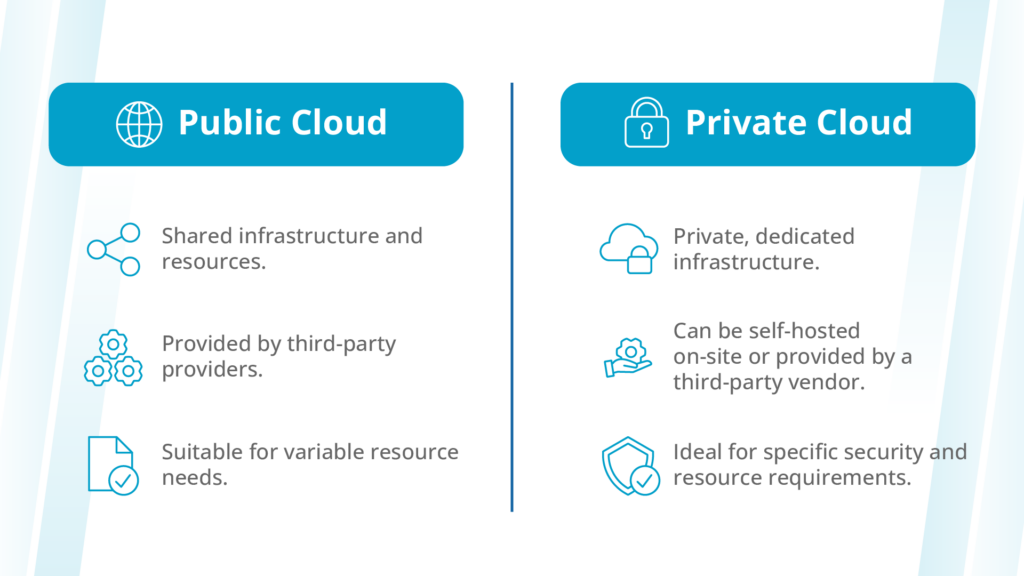
Private and public clouds are the two primary models of cloud hosting. A private cloud reserves one server for one client, who enjoys all the benefits of an isolated machine. A public cloud divides server resources in a multi-tenant environment, and customers enjoy the accessibility of a smaller virtual server.
A few of the main differences look like this:
| Private cloud | Public cloud | |
|---|---|---|
| Tenancy | Single-tenant | Usually multi-tenant |
| Infrastructure | Isolated / dedicated | Shared |
| Security | Easier to secure | Harder to secure |
| Cost | This is more nuanced than some will tell you. See below. |
Private vs public cloud: an overview
There’s no easy answer here. Some will say that standard hosting needs are well-suited to a public cloud setting, whereas robust security or compliance needs are better suited for a private cloud. But modern hosting architectures are very powerful. You can do some insanely complex things on a public cloud.
What works best for each situation is an individual decision. Our experts evaluate workload needs, complexity, security, and availability requirements to help clients decide. If you need some immediate assistance, chat with an expert now. →
Public cloud
A public cloud is a hosting environment where compute resources like storage and RAM are openly shared by multiple clients, in an arrangement called multi-tenancy. In this cloud model, framework and resources are supplied by a major CSP or a third-party provider.
Advantages of public cloud hosting
Public cloud hosting has several advantages.
- Affordable: You only pay for the resources you use, you don’t need to invest in hardware, and you don’t have to hire maintenance staff.
- Scalable: Because shared hosting uses part of a bigger server, resources can easily be shifted to meet that demand.
- Return on agility: Speed. You can build a complex, globally available public cloud in a matter of hours—accelerating time to market and experimentation timeframes.
Challenges of public cloud hosting
All public cloud hosting providers are not the same. There are some inherent challenges in public cloud environments, but how much of a problem they are often has to do with measures the provider has taken to curb them.
Common challenges can include:
- Security: Public clouds are on the public internet, so breaches and attacks are always a possibility.
- Compliance concerns: Several industries have strict customer data compliance regulations, and maintaining compliance can be challenging in a public cloud environment.
- Limited control: The hosting provider owns and maintains the server infrastructure, which leaves customers with limited control.
The solution to all of these challenges is to work with a top-quality cloud hosting provider, if you choose to use a public cloud. The very best have advanced security measures in place, HIPAA and PCI-compliance certifications, and allow root access control.
Cloud servers
The best cloud hosting to fuel your digital success – Discover how Liquid Web’s cloud hosting delivers powerful, scalable infrastructure designed for high-performance and seamless growth.
Private cloud
A private cloud is a dedicated cloud hosting environment that serves a single customer or organization. Private clouds offer the benefits of cloud computing, while allowing users to maintain control over their data, security, etc.
Advantages of private cloud hosting
Private cloud hosting offers its own set of unique advantages and challenges.
- Predictable scalability: Customers have a dedicated physical server, so you can use as much or as little computing power as you need.
- Consistent pricing: When you need to use more server resources, within your dedicated server, you can do so without your monthly hosting bill going up.
- Security: The single-tenancy arrangement of a private cloud maximizes security, by limiting access to your server.
- Compliance: You can use any third party security add on and set controls that work specifically for your organization.
- Performance: High-availability infrastructure and multiple layers of hardware and software redundancy minimize downtime, and dedicated hardware ensures the availability of computing resources. You can also fine-tune the hardware to meet specific performance requirements.
Challenges of private cloud hosting
A private cloud environment offers a lot of performance upgrades, but it can have challenges as well.
- Expense: A greater investment is required to build and maintain the infrastructure, including servers, storage, networking equipment, data center facilities, and the personnel to manage the system — whether you manage your own private cloud or hire a hosting provider to do it.
- Limited scalability: While it is easier to scale resource consumption within your physical server, that machine has its limits. If your needs grow beyond it, a private cloud may require hardware upgrades in order to keep up.
Private cloud hosting
Break performance barriers with predictably priced, fully managed private cloud hosting that out-performs top competitors by 200%.
Private vs public cloud: similarities
You’ve noticed by now that both private and public clouds have a few things in common, but there may be more than the obvious features.
- Automation: Private and public clouds both use automation tools to manage server resources efficiency.
- Scalability: Both clouds can scale resources easily, at least to a point. Scaling has different business implications, depending on whether you host on a public or private cloud, but they are both flexible.
- Uptime: Both hosting arrangements boast great availability, especially when hosting providers manage and provision resources well.
- Virtualization: Both cloud environments use virtualization to make efficient use of server resources.
Private vs public cloud: differences
While both private and public clouds have some elements in common, their strengths are in their differences.
| Private cloud | Public cloud | |
|---|---|---|
| Tenancy | Single-tenant | Usually multi-tenant |
| Infrastructure | Isolated / dedicated | Shared |
| Security | Easier to secure | Harder to secure |
| Manager | Self-managed or outsourced to an experienced team | Third-party hosting provider |
| Scalability | Flexible within the capabilities of the physical server, does not impact pricing | High scalability, usually with pay-as-you-go pricing |
| Reliability | Very high | High |
| Performance | Very high | Moderate to high, depending on the hosting provider |
| Use case | Organizations with robust security and compliance needs | Any size or type of business with standard hosting needs |
Private vs public cloud hosting is like comparing a house to an apartment. A private house is isolated, which makes it more private and secure. All the resources of that house are dedicated to one family, and they can optimize and use those resources however best suits them.
Public cloud hosting, like an apartment building, can offer a private home and a set of assigned resources within the bigger building. That space can be secure and private, especially if you have a good property manager. But if your neighbor starts a kitchen fire, for example, it could affect your home too.
What about cost?
The total cost of ownership for a public cloud vs private cloud is another nuanced consideration.
In general, you’ll frequently hear that public cloud architecture is cheaper, because you only pay for the resources you need and the cost of entry is smaller. Private cloud is often a more expensive solution, because you’re investing in an entire physical server from the start.
More recently, however, we are seeing a lot of public cloud users paying more than private cloud users. More clients are repatriating from public clouds to private clouds in order to save money.
It may seem counterintuitive, but what generally happens is that a growing company invests in a public cloud hosting as they’re getting started or upgrading from shared hosting. Over time, though, their server needs continue to grow, so their resources automatically scale, until they’re paying more for a large public cloud than they would for a private one.
That means that a private cloud arrangement is more cost efficient … to a point. It’s important to keep an eye on the server resources you’re using, and paying for, as your needs evolve. And always keep the price point for a private cloud server in mind, so you know when to migrate.
Multi cloud and hybrid cloud: other terms to know
Multi cloud is a hosting arrangement that uses multiple service providers to host an application or website—rather than utilizing a single cloud provider for everything.
Organizations may use multi cloud hosting when no single provider’s capabilities meet the organization’s needs, if some workloads need to be hosted closer to target markets, or for redundancy and improved uptime.
A hybrid cloud is a hosting arrangement that uses a private cloud and a public cloud in the same infrastructure. Each service in the clouds communicates efficiently, orchestrating and managing both instances.
Organizations use a hybrid approach when there are strict compliance regulations or security concerns that require sensitive data to be kept in a private cloud. The hybrid model, then, keeps other workloads in the public cloud for increased workload agility and flexibility.
Private vs public cloud FAQs
Getting started with private or public cloud hosting
Public cloud hosting has a ton of benefits that can help your business grow and succeed without breaking the bank.
However, many businesses rely on private cloud-based services to help them compete with larger companies at a fraction of the cost of maintaining their own infrastructure.
As you weigh your options, consider the advantages of high performance, scalability, and security to using Liquid Web’s public cloud. And if you decide you need a private cloud solution, our VMware private cloud may be right for you.
Cloud hosting
Liquid Web has a huge selection of public cloud hosting options that all prioritize advanced security, industry-leading speeds, unrivaled uptimes, and more.
Private cloud
Liquid Web is a premium VMware partner, providing the best private cloud solutions the industry has to offer. Customize your options and get started today.

Kelly Goolsby has worked in the hosting industry for nearly 16 years and loves seeing clients use new technologies to build businesses and solve problems. Kelly loves having a hand in developing new products and helping clients learn how to use them.