 Liquid Web
 In recent years, IoT cloud platforms have come to the forefront of innovation, easily blending the power of Internet of Things (IoT) devices with the vast capabilities of cloud computing. These platforms enable businesses to store, process, and analyze the enormous data streams generated by billions of connected devices.
According to the 2023 IoT Analytics report, global IoT connections surged by 18 percent in 2022, reaching 14.3 billion active endpoints. This growth is set to continue, with an expected rise to 16.7 billion endpoints soon.
In this article, you’ll discover the essential features of leading IoT cloud platforms, top players in the market, and challenges businesses face, along with best practices to overcome them.
Key points
- IoT cloud platforms enable businesses to create new revenue streams, optimize operations in real time, and leverage advanced analytics for informed decision-making.
- AWS IoT, Azure IoT Hub, IBM Watson IoT, and others offer unique features like device management, security, and scalability to support diverse IoT applications.
- Addressing security, scalability, and integration challenges is crucial for successful IoT deployments. Best practices include encryption, edge computing, and adopting open standards.
- Liquid Web provides customized cloud solutions with high performance, reliability, scalability, and robust security, designed to meet industry-specific needs.
- Liquid Web offers 24/7 expert support and managed services, ensuring your IoT infrastructure is optimized, secure, and compliant, helping you unlock your IoT potential.
The power of IoT cloud platforms: Transforming business operations
IoT cloud platforms are revolutionizing the way businesses operate, driving a fundamental shift in traditional models and creating new avenues for growth. By merging IoT technology with cloud computing, companies can now transform their operations, offering innovative services and value propositions that were previously unattainable.
Take manufacturers, for instance. Through connected devices that are continuously monitored and maintained remotely, manufacturers can shift from one-time sales to subscription-based models. This approach fosters long-term customer relationships and ensures a steady stream of revenue, making it a win-win for both businesses and customers.
Beyond this, IoT cloud platforms are enabling real-time connectivity across entire enterprises. By linking devices, machines, and systems, businesses can monitor their operations in real time, allowing them to identify inefficiencies and take corrective action almost instantly.
For example, IoT cloud platforms make predictive maintenance possible by continuously analyzing equipment data. This proactive approach helps foresee potential failures, minimize downtime, reduce maintenance costs, and extend the lifespan of machinery.
The impact of IoT cloud platforms extends to logistics as well, where they play a crucial role in optimizing supply chain management. They track assets, monitor conditions, and provide real-time data on shipments, which improves delivery times and reduces losses, ensuring that goods reach their destinations efficiently and intact.
The vast amounts of data generated by IoT devices are a goldmine of potential, but it’s the cloud platforms that truly unlock this value. With advanced analytics and real-time processing capabilities, businesses can harness this data to gain actionable insights, driving informed decision-making across the organization.
In retail, IoT cloud platforms can analyze customer behavior data to optimize store layouts, tailor marketing campaigns, and predict inventory needs with pinpoint accuracy. Similarly, in healthcare, real-time data from wearable devices and smart medical equipment can be analyzed to monitor patient health, predict potential issues, and customize treatment plans, leading to better patient outcomes.
In essence, IoT cloud platforms are transforming business operations and enabling a new era of innovation, efficiency, and growth, positioning businesses to thrive in an increasingly connected world.
Essential features of top IoT cloud platforms for business growth
Device connectivity and management solutions
To drive business growth, IoT cloud platforms must offer powerful device connectivity and management solutions. These platforms enable businesses to ensure smooth operations and minimize disruptions by:
- Supporting connectivity protocols: IoT cloud platforms support various connectivity protocols such as MQTT, HTTP, and CoAP. This allows businesses to integrate a wide range of devices, ensuring that diverse hardware can communicate effectively within a unified system.
- Streamlining device provisioning and authentication mechanisms: By automating these processes, businesses can quickly onboard new devices, ensuring they are securely connected and operational. This rapid deployment capability is vital for companies looking to scale their IoT initiatives without incurring significant time or resource costs.
- Enabling remote device monitoring and diagnostics: This aspect is vital in reducing maintenance costs and downtime, which allows businesses to monitor the health and performance of their devices in real time and identify and address issues before they escalate. Over-the-air (OTA) updates further enhance this by allowing businesses to update firmware and software remotely, ensuring that devices remain functional and secure without requiring physical access.
- Providing effective device lifecycle management tools: These tools help businesses monitor the entire lifecycle of their devices, from deployment to decommissioning, ensuring that assets are used optimally and that any inefficiencies are quickly identified and addressed.
- Offering edge computing capabilities: Edge computing enables data processing closer to the source, reducing latency and bandwidth costs, which is particularly important for real-time applications.
Advanced data analytics and insights
Advanced data analytics and insights are at the heart of what makes IoT cloud platforms so powerful. The concept of “digital twins” is a prime example of how IoT cloud platforms bridge the physical and digital worlds. Businesses can simulate and optimize operations before making changes in the real world.
For instance, a manufacturing company could use a digital twin to test production line adjustments, reducing the risks and costs associated with physical implementation.
Moreover, integrating Machine Learning (ML) and AI enables predictive analytics, helping businesses optimize processes and anticipate potential issues before they occur. Then, to improve data interpretation, customizable dashboards and virtualization tools make it easier for businesses to gain actionable insights.
Top IoT cloud platforms: Features, benefits, and comparisons
AWS IoT
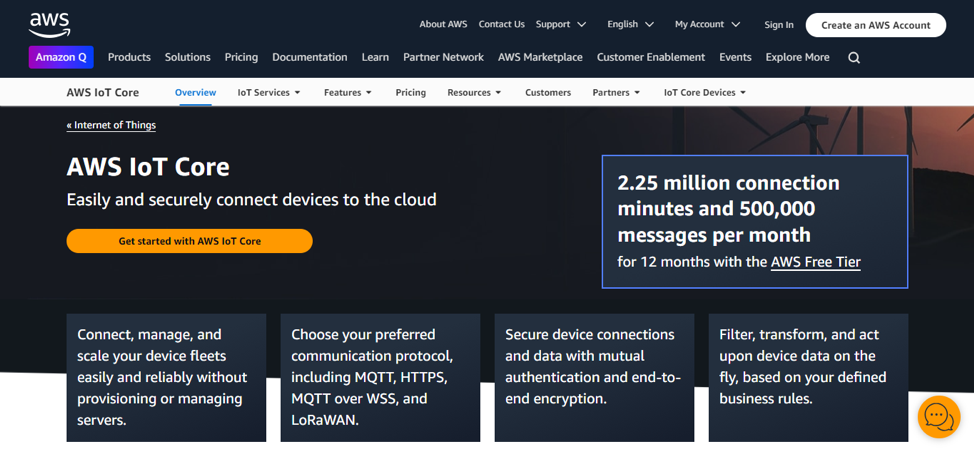
AWS IoT Core is a powerful managed cloud service that facilitates secure, bi-directional communication between internet-connected devices and the AWS Cloud. It provides a comprehensive suite of features designed to build scalable IoT solutions while offering a flexible pricing model with no minimum fees.
Key features
- Device communication protocols: AWS IoT Core supports multiple protocols, including MQTT, HTTPS, and WebSocket, allowing devices to efficiently communicate with the cloud regardless of network conditions or device capabilities.
- Security and identity: Data exchanged between devices and AWS IoT Core is protected through authentication and encryption using X.509 certificates and AWS IAM, ensuring robust security.
- Device shadow: This feature allows for seamless synchronization by storing and retrieving the current state of a device, even when it’s offline.
- Rules engine: AWS IoT’s Rules Engine processes and routes device data based on business rules, facilitating real-time decision-making without the need for managing complex infrastructure.
- Device management: The platform supports bulk registration, organization, monitoring, and remote management of IoT devices, simplifying device administration at scale.
- Integration with AWS services: AWS IoT Core integrates seamlessly with other AWS services like AWS Lambda, Amazon S3, and Amazon Kinesis, enabling the creation of comprehensive IoT solutions.
Pricing
AWS IoT Core operates on a pay-as-you-go basis, with charges based on connectivity, messaging, device shadow and registry operations, and rules engine actions. The platform also offers a 12-month Free Tier, including free messages and connection minutes.
Azure IoT Hub
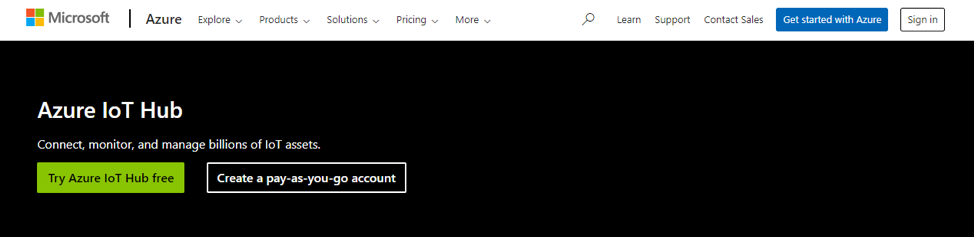
Azure IoT Hub serves as a central messaging hub for bi-directional communication between IoT devices and applications, providing a secure and scalable solution for IoT deployments.
Key features
- Bidirectional communication: Azure IoT Hub allows devices to send telemetry data to the cloud and enables cloud-to-device commands and notifications.
- Device management: It includes provisioning, device twins (digital representation of a physical device), and direct methods for managing devices at scale.
- Security: Azure IoT Hub offers per-device authentication, threat defense, and encryption to ensure data security.
- Scalability: The platform is designed to handle millions of connected devices and events per second, supporting large-scale IoT workloads.
- Protocol support: Azure IoT Hub supports multiple communication protocols, including MQTT, AMQP, and HTTPS.
- Integration with Azure services: The platform integrates with other Azure services like Azure Stream Analytics and Azure Machine Learning, enabling end-to-end IoT solutions.
Pricing
Azure IoT Hub pricing is based on IoT Hub units and messages exchanged per day, with different tiers (Basic, Standard, and Free) catering to various business needs. The Standard tier, for example, is priced at $25 per IoT Hub unit per month with a daily message allowance.
IBM Watson IoT
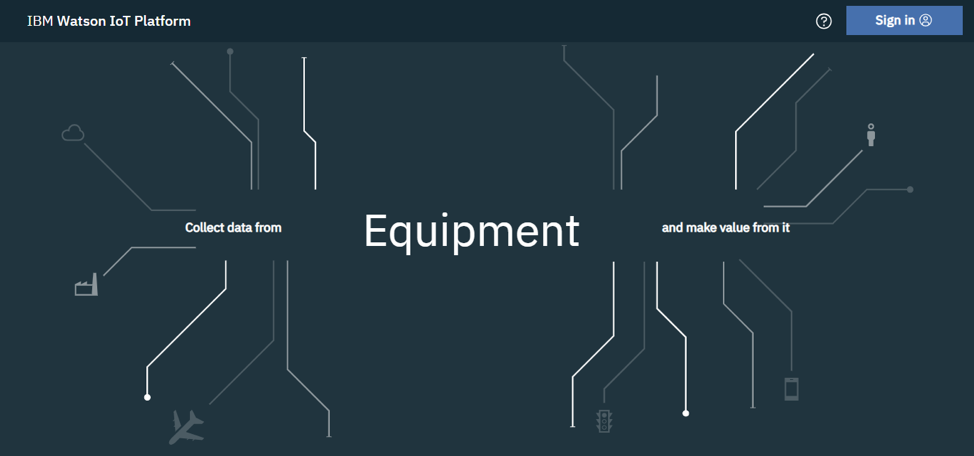
IBM Watson IoT Platform is a cloud-hosted service that facilitates the connection, management, and analysis of IoT device data, supported by IBM’s robust cloud infrastructure.
Key features
- Connect and manage devices: The platform supports MQTT and REST protocols and provides tools for managing connected devices and accessing live and historical data.
- Information management: Businesses can store, normalize, and analyze device data, integrating with other IBM Cloud services.
- Analytics: Real-time analytics and AI-driven insights are available, with a dashboard for visualizing device data.
- Risk and security management: The platform offers secure connectivity and access control, integrating security by design into its infrastructure.
Pricing
IBM Watson IoT Platform offers three tiers: Free, Standard, and Advanced Security. Pricing is based on data exchanged, analyzed, and edge data usage, with a free tier available for smaller deployments.
Cisco IoT Cloud Connect
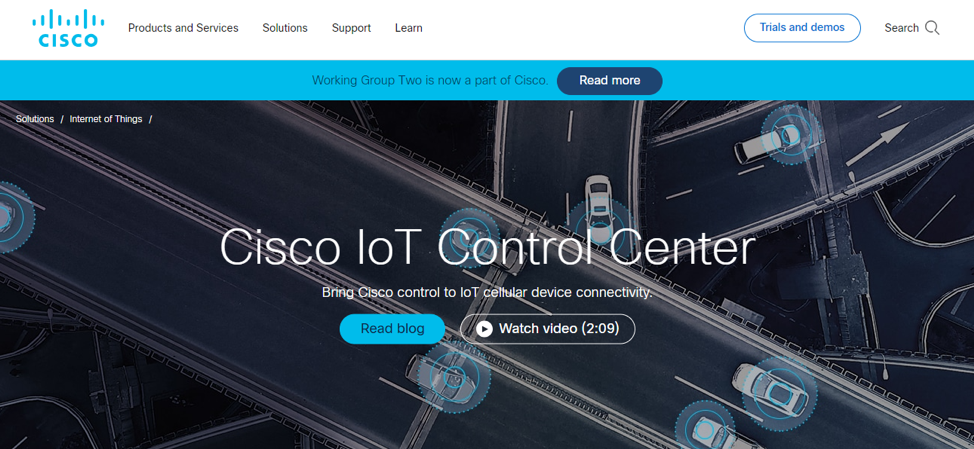
Cisco IoT Cloud Connect simplifies the secure connection of IoT devices with cloud applications, offering a centralized solution for managing IoT ecosystems.
Key features
- Device onboarding: The platform enables secure device enrollment and connectivity to major IoT hubs like AWS, Azure, and Google Cloud.
- Centralized connectivity management: Cisco provides a control center for managing cellular connectivity, integrating all IoT devices into a single SaaS solution.
- Edge computing: Cisco’s Edge Intelligence allocates data flows to local or multi-cloud environments, facilitating faster real-time processing.
- Security: The platform employs Cisco’s zero-trust security approach, protecting sensitive data and devices from cyber threats.
- Scalability: Cisco IoT Cloud Connect is designed to handle large volumes of data, supporting real-time processing and scalable IoT deployments.
Pricing
Cisco IoT Cloud Connect is sold through Service Providers, with pricing tailored to customer needs and deployment scale. Cisco Capital financing is available to provide flexible payment options.
ThingsBoard
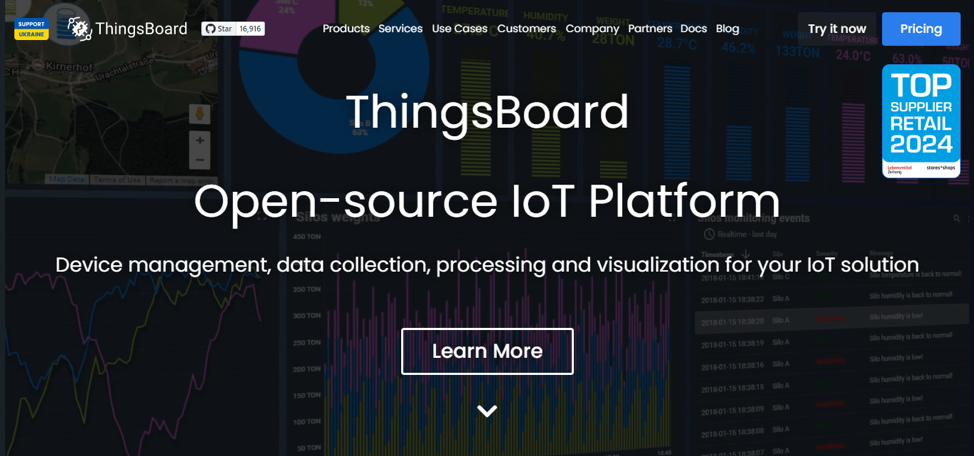
ThingsBoard is an open-source IoT platform that offers tools for the rapid development, management, and scaling of IoT projects, with a strong focus on customization.
Key features
- Device management: The platform allows businesses to provision devices, define relations between them, and manage assets and customers.
- Data collection and visualization: ThingsBoard provides customizable widgets for data visualization, with tools to collect and store telemetry data.
- Alarms and event processing: Businesses can analyze incoming telemetry data and trigger alarms for complex event processing.
- Device control: Remote device control is supported through remote procedure calls (RPC).
- Customization: ThingsBoard offers extensive customization through rule chains and custom widgets, supporting use-case-specific features.
- Security: The platform supports transport encryption and device authentication, ensuring secure operations.
Pricing
ThingsBoard offers both pay-as-you-go subscriptions and perpetual fallback licenses. Pricing is based on the number of devices/assets, with plans ranging from $10/month for small deployments to customized enterprise pricing.
Oracle IoT Intelligent Applications
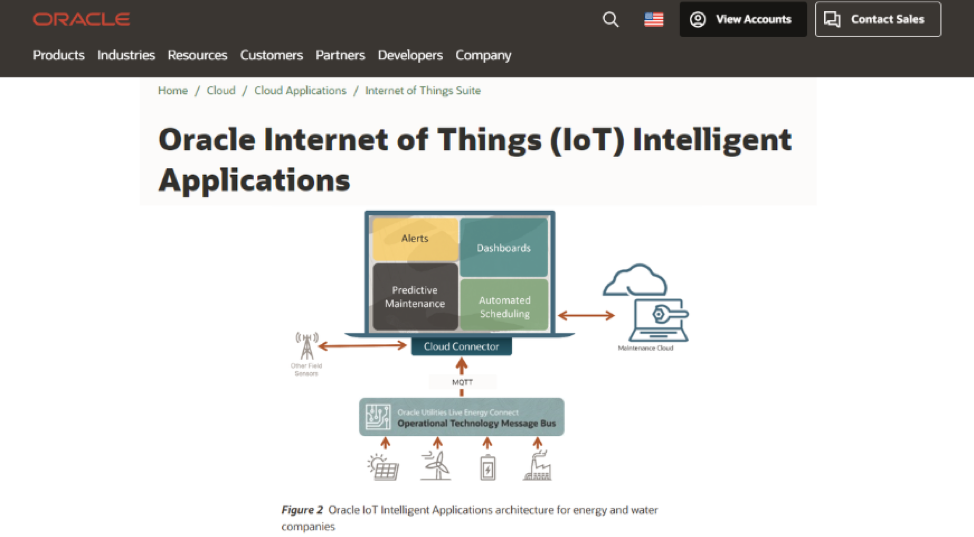
Oracle IoT Intelligent Applications is a suite designed to provide real-time visibility and insights for smart manufacturing, predictive maintenance, connected logistics, and more.
Key features
- Real-time asset visibility: The platform offers tools to monitor the health and performance of assets in real time.
- Business intelligence from sensor data: Oracle leverages sensor data to provide actionable insights for operational efficiencies.
- Automated data gathering: The platform supports automated monitoring of assets, logistics, and production for streamlined operations.
- End-to-end IoT solution: Oracle provides a complete IoT solution, integrating applications with cloud infrastructure.
- Built on scalable technology: Oracle IoT applications are built on Oracle Cloud Infrastructure, incorporating digital twins, AI, and edge computing.
- Pre-built integrations: The platform integrates with Oracle enterprise applications like ERP and SCM, facilitating automated workflows.
Pricing
Oracle IoT Intelligent Applications follow a SaaS subscription model, with pricing based on devices and message volume. Specifics are provided by Oracle sales representatives and tailored to individual business needs.
How Liquid Web can help
Liquid Web offers powerful cloud solutions designed specifically to meet the unique demands of IoT applications. With Liquid Web’s cloud servers, you get the performance, security, and flexibility needed to support and scale your IoT initiatives.
Whether you’re deploying a small network of connected devices or managing a large-scale IoT infrastructure, Liquid Web’s customizable cloud servers provide the reliable foundation you need. Additionally, Liquid Web’s cloud solutions are built to handle the rigorous demands of IoT, offering high performance to process and analyze data in real time, potent security to protect your valuable data, and the flexibility to adapt as your IoT needs evolve.
Backed by expert support, Liquid Web ensures your IoT applications are always running at their best.
Overcoming challenges of IoT cloud solutions and implementing best practices
Security
End-to-end security in IoT cloud platforms is vital, given the sensitive data and critical operations they handle. Common threats include data breaches, device hijacking, and DDoS attacks, which can severely disrupt business operations.
To mitigate these risks, best practices include encrypting data both in transit and at rest, using strong authentication mechanisms, conducting regular security audits, and segmenting networks to contain potential breaches.
Leading IoT cloud platforms like AWS IoT emphasize security, offering features such as X.509 certificate-based authentication and encryption to safeguard both devices and applications.
Scalability
Scalability is another critical aspect of IoT cloud platforms. As businesses grow, so do the volumes of data and the number of connected devices, making it challenging to maintain consistent performance.
To scale effectively, leveraging cloud-native technologies like containerization and microservices is essential. Efficient data storage and processing techniques, combined with edge computing, can reduce latency and bandwidth usage, ensuring a smooth expansion of IoT infrastructure.
Cloud solutions, such as those offered by Arm, provide scalable infrastructure that can grow with your business needs, handling large IoT workloads with ease.
Integration
Easy integration is key to creating a cohesive IoT ecosystem. Successful integration strategies involve adopting open standards and APIs, using middleware, and implementing a well-planned data architecture.
Modern IoT cloud platforms, like Arduino Cloud, facilitate easy integration with existing systems and third-party services, offering user-friendly interfaces that simplify the integration process.
Unlock your IoT potential with Liquid Web’s cloud solutions
As the Internet of Things continues to revolutionize industries and drive innovation, leveraging the right cloud solutions is essential for fully unlocking your business’s IoT potential. Liquid Web’s cloud solutions are crafted to provide the flexibility, reliability, and performance necessary to thrive in an increasingly connected world. Here’s a quick overview of Liquid Web’s offerings:
- Tailored solutions for your business: Whether you’re in manufacturing, healthcare, retail, or another sector, Liquid Web offers customized cloud solutions designed to meet the unique demands of your industry.
- High performance and reliability: Liquid Web’s cloud infrastructure is built to handle even the most demanding IoT workloads, ensuring your critical applications remain online and responsive. With industry-leading SLAs, Liquid Web guarantees the reliability you need.
- Scalable infrastructure: As your IoT ecosystem grows, Liquid Web’s scalable cloud solutions allow you to seamlessly expand your infrastructure, accommodating more devices, data, and applications without missing a beat.
- Enhanced security and compliance: Liquid Web’s cloud solutions come with robust security features, including advanced encryption and firewalls, to protect your data and devices. They also offer compliance solutions to help you meet industry-specific regulatory requirements.
- Expert support and managed services: Liquid Web’s team of cloud experts provides 24/7 support, helping you with everything from setup to ongoing management and optimization.
Unlock your IoT potential with Liquid Web today and elevate your business to new heights in the connected future.