
 Ronald Caldwell
 When you invest weeks into creating the perfect business website, your choice of a web hosting provider can make or break its success.
The right web hosting service ensures smooth performance, reduced downtimes, and increased security — all within a set budget. Choose the wrong one, and you might face poor load speeds and unreachable support, leading to frustrated business and user experiences.
But with at least 745 hosting providers available, how, exactly, do you pick the right one?
This guide offers a step-by-step strategy for selecting a reliable web hosting provider, whether you’re building a website for your business or looking for a reliable hosting partner to serve your clients.
Key points
- A hosting provider offers server space and the required tools to host website data and makes websites accessible on the Internet.
- You can choose from multiple hosting types, such as shared, VPS, dedicated, cloud, bare metal, and WordPress hosting, depending on a website’s requirements.
- When picking a hosting provider, look closely at its storage, bandwidth, uptime, security, scalability, and customer support.
- Compare different pricing plans and look for recommendations and reviews to find the best hosting provider for your business or client.
With this guide, you can confidently explore different hosting options and choose a suitable pricing plan from a reliable service provider. We’ll answer these key questions:
But first, let’s go over what a web hosting provider is.
What is a hosting provider?
A hosting provider offers the server space and infrastructure to host websites and other web apps, making them accessible to internet users. Providers are responsible for the upkeep of the server infrastructure and make sure that your website stays live.
Every hosting provider rents out server space. But they also offer additional services, such as troubleshooting, server maintenance, and website security features. The quality and reliability of these services act as key differentiators when choosing a service provider.
Host with the best provider
Liquid Web offers fast, dependable hosting services for businesses like yours
How to choose a web hosting provider
When it comes to hosting providers, every website will have unique needs. Here’s a 11-step plan for selecting a web hosting provider based on those requirements.
1. Assess your requirements
When determining the best hosting type and provider, there’s no one-size-fits-all. Understanding your business’s or client’s requirements helps you choose a service provider that has tailored plans for those needs.
Here are some factors to consider before looking for a provider:
- Website size and type: The type of website and how big it is are key factors when determining how much storage, memory, and bandwidth to look for. For instance, enterprise websites with large data processing requirements need a different type of hosting than a single landing page for a small business or startup.
- Performance requirements: Websites that continuously load pages and media have high performance requirements and need more resources. Static and informational websites, on the other hand, can load well even with fewer resources.
- Traffic: Websites with high or fluctuating traffic require higher bandwidths to load correctly and avoid crashes compared to low-traffic websites.
- Data protection: Every website requires data protection. But if a website deals with sensitive information, hosts customer data, or processes payments, it requires additional security features.
- Budget: You’ll find good hosting providers in all budget ranges. Determine your budget beforehand to minimize hassles later.
2. Determine the required type of hosting

Once you’ve assessed the website’s requirements, you can zero in on a type of hosting for your business or client.
In general, here are some of the types of web hosting you can choose from:
- Shared hosting: Multiple websites share a single server space. This is ideal for businesses with tight budgets and low performance requirements.
- Virtual private server (VPS): Websites get dedicated virtual server space but share the physical resources.
- Dedicated server: A single client occupies both the physical resources and virtual server space in dedicated hosting. This option is more secure and in that regard is a better option than VPS hosting or shared hosting but also costs more.
- Cloud hosting: Virtual cloud servers host a website, as opposed to physical or on-premise servers.
- WordPress hosting: This type of hosting provides services for websites built with WordPress, one of the most popular content management systems (CMSs) that simplifies website creation. Currently, there are over 35 million WordPress websites.
- Magento hosting: These plans optimize resources for eCommerce websites that run on Magento, another popular CMS.
- WooCommerce hosting: Another option for eCommerce websites is WooCommerce, which adds commerce functionality to WordPress.
- Bare metal servers: This highly customizable hosting option offers dedicated hardware and full control over the infrastructure.
You can also self-maintain the servers or opt for managed hosting services. With managed hosting, the service provider handles most of the server-related tasks, such as routine maintenance and troubleshooting issues to maintain uptime.
Each hosting type has its own benefits and suits different customers. For example, VPS hosting might be more suitable for websites with some large media files and multiple plugins, as it offers dedicated virtual resources. On the other hand, a beginner website owner might benefit from a managed WordPress hosting plan.
Learn more about the different hosting options with our detailed website hosting guide.
3. Look for providers offering the required hosting type
Every hosting provider has its own set of offerings. If you’ve decided to use shared hosting for your website, a hosting provider specializing in VPS can do little for you.
So, narrow down your search to providers that offer the type of hosting you require. Some hosting companies exclusively offer a single hosting type. Others, like Liquid Web, are well-known for multiple options, ranging from WordPress plans to dedicated servers.
If you’re new to website hosting or don’t want the hassle of managing servers, look for providers that excel in managed hosting. Once you’ve jotted down a few promising options, you can evaluate them using the other steps in this guide to finalize your decision.
You can also use tools like Hosting Checker or BuiltWith to learn the hosting providers of websites you like. Built With also gives data on top service providers and how many websites use them.
Check out our list of the top budget-friendly VPS hosting providers.
4. Check storage and bandwidth requirements
The measurement of storage and bandwidth varies among providers. Some companies provide a fixed amount of storage space with each plan and charge for any additional memory usage.
Others offer plans where you pay only for the storage space you use every month.
The same goes for bandwidth. Hosting providers might limit the available server capacity so that a website can handle only a certain amount of traffic at a time. Or, you can get an unmetered bandwidth plan where you access unlimited server capacity, paying as you go.
The best way to know your storage and bandwidth needs is to calculate your current website size and traffic. Then, select a plan that offers more storage and bandwidth than your current requirements.
Say your website’s pages are around 5 MB each, and you get an average of 1,000 visits every month, with each visitor checking out about three pages. Then, your current monthly bandwidth requirement is 5 MB x 1,000 x 3 = 15,000 MB, or 15 GB.
You can choose any plan that offers over 15 GB of bandwidth every month. But we recommend staying at least 20% above the current requirement to accommodate any traffic and data fluctuations, so your ideal plan will offer above 18 GB/month.
If you expect heavy traffic fluctuations, go with a plan that offers unlimited bandwidth and scalable storage capacities.
5. Review hosting uptime and reliability
Reliability and uptime are the most crucial factors when selecting a web hosting provider. Even a single minute of downtime can make your website inaccessible to customers, leading to thousands of dollars in losses.
According to Uptime Institute, more than two-thirds of outages cost over $100,000.

To avoid such losses, pick a hosting provider with uptime guarantees. Liquid Web, for example, guarantees 100% network uptime.
Some providers might offer 99.9% or 99.99% uptime. Rule of thumb: The closer to 100%, the better.
Also, make sure the hosting provider has multiple data centers around the globe. This will ensure better uptime since website functions can be transferred to a different location in case of region-specific issues.
6. Prioritize speed and performance
Your hosting provider’s server locations also play a role in determining website speed. The closer a server is to you, the lower the latency. Users who are near server locations experience fast website load times and robust performance.
Consider hosting providers with servers in multiple geographical locations to create a uniform experience for worldwide users. This reduces load times for all customers, regardless of where they are.
Also, look for plans with caching — a technique that temporarily stores loaded data so users can access it quickly when revisiting webpages.
You can also look for service providers that integrate server hosting plans with content delivery networks (CDNs). These advanced networks rely on caching to store data in multiple locations to optimize website speed and performance.
Peak-performance, full throttle
Liquid Web’s bare metal hosting delivers the raw power you need for maximum speeds.
7. Check for security and compliance features
Since the provider’s server space hosts all website files, it’s important to choose a provider with robust security features. Lackluster security makes a website prone to cyberattacks, which can cause customers to lose trust in a business and hurt revenue.
In 2023 alone, there were 6.06 billion malware attacks. To protect your business or clients from such breaches, look for these security features:
- Regular backups: Automatic backups hosted on secure servers to recover data in case of a breach.
- SSL certificates: SSL (Secure Socket Layer) certificates to encrypt data transfers between the server and the user’s browser. Websites with SSL certificates display the “https:” tag, indicating they’re secure.
- Firewalls: Security features that prevent unauthorized access to website data, safeguarding against a number of attacks, such as phishing and malware.
- DDoS protection: Feature to protect against distributed denial-of-service (DDoS), a type of cyberattack that sends large amounts of malicious traffic to a website.
- Multi-factor authentication: Verifies identities to prevent unauthorized access to website data.
- Access controls: Permission control to ensure users access only approved parts of website and server data.
- Payment protection: Payment Card Industry (PCI) compliance to protect payment and financial data.
In addition, check if the hosting provider adheres to relevant standards, like the General Data Protection Regulation (GDPR) and the Health Insurance Portability and Accountability Act (HIPAA). Without proper compliance, you could risk revealing private user information, attracting legal action.
8. Look for reliable hosting support

Issues with website hosting and servers are unavoidable, even with the best service providers. A responsive and reliable support team helps address these issues quickly, reducing undesirable consequences.
Look for hosting providers that offer 24/7, real-time customer service across channels, such as phone, email, or chat.
Make sure customer service representatives are knowledgeable and experienced in dealing with web server hosting features — especially issues related to downtime and server functions.
Some hosting providers may only offer on-demand expert support with higher-paid plans. In that case, check for a detailed knowledge base and self-help videos if you’re opting for a lower-priced plan.
9. Compare pricing plans
While cost shouldn’t be the sole deciding factor when choosing a web hosting company, it’s good to look for hosting plans that fit your budget.
Compare various plans from each provider to get an idea of the features and support that accompany each pricing tier. Apart from the mandatory CPU cores, disk space, bandwidth, and security features, check for perks like daily backups, free domain name registration, and free SSL certificates. If you’re seeking a more advanced setup, check for available services like NVMe storage and GPU hosting.
Many providers offer discounts in the first year or month if you want to try out their plans. Several hosting providers, including Liquid Web, offer a 30-day money-back guarantee for hosting packages.
When looking at hosting prices, be wary of deals that are too good to be true. Plans with too many features at very low prices often turn out to be scams. Instead, look for plans that offer great value.
Make sure to opt for a provider with transparent pricing. Hidden fees and fine print can add hundreds or even thousands of dollars to your final bill, especially if you’re making long-term hosting commitments.
10. Check for scalability

Hosting scalability is crucial for a new or growing business. Choose a service provider that offers scalable options with flexible pricing. You should be able to scale the bandwidth, memory, and storage.
Say your website’s getting a seasonal traffic surge. A scalable plan allows you to expand the bandwidth for a fee to accommodate the additional traffic and scale back when traffic goes down.
11. Verify reputation and reviews
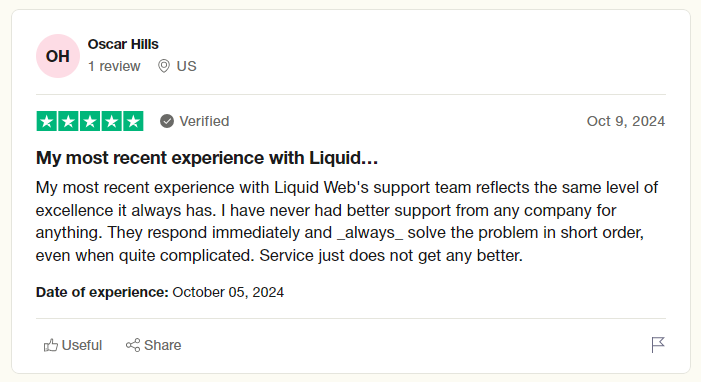
With every hosting business claiming to be the best, it’s hard to select one solely based on a provider’s word. The best way to verify claims is to look for customer testimonials.
Check trusted sites like Trustpilot for reviews. For industry-specific insights, check the service provider’s website for case studies.
Also, chat with potential hosting providers, asking specific questions related to your requirements to assess their quality.
Which provider should I choose?
With hundreds of options available, choosing the best web hosting provider can be difficult. If you’re unsure where to turn, it’s best to go with a reliable and well-known hosting provider like Liquid Web.
With over 180,000 happy customers around the world, Liquid Web offers powerful hosting solutions — from cloud to dedicated — with multiple budget tiers and incremental pricing.
And with our 24/7 expert support, you’ll never have to worry about web hosting again.
Ready to switch web hosting providers? Check out our web hosting plans.