
Compliance documentation rarely feels urgent … until it suddenly is.
- A hospital partner sends over a security questionnaire.
- An auditor requests proof of infrastructure controls.
- Legal wants confirmation before approving a contract.
None of these moments are surprising in healthcare. What is surprising is how often organizations scramble to gather documentation they assumed would be easy to obtain.
Access to compliance documentation isn’t just admin housekeeping. It directly affects deal velocity, audit readiness, and leadership confidence. For healthcare organizations and health tech companies alike, it’s part of operational maturity.
Get HIPAA-compliant hosting
Secure cloud servers for healthcare industry hosting
Why compliance documentation matters more than most organizations realize
If you operate in or adjacent to healthcare, your infrastructure is part of your compliance story.
Your application is probably airtight. Your internal policies are surely well-documented.
But the moment you rely on third-party infrastructure, regulators, auditors, and enterprise partners will want proof that your hosting environment aligns with frameworks like HIPAA, PCI, GDPR, and SOC.
And verbal assurances are not enough. Neither are vague website statements about “industry-leading security.” What stakeholders want to see are current, accessible documents that demonstrate alignment with recognized standards.
When documentation is easy to access, it reinforces trust.
When it is difficult to obtain, it introduces friction and doubt.
3 times compliance docs become urgent
Compliance documentation has a funny way of staying quiet until it suddenly becomes the most important thing on your to-do list. Not because anything changed on your side, but because someone else’s timeline just became your problem.
1. Vendor risk assessments and security questionnaires
You already know the drill. The vendor risk review comes in, the security questionnaire lands in someone’s inbox, and suddenly everyone needs answers by Friday. The questions aren’t unexpected, but the urgency always is.
When compliance documentation is easy to access, you can respond quickly, confidently, and consistently. When it isn’t, you end up digging through old email threads, tracking down support contacts, or re-requesting documents you swear you already had.
2. Audit preparation and incident readiness
Even if you’re not actively in audit season, you’re never really out of it either. The request for documentation can show up without much warning, and nobody wants to waste time playing “where did we put that certificate?” while an auditor is waiting.
Fast access to compliance documentation gives your team breathing room. It also keeps the process clean and repeatable, which is exactly what auditors like to see.
3. Procurement and legal review
You can have engineering aligned, timelines scoped, and implementation ready to go. Then procurement and legal step in, and suddenly everything pauses until compliance documentation is reviewed and approved.
That part is normal. The problem is when the documents are hard to find, unclear, or scattered across different channels. When the right compliance proof is available immediately, legal reviews tend to stay focused on the contract instead of turning into an infrastructure scavenger hunt.
The hidden cost of slow access to compliance documentation
Slow access to compliance documentation rarely shows up on a balance sheet, but the cost is real.
Deals take longer to close. Launch timelines shift. Internal teams spend time chasing paperwork instead of improving systems. Support channels absorb requests that could have been handled through self-service access.
There is also a perception cost. When documentation is difficult to obtain, stakeholders question whether compliance processes are equally opaque. In regulated industries, perception matters.
Over time, these small inefficiencies compound into slower growth and higher operational overhead.
Use case: Health tech companies moving fast in regulated environments
Health tech companies operate in a unique tension. They are expected to innovate quickly while maintaining rigorous compliance standards.
For venture-backed startups and scaling platforms, infrastructure compliance becomes part of enterprise credibility. Hospitals, health systems, and large partners will not move forward without documented proof that hosting environments align with HIPAA and related frameworks.
When compliance documentation is centralized and accessible:
- Security questionnaires are easier to complete.
- Vendor risk assessments move faster.
- Legal reviews require fewer back-and-forth requests.
- Leadership can answer investor and partner questions with confidence.
Use case: Small and mid-sized medical practices focused on reducing risk
Small to mid-sized medical practices have a different challenge. They don’t often have dedicated compliance departments or in-house security teams.
For practice managers and administrators, compliance documentation is about preparedness and peace of mind. When an auditor asks for proof of infrastructure compliance, there is little margin for delay.
Clear, self-service access to compliance certifications helps practices:
- Keep required documentation on file for governance records.
- Respond quickly to audit inquiries.
- Validate vendor alignment during contract renewals.
- Reduce reliance on support for routine compliance questions.
What compliance transparency should look like in a hosting provider
Healthcare organizations should expect more than generic security claims.
Mature compliance transparency includes:
- Self-service access to standard compliance certifications for relevant frameworks.
- Clear visibility into which certifications apply to specific data center locations.
- A structured, secure process for requesting more sensitive documentation when appropriate.
This approach balances openness with responsible handling of sensitive materials. It reduces friction without compromising governance.
Introducing the Compliance Dashboard in the my.LiquidWeb portal
To support healthcare organizations that need faster access to compliance documentation, Liquid Web has introduced a centralized Compliance Dashboard within the my.LiquidWeb portal.
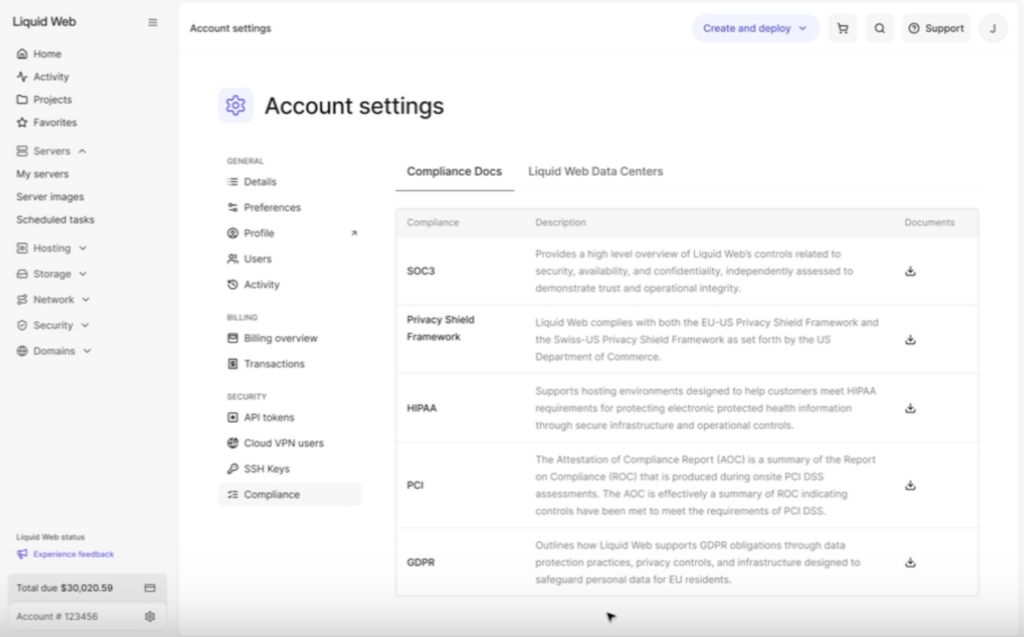
Customers can download compliance certifications for core frameworks, including HIPAA, PCI, GDPR, and SOC3, directly from their account. The dashboard also provides visibility into data center compliance documentation, making it easier to understand how certifications align with specific infrastructure locations.
As additional compliance documentation becomes available across more data centers, the dashboard will continue to expand. The goal is straightforward: make compliance documentation easier to find and easier to use during risk reviews and audits.
The Compliance Dashboard is available in the my.LiquidWeb portal under:
Account Settings → Security → Compliance
Compliance access is operational maturity
In healthcare, compliance is table stakes.
What differentiates organizations is how efficiently you handle it. Easy access to compliance documentation reduces friction during audits, accelerates partner approvals, and strengthens confidence across leadership teams.
Whether you are scaling a health tech platform or managing a growing medical practice, infrastructure transparency supports better decisions and fewer surprises.
If you are a Liquid Web customer, you can explore the Compliance Dashboard today in the my.LiquidWeb portal. If you are evaluating hosting options for regulated workloads, our team can walk through how we support HIPAA-ready infrastructure and compliance transparency.
Get HIPAA-compliant hosting
Secure cloud servers for healthcare industry hosting