 Liquid Web
 When evaluating server infrastructure for businesses that demand excellent hardware performance, two powerful options emerge: bare metal servers and dedicated servers. While both deliver high performance and resource isolation by eliminating the ‘noisy neighbor’ issue synonymous with shared hosting, their distinct characteristics serve different business needs.
Let’s examine how these server types compare to help you make an informed decision for your business operations.
Key points
- Bare metal servers and dedicated servers both offer high performance, single-tenant environments for resource-intensive workloads.
- Bare metal cloud servers provide on-demand scalability and integration with cloud environments, ideal for dynamic workloads and hybrid cloud setups.
- Dedicated servers offer full customization and predictable performance, best suited for stable, long-term workloads.
- Bare metal servers excel in high-performance scenarios like AI, gaming, and big data analytics, while dedicated servers are perfect for application development and email hosting.
- Scalability is easier with bare metal cloud servers due to API-driven provisioning, while dedicated servers require manual scaling and hardware upgrades.
- Both options offer strong security, with bare metal cloud servers integrating advanced DDoS protection and encryption features.
- Liquid Web provides industry-leading bare metal and dedicated server solutions, supported by a full-time engineering team to help tailor the right choice for your needs.
What is a bare metal cloud server?
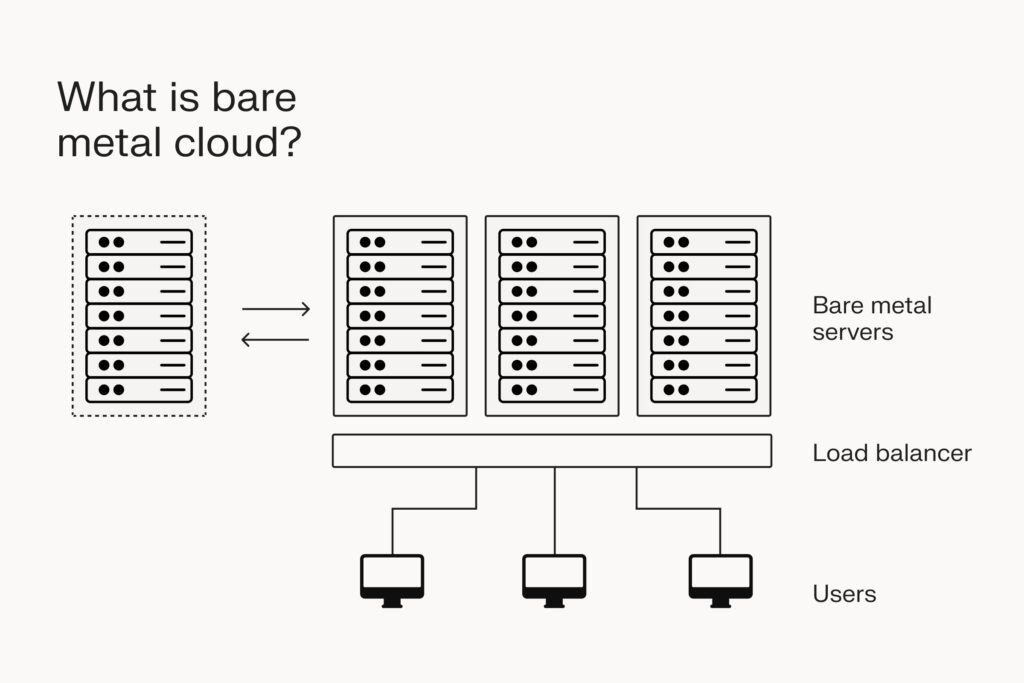
A bare metal server is a physical server with hardware resources – like CPU, RAM, and storage – dedicated solely to one user. Unlike virtual machines, which share the physical hardware with multiple users, a bare metal server gives you complete and exclusive access to all its resources. This exclusivity means you have full control over the server’s configuration, operating system, and software. It also often translates to better performance, as you don’t have to compete with other users for computing power.
To take this a step further, a bare metal cloud server offers the same dedicated hardware as a traditional bare metal server, but it is provided through a cloud-like service model. This means you can quickly deploy, scale, and manage a physical server on demand, similar to how you would provision virtual machines in a public cloud. You benefit from the high performance and security of a dedicated server, as well as the flexibility and pay-as-you-go pricing typical of cloud services. This combination gives you the best of both worlds: the power and control of dedicated hardware paired with the convenience and scalability of cloud computing.
Advantages of bare metal cloud servers
- High performance: Both bare metal servers and bare metal cloud servers provide exclusive access to physical hardware, ensuring no resource sharing or performance degradation. This makes them ideal for resource-intensive tasks like databases, AI workloads, and high-traffic applications like game servers.
- Security: All bare metal servers are isolated. Users don’t share resources with other tenants, which lets them create custom security policies to protect their data from breaches.
- Scalability: Bare metal cloud servers offer on-demand provisioning, allowing businesses to scale up or down based on workload needs. Traditional bare metal servers also offer customization, giving users the flexibility to configure hardware and software for specific requirements.
Disadvantages of bare metal cloud servers
- Potentially higher costs in the long run: The upfront cost of bare metal servers can be significant, especially if purchasing the server outright. Maintenance, upgrades, and data center hosting add to the expenses. Even with bare metal cloud servers and their flexible pay-as-you-go pricing, it can become expensive for long-term or consistently high workloads compared to virtualized cloud solutions.
- Management complexity: For bare metal servers, you are responsible for managing everything, from hardware maintenance to software updates and security patches. And, while bare metal cloud servers are easier to manage than traditional bare metal, they may still require a level of technical expertise to configure and optimize effectively, especially for complex environments.
- Potential resource underutilization: If workloads are not consistently resource-intensive, dedicated hardware can result in wasted capacity, as resources like CPU and RAM remain underused. If not carefully managed, provisioning too many servers or overestimating capacity needs can lead to unnecessary costs.
What is a dedicated server?
Like bare metal servers, dedicated servers are also single-tenant servers. Customers have exclusive access to the hardware resources and each customer is assigned a physical machine in a data center, for which they are fully responsible.
Depending on business needs, users can opt for managed or unmanaged hosting. A managed hosting plan lets users focus on their business while the hosting provider monitors the server’s hardware and software. This is unlike unmanaged hosting, where the customer is fully responsible for managing their server.
Advantages of dedicated servers
- Control: Dedicated servers give users complete control over their resources, including the CPU, RAM, storage, and network, which can be adjusted according to business requirements.
- Predictability: Users can predict their server behavior depending on the assigned workloads, as they are not competing with other users for the hardware resources. This makes it an ideal choice for mission-critical applications that require guaranteed stability and security.
Disadvantages of dedicated servers
- Constant supervision: Unless the host manages it, users are usually completely responsible for their dedicated server, making it essential for them to possess the technical skills to monitor and configure their server.
- Scalability challenges: Scaling a dedicated server requires more physical resources to be configured manually and can put a strain on the overall budget.
Explore bare metal pricing
Experience peak performance with dedicated resources & lightning-fast load times
Bare metal vs bare metal cloud vs dedicated servers: Key differences
Although both bare metal and dedicated servers provide single-tenant environments that ensure high performance and isolation, their differences can be pivotal depending on business requirements. Below is a summary of how bare metal servers compare with dedicated servers.
| Feature | Bare metal server | Bare metal cloud server | Dedicated server |
| Provisioning | Manual setup and configuration – requires time and expertise. | Automated provisioning with fast OS installation and APIs for quick deployment. | Manual setup and configuration, slower than bare metal cloud. |
| Performance | High performance with dedicated hardware, no virtualization overhead. | Optimized for high-performance computing with access to the latest hardware. | Consistent performance with standard hardware, but less cutting-edge than bare metal options. |
| Virtualization | Full access to hardware, but typically not virtualized unless configured manually. | Supports lightweight virtualization or containers with minimal overhead. | May require traditional hypervisors for virtualization, which can introduce performance impact. |
| Cloud integration | Limited; typically used as standalone servers. | Native cloud integration, allowing seamless hybrid or multi-cloud setups. | Limited; requires additional work or third-party tools for cloud integration. |
| Scalability | Limited scalability; physical hardware upgrades needed for scaling. | Dynamic scalability – similar to virtualized cloud servers, with quick resource provisioning. | Scaling is manual and requires physical changes, such as adding more hardware. |
| Customization | High; complete control over hardware and software configurations. | Limited to the provider’s pre-configured hardware and software options. | Full customization of both hardware and software. |
| Security | High; complete control over security measures but user-managed. | Cloud-grade security with options for customizable policies. | High; full control over security measures but requires manual setup and monitoring. |
| Hardware updates | Hardware remains fixed for the duration of use; user responsible for upgrades. | Regular updates to hardware by providers, ensuring access to the latest technologies. | Standard hardware that is updated less frequently due to contract constraints. |
| Provisioning speed | Slower setup due to manual configuration. | Fast, automated provisioning within minutes or hours. | Slower provisioning compared to bare metal cloud servers. |
| Pricing | Typically long-term contracts or fixed monthly payments. | Pay-as-you-go pricing model, offering flexibility for usage-based billing. | Fixed monthly or annual payments – often less flexible than bare metal cloud servers. |
| Use cases | Ideal for applications needing high customization and control (e.g., HPC, databases). | Suitable for dynamic workloads, hybrid cloud strategies, and on-demand high-performance computing. | Best for predictable, long-term workloads requiring dedicated hardware without frequent changes. |
Provisioning
Bare metal cloud servers are built to be set up quickly and automatically, often in just a few minutes. Using an Infrastructure-as-Code (IaC) method, users can create or remove servers easily through APIs or control panels. This flexibility makes them perfect for situations where workloads change often or where fast scaling is needed.
In contrast, traditional dedicated servers typically require manual provisioning, which can take hours to days. The setup process often involves hardware configuration, operating system installation, and network setup by the hosting provider. This slower provisioning makes dedicated servers more suitable for long-term, stable workloads.
Performance
While both options provide excellent performance, bare metal servers typically offer superior computing power due to optimized hardware configurations combined with modern infrastructure and reduced virtualization overhead. They excel in scenarios requiring both high performance and the ability to scale quickly.
Dedicated servers provide consistent, predictable performance that is ideal for stable workloads. Their complete isolation ensures resource availability but may lack the peak performance capabilities of newer bare metal hardware.
Virtualization
Bare metal servers typically do not rely on traditional hypervisors, providing direct hardware access to the operating system. This lack of a virtualization layer eliminates overhead, offering near-native performance and full control over resources. However, they are compatible with containerization tools like Docker and Kubernetes, making them suitable for modern virtualized environments.
Dedicated servers offer traditional virtualization capabilities with complete control over the hypervisor layer. They can run VMware, Xen, or Hyper-V, which allow for virtual machine (VM) hosting. This flexibility makes them ideal for running multiple isolated environments on a single physical server. However, virtualization introduces some overhead, which may slightly impact performance.
Cloud compatibility
Bare metal cloud servers integrate seamlessly with cloud environments, supporting hybrid and multi-cloud deployments. Features like API-driven management, elastic scaling, and compatibility with cloud-native services (e.g., AWS, Azure) enhance operational flexibility. As a result, they are well-suited for hybrid cloud setups, where workloads shift between on-premises, public, and private clouds.
Traditional dedicated servers are less inherently cloud-compatible. While they can be integrated into hybrid environments, they often lack native support for APIs and automation tools, requiring additional configuration or middleware for easy integration.
Security
Security is enhanced by the single-tenant nature of bare metal servers, as there is no resource sharing with other users. Additionally, cloud providers offer advanced security features like DDoS protection, firewalls, and encryption. However, their cloud-accessible nature may introduce vulnerabilities if not properly configured.
Dedicated servers also provide single-tenant isolation, which is ideal for sensitive workloads. Since they are often hosted in private data centers, they can offer enhanced physical security. However, advanced security measures may require manual configuration by the user.
Scaling
Bare metal cloud servers are built to address the scalability challenges of traditional hardware solutions, combining the raw performance of dedicated servers with the elasticity of cloud infrastructure. They can often scale both vertically and horizontally. Vertical scaling might involve allocating more CPU cores or RAM in real-time, while horizontal scaling integrates smoothly with load balancers to distribute traffic across multiple servers.
Also, modern bare metal cloud solutions provide APIs for infrastructure management, enabling programmatic scaling. Developers can automate the process of spinning up or shutting down servers, integrating scaling policies with tools like Terraform, Ansible, or Kubernetes.
These scaling options make bare metal cloud servers highly suitable for workloads that are unpredictable or highly variable, such as AI/ML training, big data analytics, or large-scale web applications.
Conversely, dedicated servers traditionally cater to stable, predictable workloads, and their scaling process reflects this design philosophy. Scaling typically requires manual intervention. For vertical scaling (e.g., adding more RAM, upgrading the CPU, or increasing storage), the hosting provider must physically access the hardware to install new components. This often requires downtime, scheduling, and careful coordination.
Horizontal scaling, such as adding additional servers, requires purchasing or leasing more physical machines, setting up networking, and reconfiguring the environment to distribute workloads. This process can take days or even weeks, making dedicated servers less suitable for rapidly changing workloads.
Since scaling is slower, organizations often plan capacity months in advance, sometimes provisioning more resources than needed to avoid bottlenecks.
Customization
Bare metal cloud server servers allow extensive customization, including operating systems, software stacks, and network configurations. However, customization is often managed via predefined templates and automation tools, which may limit the degree of control compared to traditional servers.
On the flip side, dedicated servers offer full customization at the hardware and software levels. Users can specify exact hardware components, operating systems, and software configurations, making them suitable for highly specialized workloads.
Hardware
Bare metal cloud servers are consistently updated with the latest technology, such as:
- Latest generation processors (AMD EPYC, Intel Xeon)
- NVMe and high-performance SSD storage options
- Advanced networking with up to 100Gbps connectivity
Regular hardware refreshes by the provider On the other hand, dedicated servers typically maintain the same hardware configuration throughout the contract period, such as:
- Traditional storage options (SSD/HDD)
- Standard networking capabilities
Pricing
Bare metal customers are typically billed for factors like the resources they use, how much data they transfer, and their server configuration (i.e., the memory, CPU, and storage selections), which could vary based on cloud providers. Inversely, dedicated servers are billed monthly or annually, regardless of resource utilization.
Bare metal cloud server use cases
Ecommerce websites
Ecommerce websites are different from regular websites as they often experience high-traffic moments. Bare metal cloud server offers ecommerce websites the flexibility they need to serve variable traffic with maximum uptime.
Gaming platforms
Online gaming requires super-fast CPUs and low-latency servers to give players a smooth gaming experience without buffering. Some games support real-time simulation, which requires maximum bare metal performance.
Dedicated server use cases
Application development
Most applications under development don’t require intensive computing resources. But for those meant to serve customers online, developing them in a production-like environment makes sense. Dedicated servers can facilitate continuous integration and deployment (CI/CD) by hosting workflows. Smooth workflows are key in streamlining engineering, testing, and code deployment, reducing the time to market a software product.
Email servers
Email is essential for big organizations due to sensitive information being transmitted between staff frequently. As a result, dedicated servers are ideal for hosting email servers as it allows admins to deploy stringent custom security policies, implement robust firewalls, apply strong encryptions to emails, and create intrusion detection systems that protect the integrity of every email within the organization.
Final thoughts
The choice between bare metal servers and dedicated servers ultimately depends on your workload requirements, performance needs, and management preferences. Bare metal servers offer an excellent balance of performance and flexibility, making them ideal for modern, dynamic workloads that benefit from cloud integration. On the other hand, dedicated servers provide more control and stability, perfect for consistent workloads.
Whatever your choice may be, Liquid Web offers both bare metal servers, as well as dedicated servers. Both options come with industry-leading customer support that is available full-time.
Not sure which option is best for your business? Our supportive team of engineers is ready to help you find the right solution for your business if you need help picking one.