 Liquid Web
 Would you like a reliable server with powerful, customizable hardware — and a more compliant hosting solution that protects data privacy? If yes, it’s time to choose a bare metal cloud provider.
Bare metal cloud servers are physical servers dedicated to a single tenant with no virtualization layer.
Unlike traditional cloud hosting solutions, bare metal cloud servers offer 100 percent dedicated hardware and software resources, which makes them more personalized, consistent, and secure. With this in mind, many business owners are switching to bare metal, with the global market expected to reach $56.6 billion by 2031.
Not all bare metal server providers are built the same, though. This guide will explain what bare metal hosting is and when it’s useful. Then, you’ll discover the best bare metal server providers to choose from.
- Understanding bare metal cloud hosting
- Why use bare metal servers?
- Bare metal providers
- Final thoughts: The best bare metal cloud hosting providers
Understanding bare metal cloud hosting
Bare metal cloud hosting provides dedicated physical servers to a single tenant. These servers offer 100 percent dedicated hardware and software resources. Bare metal servers have no pre-installed virtualization layer.
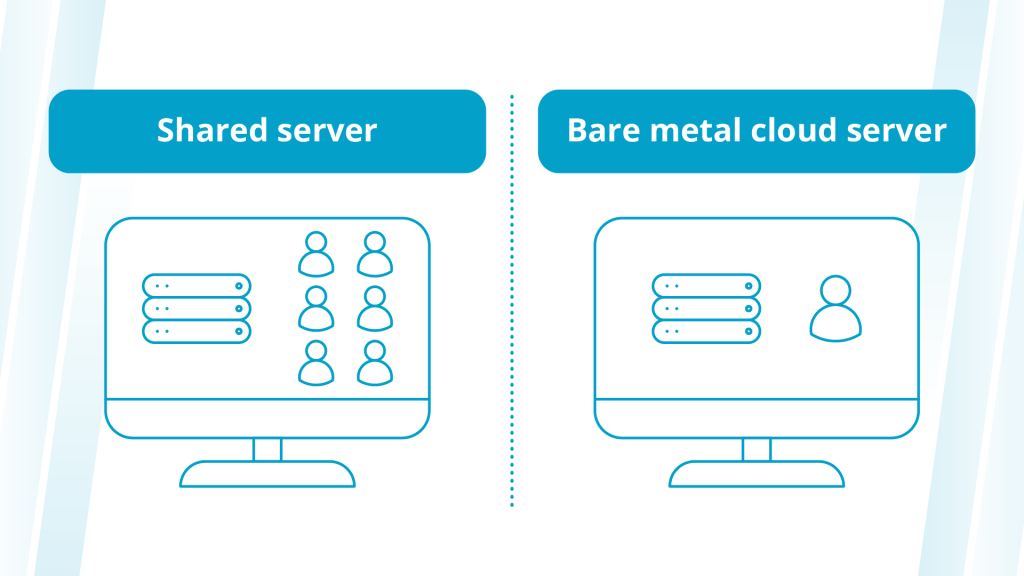
Hosting providers rent out physical servers for clients who are, effectively, tenants. Some tenants have digital neighbors — that’s called shared hosting.
For example, traditional cloud servers are shared spaces where each tenant has their own storage and bandwidth allotted. This is good for cost savings but comes with drawbacks from the server’s resources shared between digital neighbors.
But with a bare metal hosting provider, you get your own physical server where you don’t share computing resources with anyone. Furthermore, bare metal cloud servers don’t have a pre-installed virtualization layer (also known as a hypervisor). In other types of servers, these layers are used to create separate digital spaces for clients to use a fraction of the server’s resources — kind of like how an apartment is divided into rental units.
Since bare metal cloud servers are free from pre-installed virtualization layers, you get complete control of the underlying hardware. That’s a handy perk many other server types can’t claim.
What is a bare metal host?
A bare metal host is a physical server dedicated to one user without virtualization software. The operating system runs directly on the hardware. This direct access provides better performance than virtualized environments. Bare metal hosts offer complete control over server resources.
Why use bare metal servers?
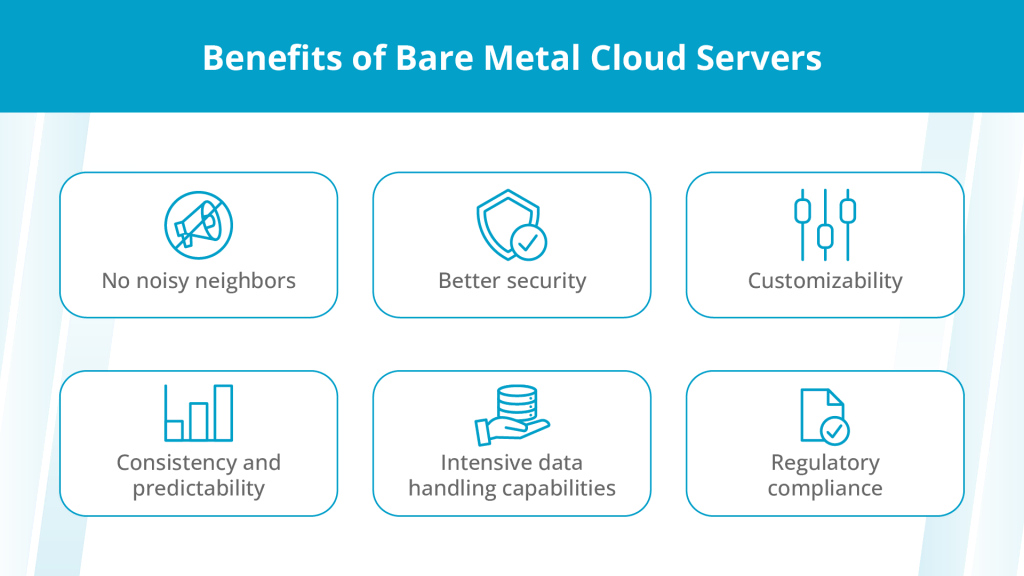
Let’s consider the perks of bare metal servers in-depth so you can imagine the best use cases.
No noisy neighbors: Eliminate resource contention between tenants
In a shared, multi-tenant cloud environment, performance can fluctuate when other users consume a disproportionate amount of resources like CPU, RAM, or network I/O. This “noisy neighbor” effect does not exist in a single-tenant bare metal environment.
All physical resources are dedicated exclusively to you, ensuring your applications receive the full, unthrottled power of the underlying hardware for consistent, interference-free performance.
Better security: Physical data isolation protects against cross-tenant vulnerabilities
The single-tenant nature of bare metal servers provides a fundamentally more secure environment.
- Physical separation: Your data is physically isolated from other tenants, eliminating the risk of “breach crossover” where a security failure on another tenant’s virtual machine could impact your environment.
- Reduced attack surface: The architecture reduces the attack surface for threats common in shared environments, such as side-channel attacks or hypervisor vulnerabilities.
- Dedicated IP: Your organization receives a dedicated IP address, preventing it from being blocklisted due to the malicious activity of another tenant.
- Hardware-level control: You get direct access to hardware-level security features, such as dedicated firewalls, allowing for the implementation of robust security policies at the server’s core.
Cyberattacks are increasing in frequency — Cloudflare blocked 20.5 million DDoS attacks in Q1 2025 alone, which was about 96% of the total number of DDoS attacks in 2024. Since one shared server houses multiple clients, hackers take advantage of the opportunity for a larger-scale cyberattack. Your business can avoid these security risks by using bare metal cloud servers.
Customizability: Users control both the software and physical server configurations
Bare metal provides root-level access to the hardware, offering complete control that is not possible in shared or virtualized environments.
- Software freedom: Install any operating system (e.g., Ubuntu, CentOS, Windows Server) or your own hypervisor (e.g., VMware, KVM) without provider restrictions.
- Hardware tailoring: Tailor hardware to your exact workload by selecting specific CPU models (e.g., Intel® Xeon®, AMD EPYC™), defining the precise amount of RAM, and choosing storage configurations, including high-speed NVMe SSDs for I/O-intensive applications.
Fine-tuning: You can fine-tune low-level settings, including BIOS/UEFI configurations and RAID levels (e.g., RAID 0, 1, 5, 10), for optimal performance and data redundancy.
Consistency: Dedicated resources provide predictable, low-latency performance
Because you command 100% of the server’s resources, you can accurately benchmark and forecast application performance without the variability introduced by other tenants.
This is critical for applications sensitive to latency, such as high-frequency trading, AdTech bidding platforms, real-time analytics, and online gaming, where microsecond-level consistency is required.
A bare metal server provides a stable performance baseline, free from the “jitter” of a shared resource pool.
Intensive data handling capabilities: Direct hardware access maximizes performance for demanding workloads
Bare metal servers are engineered for enterprise-level workloads like big data processing, machine learning model training, and large-scale databases.
- High-end specifications: Configure servers with top-tier components, such as dual-socket CPUs with up to 128 cores, terabytes of DDR5 RAM, and petabytes of all-flash NVMe storage.
- No hypervisor overhead: The absence of a mandatory provider hypervisor layer eliminates performance overhead (which can be 5-10%), ensuring that applications like Hadoop, Spark, or Cassandra utilize the raw processing power of the hardware directly.
- High-throughput networking: Utilize high-throughput network interfaces, typically from 10 Gbps to 100 Gbps, to handle massive data ingress and egress without bottlenecks.
Regulatory compliance: Single-tenant architecture simplifies adherence to data governance standards
The physical isolation of data in a single-tenant environment is crucial for organizations subject to strict data protection laws. For industries like finance (PCI DSS) and healthcare (HIPAA), you maintain complete control over data residency and access logs, which is essential for demonstrating compliance during audits.
By controlling the entire software and hardware stack, you can implement the specific encryption protocols and security controls mandated by regulatory bodies.
In conclusion, bare metal servers have several advantages over other types of servers. To make the most out of your choice to switch, find a bare metal cloud provider that’s in tune with your requirements. Use the following section to discover the best options.
Bare metal providers
- Liquid Web
- Servers.com
- Cherry Servers
- Hivelocity
- Scaleway
- Amazon
- INAP
- RedSwitches
- OpenMetal
- Oracle
- Vultr
Pick the provider that offers features tailored to your business circumstances. Here’s a detailed rundown of the top bare metal hosting providers to make your choice easier:
1. Liquid Web
Liquid Web offers fully managed bare metal servers powered by Intel® Xeon® processors, with configurations designed for a variety of workloads. The provider focuses on high performance, robust security, and dedicated support, offering a 100% Network and Power Uptime Service Level Agreement (SLA).
Key features include:
- Bandwidth: Servers include 5 TB of bandwidth.
- Memory: RAM starts at 16 GB and is expandable based on workload requirements.
- Storage: Standard configurations come with dedicated SSD primary drives and a secondary SATA backup drive.
- Access: Full root-level access and dedicated IP addresses are standard, ensuring complete server control.
- Security: Standard DDoS protection is included, with advanced security and PCI compliance scanning available as add-ons.
- Add-ons: Graphic processing units (GPUs) are available to accelerate intensive processing tasks, alongside options like cloud load balancers.
- Support: Includes 24/7/365 human support via chat and help desk.
- Management: Servers can be managed with a choice of control panels, including InterWorx, Plesk, and cPanel.
With regular backups, 24/7/365 support, and a focus on security, this cloud provider has one of the highest NPS scores in the industry — its customers are loyal and outspoken.
More features:
- Enjoy a unique IP address and 100 percent server allotment.
- Experience the 100 percent uptime guarantee.
- Control server features with easy system panels.
Price: Standard servers start at $149 monthly for both Windows and Linux. Premium servers start at $199 monthly.
2. Servers.com

Servers.com offers automated bare metal hosting with a focus on rapid deployment and a globally distributed network. It allows users to build custom server configurations that can be provisioned quickly to meet specific performance and geographical needs.
Key features include:
- Rapid provisioning: Servers are automatically provisioned and ready for use in 40 minutes or less.
- Hardware customization: Offers a wide range of configurable components, including various CPU, RAM, storage, and network options to match any workload.
- Global network: Operates data centers across the United States, Europe, and Asia, providing low-latency connectivity and redundancy for international users.
- Scalability: Resources can be easily scaled, and new servers can be added or existing ones upgraded to accommodate changing business demands.
- Security: Provides foundational DDoS protection and operates out of secure data centers to protect physical infrastructure.
- Support: A dedicated technical support team is available 24/7 to assist with any issues.
Price: Bare metal server plans start at $107 per month.
3. Cherry Servers
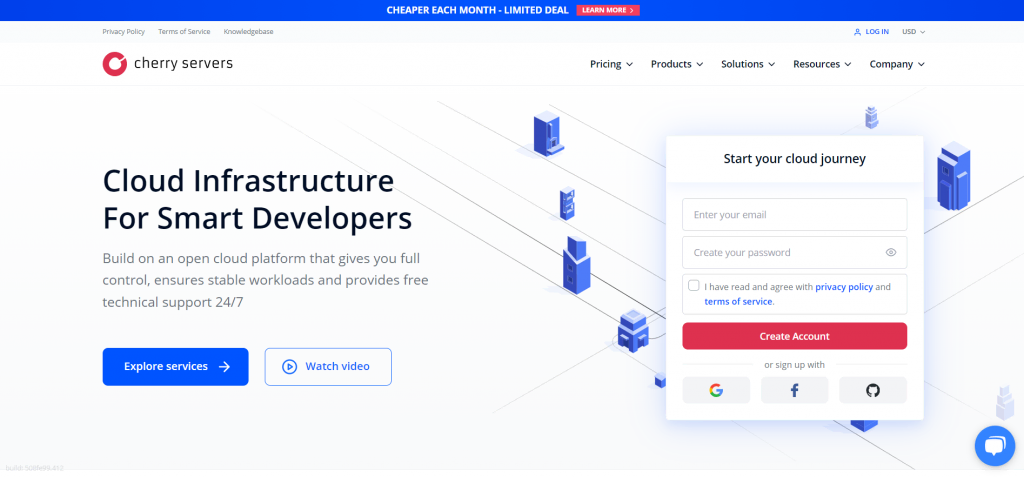
Cherry Servers offers pre-configured and fully custom bare metal servers designed for a range of light to heavy workloads. It allows users to start with a base configuration and add components as needed.
- Performance: Basic servers start with four CPU cores at 3.5 GHz.
- Memory: Begins at 32 GB of RAM, with options to expand.
- Bandwidth: Provides 1 to 3 Gbps bandwidth with included DDoS protection.
- Customization: Supports full customization of the platform, RAM, storage, and other hardware components.
- Storage: Offers scalable storage options with free backups included.
- Automation: A fully automated platform allows for the management of server resources.
Price: Lightweight server plans start at $104 monthly.
4. Hivelocity
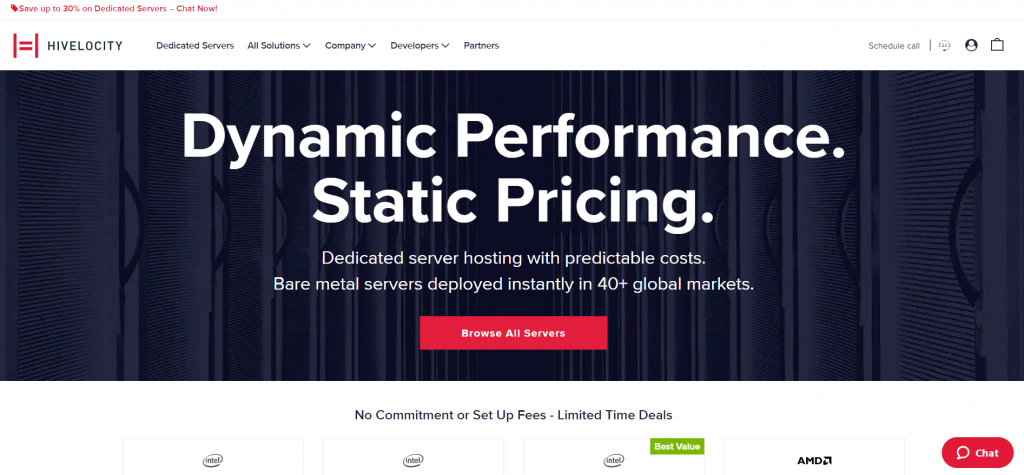
Hivelocity provides on-demand bare metal servers powered by Intel and AMD, focusing on rapid deployment and global availability.
- Deployment: Instant servers can be provisioned and deployed within 20 minutes.
- Performance: Basic server configurations include 3.5 GHz processors.
- Memory: Starts with 32 GB of RAM.
- Network: Operates in over 36 global locations and offers a 99.9% connectivity guarantee.
- Management: Includes a control panel for tasks like bandwidth monitoring and a REST API for configuration.
- Support: Plans include two hours per month of reactive technical support.
Price: Premium plans start at $62 monthly.
5. Scaleway
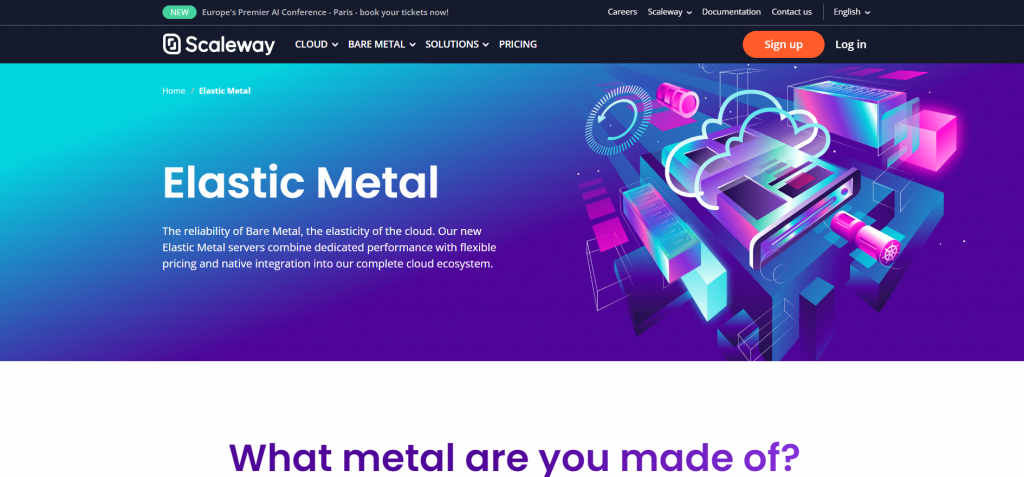
Scaleway offers “Elastic Metal” servers, a bare metal product designed to provide the flexibility and scalability of a cloud environment.
- Server Tiers: Provides five distinct server levels, from “Aluminum” to “Titanium,” each designed for a specific use case.
- Networking: Includes flexible IPs that can be attached or detached on demand and a private network for building secure infrastructure.
- Scalability: Designed for convenient scaling of server capacity up or down.
- Ecosystem: Integrates with other Scaleway products, including managed instances and databases.
Price: The basic Aluminum plan starts at roughly $46.57 monthly.
6. Amazon Web Services
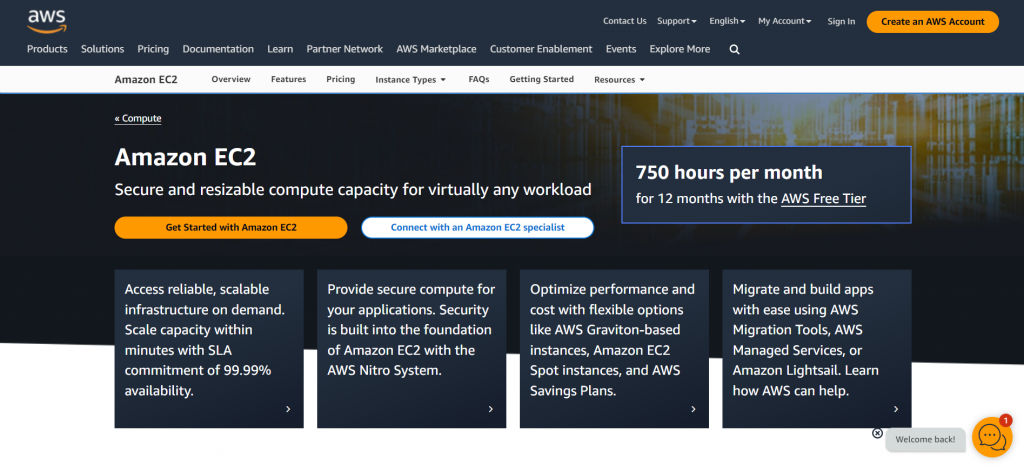
Amazon Web Services provides bare metal instances as part of its Elastic Compute Cloud (EC2) platform, allowing direct processor and memory access for high-performance applications.
- Processors: Powered by Intel® processors.
- Availability: Offers a 99.99% uptime guarantee through the use of multiple availability zones.
- Customization: Provides root-level access with support for various operating systems, including Windows and Linux distributions like Ubuntu and SUSE.
- Billing: Features per-second billing and offers discounted “Spot” instances that utilize unused capacity.
- Management: EC2 instances can be hibernated and resumed based on usage and include time synchronization services.
Price: Request a quote for the most accurate pricing.
Get 50% off 3 months
Experience peak performance with dedicated resources & lightning-fast load times
7. HorizonIQ (formerly INAP)
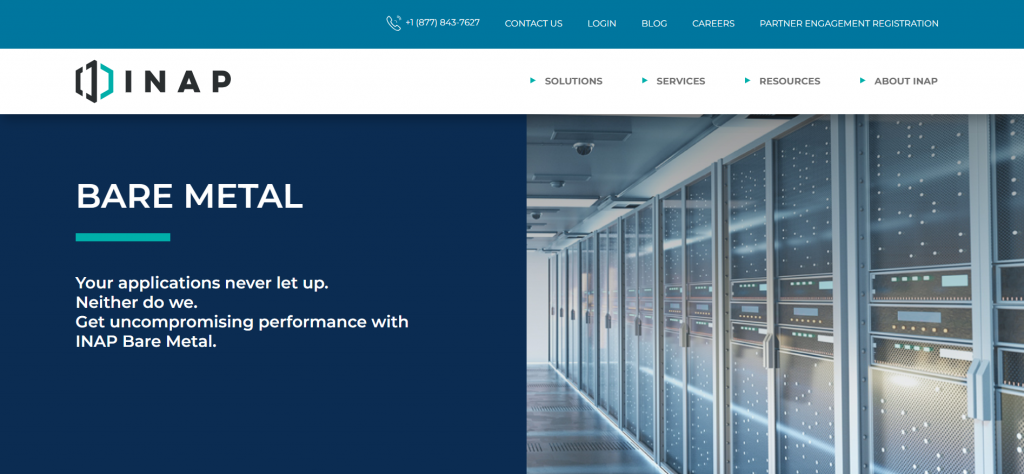
INAP, now known as HorizonIQ, delivers high-performance bare metal servers with a strong focus on integrated security and data protection services.
- Performance: Utilizes NVMe storage for high performance and low latency.
- Bandwidth: Includes 10 TB of monthly data transfer.
- Security: Offers extensive data protection features, including cloud backups, data seeding, and insider protection against malware.
- Global Presence: Operates data centers across North America, Europe, and Asia.
Flexibility: Provides both instant-deploy and fully custom server options, supporting standard Windows/Linux images or user-provided images.
Price: The budget-friendly server plan starts at $100 monthly.
8. RedSwitches
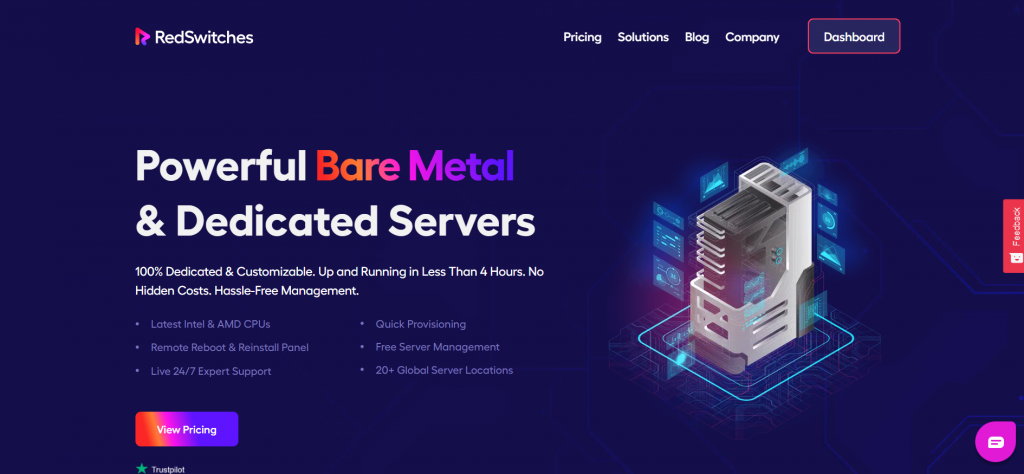
RedSwitches provides fully managed bare metal server solutions, handling all aspects from hardware setup and troubleshooting to ongoing maintenance.
- Deployment: Offers instant servers that deploy in minutes, as well as fully customizable builds.
- Management: Services include hardware setup, troubleshooting, rebooting, and 24/7 server monitoring. Note that API access and a control panel are not offered.
- Security: Includes malware scanning and DDoS protection.
- Support: Provides round-the-clock technical support.
- Network: Has a worldwide presence with data centers across the U.S., Europe, Asia, and Australia.
Price: Servers start at roughly $40.05 monthly with annual billing.
9. OpenMetal
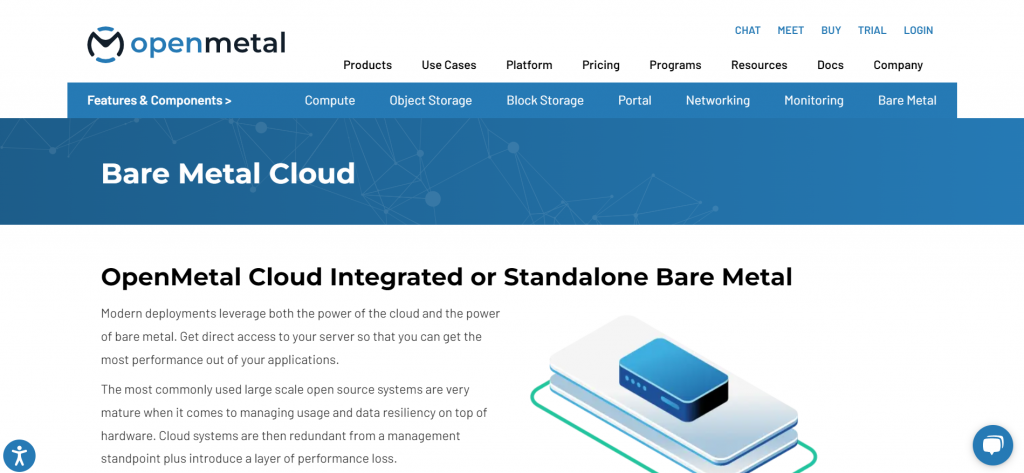
OpenMetal offers bare metal as a service with a focus on powerful, custom-built private cloud infrastructure.
- Standard Hardware: A typical server configuration includes 16 CPU cores.
- Memory: Supports up to 1 TB of RAM for high-performance computing.
- Storage: Standard builds come with 3.2 TB of NVMe storage.
- Customization: Provides many hardware options beyond the standard fleet to meet specific requirements.
- Ecosystem: Built to support cluster systems like Kubernetes and MongoDB.
Price: Plans cost as low as $356.40 monthly with a five-year agreement.
10. Oracle
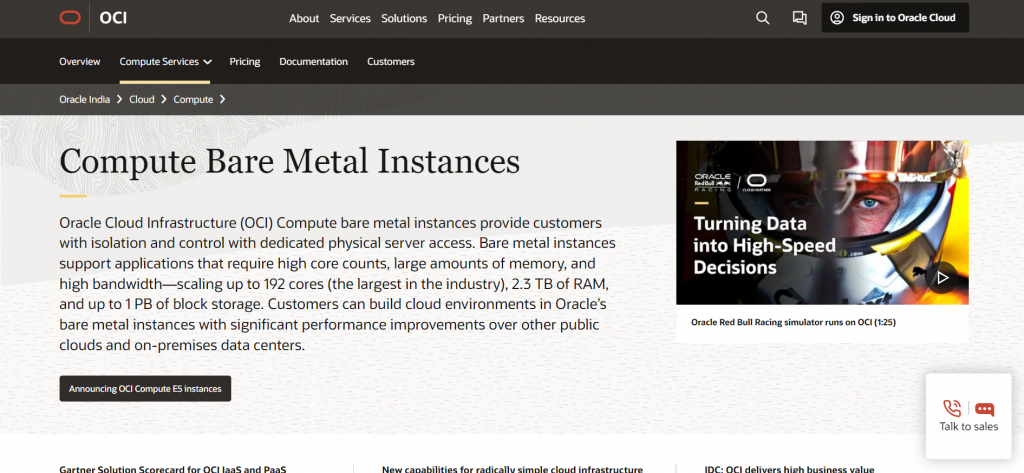
Oracle offers high-performance bare metal instances designed for enterprise-level, compute-heavy workloads requiring a large number of cores and dedicated hardware.
- CPU: Scales up to 192 CPU cores per instance.
- Storage: Provides up to 1 PB of block storage.
- Performance: Built for low-latency cluster networking and optimized for machine learning and AI workloads.
- Security: Employs root-of-trust techniques to secure data and software.
- Integration: Integrates with Oracle services (e.g., Siebel, Hyperion) and supports a range of Windows, Linux, and custom images.
Price: Standard servers start at $0.0015 for every gigabyte per hour.
11. Vultr
Vultr delivers high-performance bare metal servers featuring a high-speed network and the latest processors for handling intensive workloads.
- Network: Provides a dedicated 10 Gbps network and operates servers in over 32 global locations.
- Memory: Offers configurations with up to 25 TB of RAM.
- Processors: Utilizes the latest servers from Intel and AMD.
- OS Support: Supports a wide array of operating systems, including Fedora and OpenBSD, and allows users to upload their own.
- Management: Includes a control panel for managing teams, API access, and identity through single sign-on (SSO).
Price: Basic servers start at $120 monthly.
Choosing the right bare metal cloud provider
Now you know that every bare metal hosting provider is a bit different and how to consider your data processing needs, budget, and resource requirements to choose the right host.
With Liquid Web, you get a high performance bare metal cloud server with unlimited incoming bandwidth and round-the-clock IT support. The enterprise-tailored plans deliver you a stress-free cloud experience paired with the reliability and security of dedicated hardware.