◦ Setup in under 1 hour
◦ User-friendly API
Bare Metal → Security
How bare metal servers improve security
Why businesses are turning to bare metal for security
Security concerns are no longer just for enterprise IT teams. Small businesses, healthcare providers, ecommerce shops, and startups are all facing increased pressure to protect customer data and comply with regulations.
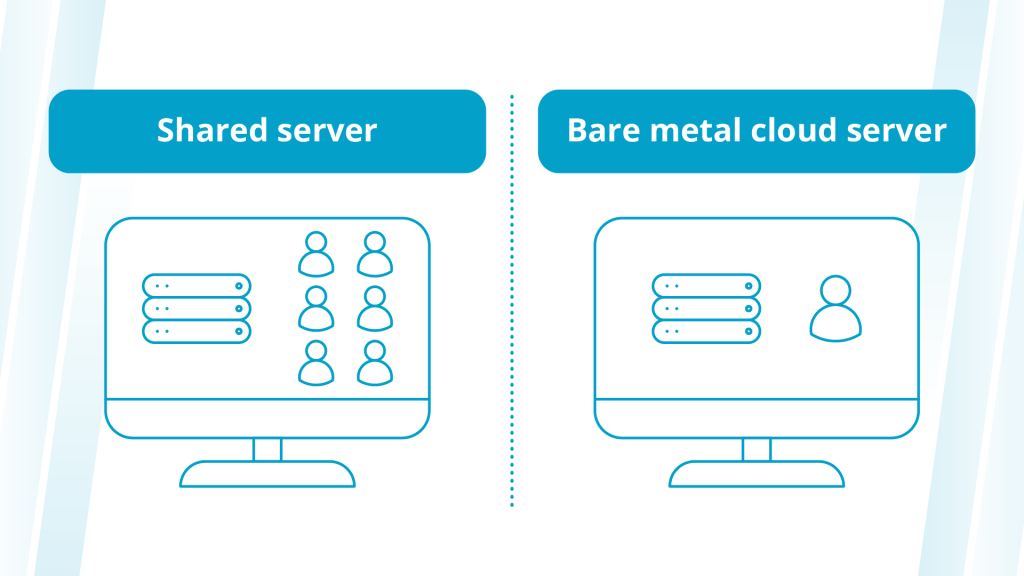
Many of these threats—like hypervisor attacks, data leakage, or noisy neighbor vulnerabilities—stem from shared environments.
That’s where bare metal servers come in. Unlike public cloud instances, bare metal servers give you complete control of an entire physical machine. No hypervisors, no shared infrastructure, no mystery tenants.
2. Granular control over security architecture
When you rent a bare metal server, you don’t just get access to the operating system, you get full control of the entire hardware and software stack. That means:
- You choose the OS and configure it from the kernel up.
- You control which ports are open, what services are running, and how users authenticate.
- You can set up custom firewalls, intrusion detection systems (IDS), and security rules.
- You can segment networks to isolate traffic and limit exposure.
Compare that to a VPS or cloud instance, where some features (like BIOS settings, host-level firewalls, or firmware patches) may be outside your reach. With bare metal, if you want to lock it down, you can.
3. Reduced attack surface compared to virtualized environments
Virtualization introduces additional layers of software that must be secured and maintained. These layers (hypervisors, virtual switches, cloud APIs, etc.) can be exploited if not patched or configured properly. Each one adds complexity, and complexity increases the chances of a security hole being missed.
Bare metal strips all that away. With no virtualization layer, there are:
- Fewer interfaces exposed to the internet
- Fewer default services running
- No inter-VM traffic that could be sniffed or hijacked
That reduction in attack surface is one of the most compelling reasons to choose bare metal for sensitive workloads. It’s a simpler system with fewer moving parts, and that makes it easier to secure.
4. Hardware-level security advantages
Bare metal servers also allow for deeper integration with hardware-based security features that aren’t always available in virtualized environments. These include:
- Trusted Platform Module (TPM): A physical chip that stores cryptographic keys and verifies system integrity
- Secure Boot: Ensures only signed and verified operating systems can start on your server
- Out-of-band management tools (like IPMI or iDRAC): Let you monitor, update, and lock down the server at the firmware level
- Disk-level encryption with BIOS lockdown: Keeps data protected even if drives are removed or stolen
When you control the hardware, you control every aspect of how that hardware is secured.
5. Easier path to compliance
If your business needs to meet regulatory standards like PCI DSS (for payment data), HIPAA (for health data), or GDPR (for EU customer data), bare metal can make compliance easier in several ways:
- Isolation: No tenant crossover means you don’t have to prove your neighbors are secure.
- Data locality: You know exactly where your data resides—down to the rack and drive.
- Auditability: You can generate complete logs across every layer of your infrastructure.
- Customization: You can build the exact controls required by your compliance frameworks.
Virtual environments often require extra compensating controls to meet these same standards. With bare metal, the foundation is already secure.
Common use cases where security matters most
Bare metal servers aren’t just for the enterprise. They’re used by organizations of all sizes that need to protect sensitive data, isolate workloads, or comply with strict rules. Some common scenarios include:
- Healthcare platforms hosting electronic health records (EHRs)
- Finance or banking apps processing transactions or storing account data
- Ecommerce stores handling credit card information and order histories
- SaaS businesses deploying multi-tenant applications with hard tenant isolation
- IoT and edge deployments where local processing must be secured on dedicated hardware
- Government contractors managing classified or compliance-bound systems
If security is a priority, bare metal is a strong fit, no matter the size of your organization.
Why misconfiguration matters: user responsibility on bare metal
There’s a catch: bare metal puts you in the driver’s seat. That control also comes with responsibility.
- If you don’t apply security patches, no one will do it for you.
- If you expose SSH or RDP to the public internet, you’re the one who has to lock it down.
- If you forget to back up your data or implement monitoring, there’s no safety net.
Bare metal is more secure if it’s properly configured. It’s not “secure by default” like some managed cloud environments. But for teams that are willing to put in the effort, it offers unmatched security potential.
Actually, an even easier solution is managed bare metal servers. Managed hosting adds an extra layer of service and support that enables your service provider to take care of all the technical server stuff, like installs, security monitoring, patches, server management, etc.
Key advantages over VPS or cloud instances
Let’s recap how bare metal compares to other common hosting environments:
| Feature | Bare Metal Server | Shared Cloud Instance |
|---|---|---|
| Physical Isolation | Yes | No |
| Hypervisor Attack Risk | None | Present |
| Admin Control | Full | Limited to OS level |
| Hardware-Level Security | Fully customizable | Often abstracted or restricted |
| Compliance Compatibility | Easier to demonstrate | Harder to isolate tenant data |
| Shared Resources | None | Yes (CPU, memory, I/O, etc.) |
FAQ: bare metal server security
Next steps for improving security with bare metal servers
Bare metal servers give businesses unmatched control over their infrastructure, which is perfect for isolating sensitive workloads and reducing risks from shared environments. (But the security benefits only shine when the environment is properly configured and maintained.)
When you’re ready to upgrade to a dedicated server—or upgrade your server hosting—Liquid Web can help. Our bare metal server hosting options have been leading the industry for decades, because they’re fast, secure, and completely reliable. Choose your favorite OS and the management tier that works best for you.
Click below to explore dedicated bare metal server options or start a chat with one of our experts to learn more.
Additional resources
Bare metal vs hypervisor →
Key differences between bare metal and hypervisors, and some of their best functions and use cases
What is bare metal programming? →
Benefits, challenges, use cases, and more
IaaS vs bare metal →
Definitions, differences, and how to choose

Zachary Armstrong is a writer who specializes in breaking down complex subjects and making them easy to understand. He has a passion for technology, believes it can change the world for the better, and wants to tell the whole world about it.