

 Liquid Web
 Regional banks and credit unions increasingly rely on systems that operate outside their core banking platforms—including customer-facing digital experiences, vendor integrations, analytics tools, and security systems.
While these systems are often labeled “non-core,” their impact on customer trust, regulatory posture, and operational risk is significant.
This brief outlines a practical, examiner-safe framework for determining where systems should live, how they should be governed, and how institutions can innovate without increasing risk.
The premise: systems that don’t belong inside the core still require dedicated, isolated infrastructure with clear accountability, predictable performance, and audit-ready documentation.
The challenge institutions face
Most infrastructure decisions have historically been framed as a binary choice:
- Core systems (highly controlled, standardized)
- Everything else (often treated as lower risk)
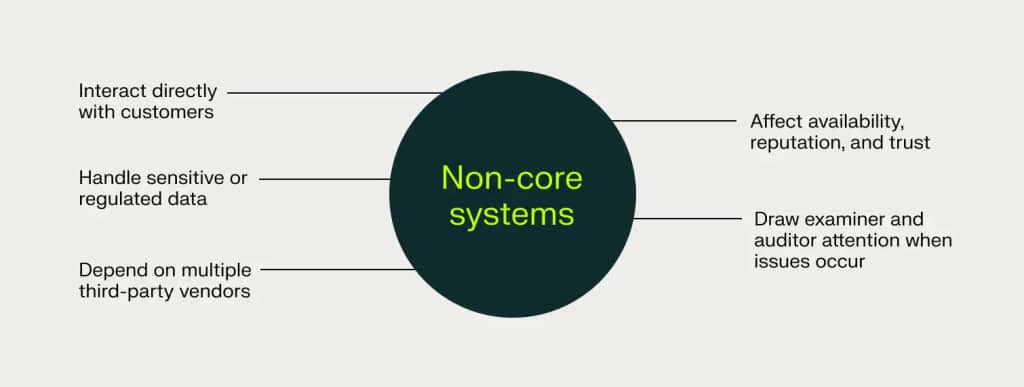
That model doesn’t reflect the current reality. Today, many non-core systems:
- Interact directly with customers
- Handle sensitive or regulated data
- Depend on multiple third-party vendors
- Affect availability, reputation, and trust
- Draw examiner and auditor attention when issues occur
The risk comes from placing these systems on infrastructure that can’t be clearly governed, examined, or defended—where performance is unpredictable, accountability is fuzzy, and failures spread farther than anticipated.
How examiners actually evaluate systems
Examiners do not assess systems based on whether they’re core or non-core. They evaluate systems based on whether the institution can clearly demonstrate:
- Risk awareness
- Appropriate controls
- Clear ownership and accountability
- Documented responsibilities
- Effective monitoring and incident response
Examiners ask:
- Why does this system live where it does?
- Who owns it?
- How is risk mitigated?
- How does it behave under pressure?
- How do you know it’s working as intended?
Infrastructure decisions that cannot answer these questions create regulatory exposure.
The role of first-class infrastructure

This level of rigor is standard for core platforms. Non-core, mission-critical systems require it too.
Common categories of non-core, mission-critical systems
Institutions most often see this challenge in these areas:
Customer-facing digital systems
Public websites, digital experience layers, onboarding tools, and marketing platforms are often the first systems customers interact with—and the first scrutinized when availability or security issues arise.
Vendor and integration ecosystems
Fintech vendors, middleware, APIs, and data exchanges enhance capabilities but expand the third-party risk surface when the responsibility for infrastructure isn’t clear.
Innovation and pilot environments
New tools require testing or validation outside the core. Without controlled environments, pilots can introduce risk unintentionally.
Sensitive or special-purpose workloads
Fraud analytics, digital forensics, security tooling, and regulatory reporting systems often demand heightened controls despite operating outside core processing platforms.
None of these systems typically belong in the core. All of them require infrastructure with clear ownership and predictable performance.
A common (and understandable) mistake
When faced with these pressures, institutions often default to one of two approaches:
- Forcing non-core systems into the core platform. This slows innovation and stretches core platforms beyond their intended purpose.
- Placing non-core systems on generic or shared infrastructure. This can create hidden risks that surface during incidents, audits, or exams.
Neither approach reliably produces clear, defensible answers to examiner questions. Shared infrastructure makes it harder to demonstrate predictable behavior, trace accountability, or explain what happened when questions pop up.
Introducing an intentional architecture model
A more durable approach is intentional architecture—placing systems based on function, risk, and control requirements rather than convenience.
This model recognizes three realities:
- Core platforms exist to protect stability and standardization
- Not all important systems belong inside the core
- Non-core systems can still meet the same standards of rigor and accountability

What this enables for the institution
When non-core systems are supported by first-class, dedicated, isolated infrastructure:
- Security teams gain clearer responsibility boundaries and documented controls
- Compliance teams gain audit-ready documentation aligned to regulatory frameworks
- IT teams gain predictable performance and fewer emergency escalations
- Executives gain confidence that growth doesn’t create hidden risk or cost uncertainty
- Boards gain clarity and can trust that infrastructure decisions are solid
A common, defensible narrative emerges: ‘We deliberately separate core and non-core systems, while applying appropriate controls to both.
The role of Liquid Web
Liquid Web supports this model by providing dedicated, compliance-ready infrastructure designed for non-core, mission-critical systems in regulated environments.
Our focus:
- Dedicated, isolated environments that eliminate shared risk and performance variability
- Clear responsibility models with no ambiguity about who owns what
- Predictable performance that doesn’t depend on other workloads
- Audit-ready documentation aligned to regulatory frameworks
- Expert support from teams who understand regulated environments and compliance realities
We don’t replace core banking platforms. We provide the infrastructure and expertise that let institutions run everything around the core with confidence.
The takeaway
Non-core systems influence customer trust, shape regulatory posture, and create or mitigate institutional risk.
Treating them as first-class means providing dedicated infrastructure with clear accountability, predictable performance, and complete visibility.
That’s infrastructure leaders can trust.
A new way to think about cloud decisions in regulated financial institutions.
Regional banks and credit unions are running more technology than ever before: customer-facing websites, digital onboarding tools, vendor integrations, analytics platforms, security tooling, marketing systems, and regulatory reporting environments.
None of these are the core. But when they fail, the consequences are real.
This is where many institutions feel stuck. They know certain systems don’t belong inside their core banking platform, but they also know those systems are too important to be treated casually.
That tension is where infrastructure decisions break down—and where unclear accountability, unpredictable performance, and hidden risk quietly accumulate.
Non-core does not mean low-risk
For years, infrastructure decisions have been framed simply:
Core systems = critical
Everything else = supporting
That mental model doesn’t hold water anymore.
Today, many non-core systems:
- Touch customers directly
- Influence trust and perception
- Carry sensitive data
- Trigger regulatory scrutiny
- Create brand and reputational risk when they fail
A public website outage during peak activity. A broken integration during account opening. A misconfigured vendor environment exposed to the internet.
None of these live in the core, but all of them create board-level problems.
Regulators evaluate systems based on risk, controls, accountability, and impact—not whether they’re core or non-core.
The issue: these systems often run on shared infrastructure that wasn’t designed for their importance—creating unpredictable performance, unclear accountability, and hidden risk that surfaces during incidents and exams.
Why this gap exists (and why it’s growing)
This problem comes from structural reality, not bad decisions.
Core banking platforms are designed—correctly—to:
- Protect the ledger
- Maintain stability
- Standardize environments
- Satisfy regulators at scale
- Move cautiously by design
That conservatism is a feature. But it creates a boundary.
As institutions add more digital capabilities, the number of systems that must exist outside the core keeps growing—while expectations for security, performance, and auditability keep rising.
The result: a growing class of systems that are:
- Too important for shared or commodity hosting
- Too flexible to live inside the core
- Too regulated to be treated as just IT”
All critical systems, regardless of where they live, require appropriate controls, documentation, and oversight.
This is the gap that Specialty Cloud exists to fill. Infrastructure designed specifically for non-core, mission-critical systems
What we mean by first-class infrastructure
First-class infrastructure in regulated environments means:
Dedicated resources—your workload runs exclusively on infrastructure that serves you, eliminating performance variability caused by shared resources
Intentional isolation—failures are contained within clear boundaries, not shared across unrelated systems
Predictable performance—your system’s responsiveness doesn’t depend on other tenants’ activity or unexpected demand spikes
Clear accountability—ownership is documented and doesn’t shift during incidents or audits
Complete visibility—you can explain how the system operates, performs under pressure, and behaves when things go wrong
Audit-ready documentation—controls and architecture are documented and aligned to regulatory frameworks, not retrofitted after the fact
Infrastructure decisions should clearly answer:
- Who owns the system?
- Who is responsible for security and patching?
- How access is controlled and monitored?
- How incidents are detected, escalated, and resolved?
- How data is protected, backed up, and recovered?
First-class infrastructure supports those answers by design — not by exception. When non-core systems run on this infrastructure, institutions gain confidence that innovation and growth aren’t quietly increasing risk.
Where institutions feel this most acutely
Across regional banks and credit unions, we consistently see the same pressure points:
Customer-facing digital systems
Examiner focus: Customer-facing systems are reviewed for availability, data protection, and third-party risk—even when they’re not part of core processing.
Vendor and integration ecosystems
Examiner focus: Third-party risk management requires clear responsibility boundaries between vendors, platforms, and infrastructure providers.
Innovation and pilot environments
Examiner focus: Pilot and test environments fall under review when they handle production data or connect to regulated systems.
Sensitive, special-purpose workloads
Examiner focus: Fraud detection, investigations, and regulatory reporting systems are evaluated for data integrity, access control, and retention—regardless of where they’re hosted.
None of these systems belong in the core.
All of them deserve better than an afterthought.
The mistake many institutions make
When faced with this gap, institutions often default to one of two extremes:
- Force everything into the core. Slowing innovation, increasing friction, and stretching platforms beyond their intent.
- Push non-core systems onto generic or shared infrastructure. Creating hidden performance, security, and audit risks that surface later.
Examiners care less about where a system lives than whether the institution can clearly explain why it lives there, how it’s controlled, and how risk is mitigated.
Introducing the role of Specialty Cloud
Specialty Cloud describes infrastructure designed specifically for non-core, mission-critical systems in regulated environments.
Its role:
- Run systems that shouldn’t live in the core
- Meet the same standards of rigor and accountability
- Support innovation without increasing institutional risk
- Provide clear ownership and responsibility boundaries
- Deliver predictable performance through dedicated, isolated resources
- Give complete visibility into how systems operate and perform
In practice, this means dedicated infrastructure where:
- Your workload doesn’t compete with other tenants for resources
- Performance is predictable under pressure
- Accountability is clear and documented
- Failures are contained, not shared
- Examiners can trace responsibility without ambiguity
This approach demonstrates intentional architecture—systems are placed based on risk, function, and control, not convenience. Specialty Cloud exists so institutions don’t have to choose between progress and prudence.
What this enables (beyond technology)
When non-core systems are treated as first-class:
- Security teams gain clearer responsibility models
- Compliance teams gain better documentation and audit readiness
- IT teams gain predictable performance and fewer fire drills
- Executives gain confidence that growth isn’t creating hidden exposure
- Boards gain clarity instead of surprises
Board-level narrative: ‘We’ve deliberately separated core and non-core systems while applying appropriate controls to both.’
This is an organization confidence upgrade, not just a technical one.
A more durable way forward
The future of infrastructure in regulated financial institutions is not everything in the core or everything in the cloud.
It is intentional architecture:
- Core platforms where standardization and stability matter most
- Specialty Cloud infrastructure where non-core systems demand first-class treatment
Institutions that adopt this mindset move faster because they manage risk better, not because they take more risk.
Where Liquid Web fits
Liquid Web provides dedicated, compliance-ready infrastructure designed specifically for non-core, mission-critical systems in regulated environments.
We help regional banks and credit unions by providing:
- Dedicated, isolated environments. Your workload runs on infrastructure that serves you exclusively, eliminating shared risk and performance variability.
- Predictable performance. Your system’s responsiveness doesn’t depend on other tenants’ activity—performance stays consistent under pressure.
- Clear responsibility models. Ownership is documented and doesn’t shift during incidents. You know who to call, and they know your environment.
- Audit-ready documentation. Controls and architecture are documented and aligned to regulatory frameworks, not retrofitted after the fact.
- Expert support. Direct access to engineers with deep environment knowledge who understand regulated institutions and compliance realities.
Our approach emphasizes transparency, clear responsibility models, and documentation that makes infrastructure decisions easier to explain and defend.
We don’t replace core platforms. We provide the infrastructure and expertise that let institutions run everything around the core with confidence.
The takeaway
Non-core systems shape customer trust, influence regulatory posture, and create or prevent institutional risk.
Treating them as first-class means providing dedicated infrastructure with clear accountability, predictable performance, and complete visibility.
Optional closing line (strong for exec audiences)
The safest infrastructure decisions are not the ones that avoid change–they’re the ones that can be clearly explained, documented, and defended when it matters most.