

◦ Comprehensive security
◦ 24/7 support
Financial Services → Cost Of Getting It Wrong
Financial services hosting: the cost of getting it wrong
Financial institutions run in a zero-margin-for-error environment. Customers expect instant access to accounts, frictionless payments, and airtight data security. Hosting is the foundation of that speed and reliability, which means downtime is expensive.
A lot of companies think that the negative hit to their bottom line during downtime comes from the lost opportunity to sell, but that’s just a small portion. When the site goes down, revenue takes a hit from multiple angles:
- The sell
- Customer loss
- Customer acquisition stalling
- Reputational damage
- The long-term strain on internal resources
- Regulatory penalties
- Competitive opportunity costs
What looks like $10K in lost revenue may actually be $100K+ across all five buckets.
Let’s break down each one and make sure it doesn’t happen to your organization.
Get fast, reliable hosting for financial services
Power your site with the industry’s fastest, most optimized financial services hosting

2. Lifetime value of a lost customer
Retention costs less than acquisition, but in financial services, churn is especially damaging. Among U.S. banks alone, customer churn costs about $195 billion every year.
Customers who experience repeated downtime, app crashes, or a breach don’t just leave—they take their deposits, investments, and trust with them. Winning them back is nearly impossible.
Hosting platforms designed for redundancy, compliance, and advanced security give customers confidence to stay.
- Redundancy ensures services remain up even if a component fails.
- Compliance frameworks prove to regulators and customers that sensitive data is protected according to strict standards.
- Advanced security—such as firewalls, intrusion detection, and real-time monitoring—means threats are identified and contained before they disrupt customers.
3. The impact on customer acquisition
Growth depends on credibility. When compliance gaps or repeated outages surface, institutions lose their eligibility for new partnerships, fintech integrations, or expansion into regulated markets.
Even the perception of instability raises questions from potential clients, which carries significant financial implications. Consider the average CLV for your business—thousands per customer for a retail bank or the average fintech brand, to tens of thousands for mortgage lenders and enterprise SaaS providers.
Hosting with PCI DSS or SOC 2 certifications signals to the market that your institution is stable and trustworthy. These certifications demonstrate that your provider follows industry-accepted practices for handling sensitive data, maintaining system reliability, and securing customer transactions.
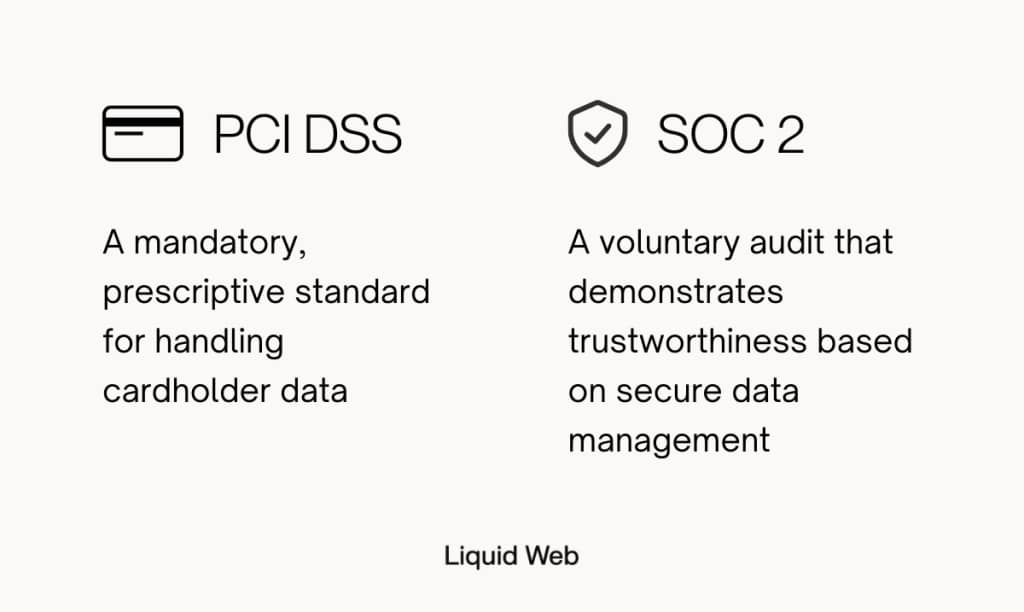
To a potential partner or regulator, they serve as a third-party seal of approval. For your business development team, that reduces friction in the sales cycle, because compliance questions are answered before they’re even asked.
4. The reputational fallout
A single outage or data breach can dominate headlines, wipe millions off brand value, and trigger regulator scrutiny. Once public trust erodes, you end up spending more marketing dollars trying to fix the reputation loss, instead of generating awareness.
Choosing hosting with strong firewalls, encryption, and proactive threat monitoring is as much about protecting your brand as your infrastructure.
- Firewalls control and filter traffic, blocking suspicious behavior before it enters your systems.
- Encryption scrambles sensitive data, making it useless to attackers even if it’s intercepted.
- Proactive monitoring means experts are watching for unusual activity 24/7 and can shut down attacks in real time.
It takes 10, five-star reviews to bounce back from a single, one-star review. A serious outage can create more than one negative review.
5. The drain on time, effort, and energy
When IT teams spend most of their hours patching vulnerabilities or firefighting outages, strategic growth falls behind. The opportunity cost is massive: revenue-generating activities, like mobile banking enhancements or AI-driven personalization, get sidelined in favor of “keeping the lights on” and fixing problems.
Managed hosting with compliance baked in eliminates much of this drain. Managed services mean your hosting provider handles software updates, patching, backups, and system monitoring.
Instead of constantly firefighting, your IT staff can focus on deploying new apps, exploring AI, or improving digital services—initiatives that actually move the business forward.
6. The regulatory and legal risks
Financial regulators increasingly treat IT infrastructure as a compliance matter. Hosting that fails to meet standards like PCI DSS or SOC 2 opens institutions to fines, audits, and—in extreme cases—license restrictions.
The cost of a data breach continues to grow, year over year. The most recent report put the average cost of a data breach, for a financial organization, at about $4.88 million.
Working with a provider that already maintains these certifications removes compliance friction. Instead of scrambling to prove controls, financial firms can focus on demonstrating performance and customer service to regulators.
7. The competitive opportunity cost
Infrastructure gaps slow innovation as well. While competitors roll out digital lending platforms or AI-driven investment tools, firms stuck in outage cycles can’t compete. The longer the delay, the harder it is to regain market position.
Hosting built for agility and scalability ensures firms can focus on launching the next feature set, not patching yesterday’s problems. This lets product teams move faster, whether that’s rolling out a new mobile app feature or expanding into new regions, instead of being constrained by infrastructure bottlenecks.
How to get financial services hosting right
The risks are real, but the path forward is straightforward. Institutions should evaluate hosting providers on several non-negotiables:
Check for SLA-backed performance guarantees
Uptime commitments are written into service level agreements (SLAs). A 99.99% SLA means your systems can’t be down for more than about 4 minutes per month. That guarantee forces the provider to build in backup systems and monitoring so your services stay online even during equipment failures.
Ask about certifications such as PCI DSS and SOC 2
These certifications are independent validations that a hosting provider follows strict security and availability controls.
For example, PCI DSS covers how payment data is stored and transmitted, while SOC 2 verifies operational processes. Using a certified provider means auditors accept their reports as proof, cutting your compliance burden significantly.
Look for encryption, DDoS protection, and advanced firewalls
Encryption ensures that even if sensitive financial data is intercepted, it can’t be read without the key. DDoS protection absorbs or reroutes malicious traffic so attackers can’t flood your systems with fake requests. Firewalls filter traffic in and out, allowing only legitimate connections. Together, these tools form the frontline defense that customers and regulators expect.
Verify 24/7 expert support
Financial transactions don’t keep office hours, and neither do attackers. Around-the-clock support means when something goes wrong, an expert can start troubleshooting immediately. That reduces downtime and reassures both your team and your customers that problems won’t linger.
Make sure redundant infrastructure and disaster recovery are built in
Redundancy means every critical system has a backup, often in a separate data center. If one server or site goes offline, another instantly takes over. Disaster recovery planning extends this concept to larger failures, such as regional outages, ensuring customer transactions continue even in worst-case scenarios.
Financial services hosting FAQ
Next steps for financial services hosting
Getting financial services hosting right is about protecting revenue, reputation, and growth opportunities. The risks of poor hosting ripple through every part of the business, but with the right provider, the opposite is true: hosting becomes a competitive advantage.
The next step is simple: evaluate whether your hosting partner can meet compliance, uptime, and scalability needs today and in the future. If they can’t, it’s time to consider alternatives.
When you’re ready to upgrade, Liquid Web can help. Liquid Web’s financial services hosting solutions combine PCI DSS–certified infrastructure, redundancy, advanced security, and industry-leading SLAs. With 24/7/365 support and built-in compliance safeguards, we help financial institutions eliminate hosting risk and focus on growth.
Click through below or start a chat now with a financial services hosting expert to learn more.
Financial services hosting solutions
Enhanced security
Compliance ready
Multiple management tiers
Additional resources
What is financial services hosting? →
A complete beginner’s guide
The future of financial services hosting →
AI, ML, and edge computing
How to choose a hosting provider →
10 tips for financial services hosting

Philip Palmer is a proud husband and father, and has been Director of Sales at Liquid Web since 2022. His commitment to client partnerships and dedication to excellence enable him to help clients create measurable business growth. A decorated Marine himself, Philip is also the founder and Executive Director of WarriorWOD—a nonprofit that serves to provide hope and holistic PTS recovery for veterans.