

How Does a CDN Work to Speed Up Your Ecommerce Site?
How Does a CDN Work
The acronym CDN stands for Content Delivery Network which is used to serve content around the world from the closest and faster web server for the requestor, based on geographic proximity. This performance is gained by distributing web servers geographically for worldwide coverage.
The network of Origin Servers and distributed Edge Servers caches static content from the primary server thereby reducing web traffic and load on the main servers, letting them run more efficiently. Such a design speeds web page load time, when pulling down content for the requestor.
Read more in the What is a Content Delivery Network (CDN)? article, which defines a CDN in this way:
A Content Delivery Network (CDN) is an interconnected system of servers that are strategically placed in multiple geographic locations around the world. A CDN improves load times for your website and provides faster delivery of content to numerous users by duplicating the content on multiple servers known as edge servers and directing the content according to a user’s geographic location.
Using a CDN allows you to reduce traffic load to your site while also improving front end performance by speeding up the loading time for static assets. When a web browser loads a page using a CDN, the bulk of the data transferred will come from a server close to them geographically. CDN services also implement excellent caching of assets that allows them to respond to requests faster than a normal web server typically will. There are several specific terms associated with CDNs.
How Does a CDN Work: CDN Efficiency Explained
Through optimizations that range from increasing the number of sources, their closeness, and caching content for easy retrieval, CDNs make the process of delivering content online more efficient.
This is essential to the modern web, which has become dominated by high resolution images and video, streaming audio, and beautiful animations.
Most hosting providers include a CDN in their plans. If that is not the case, a provider like Cloudflare can be helpful.
CDN Example
You may be interested in learning how efficiency is gained by the CDN as laid out in the CDN Benefits & Features for Ecommerce blog:
So, how does a CDN work? Think about it this way. In a traditional method of content delivery, everything comes from one source. Compare it to a single stream of water. A stream is usually only a certain width. That means that you’re getting water at the rate that the flow can deliver.
If you want to fill up a tub, several factors come into play. If the source is far away from the tub, it could take a long time for the water to begin filling up.
And since you clear out your tub after every time you use it — like an incognito browser might — you have to repeat the process every time.
And, if you’ve ever filled a pool, you know that a great way to speed up that process is to have several sources of water at once.
Gain more insights by reading the 9 Ecommerce Optimization Tips for Fast & Effective Sites blog.
Why You Need a CDN
After you read the blog related to Why You Need a CDN you will better comprehend why successful websites reply on optimizations factors provided by a CDN:
Improved User Experience
With the images and other assets like video traveling short distances, the user experience improves. Users expect your site to load within two to three seconds, regardless of their connection’s bandwidth.
A WordPress CDN guarantees that your visitors don’t have to wait needlessly for images to arrive. Critical business interactions like purchases happen more quickly and more reliably. After deploying a WordPress CDN, you should see a reduction in shopping cart abandonment and payment interruptions.
Improved Search Engine Optimization
Google recently started using site speed measurements as a ranking factor.
Google measures three main Core Web Vitals:
– Loading speed.
– How fast a user can interact with your site or page.
– Visual stability.
A CDN is crucial for page loads and how fast a visitor can see the relevant content.
The higher your site ranks in the Google search results for specific key phrases, the more likely potential customers will find your site, services, and products.
How Does a CDN Work: General Benefits of CDNs
Learn the General Benefits Most CDNs:
3 CDN Benefits You Can Expect
There are a number of CDN benefits — especially for ecommerce site owners. CDNs are an excellent tool for growing revenue and retaining customers. Let’s walk through these Content Delivery Network features and benefits in the context of Managed WooCommerce hosting.
1. CDNs Boost Page Speed & Conversions
CDN is key to page speed, and as we know, page speed is everything right now.
Slow page load times cost merchants money. In fact, 40% of people abandon a website that takes more than three seconds to load. People don’t like to wait. We are not patient.
By having a fast ecommerce site, you’ll improve your user experience. The longer a potential shopper browses, the more of a chance they’ll add something to the cart, or better yet, they will add multiple things to the cart. In this way, page speed is critical for conversions, or sales.
2. CDNs Can Improve Your Page Ranking
We also have to consider the algorithmic factor.
CDNs increase site speed, which is key to ranking high on Google. Google likes fast sites. Ranking factors today are all about usability and user-friendliness.
To Google, slow page load times are considered a signal of poor experiences. If your site is too slow, your ranking will drop on Google. That means you’ll lose potential new customers and site traffic.
3. CDNs Help You Save on Bandwidth Expenses
In most cases, working more efficiently for your store’s visitors also means your technology is working smarter for you. Using a CDN not only improves page speeds, but it also can save you money in other areas.
For example, consider bandwidth costs in relationship to CDNs. In the tub analogy, you have to pay for every gallon of water you put through.
In this case, CDNs help by adding more sources and managing the fill intelligently.
You usually have a bandwidth recommendation on your hosting plan, and in the case of some hosts, a cap. By managing the delivery of the content better, your CDN also manages your bandwidth expenses better.
How Does a CDN Work: Specific Benefits of the Liquid Web Edge CDN
Learn the benefits of the Liquid Web Edge CDN and its more than 280 worldwide locations:
Liquid Web Edge CDN
Improve page speed with our purpose-built Content Delivery Network. It is integrated into our platforms for easy use without a ton of configuration complexity.
1. Fast
Advanced caching prioritizes your most frequently accessed files, making every site visit as fast as possible.
2. Flexible
Our 280+ Edge locations and features like HTTP/2 or Brotli compression give the advantage on page load time.
3. Secure
Cutting edge security technology and advanced configuration management keep your solution secure.
4. Scalable
A Content Delivery Network capable of supporting the smallest and the largest of sites.
How Does a CDN Work: General Description & Benefits of a Point-of-Presence (POP) Server
End users of, and visitors to, your website can request and receive page/site assets through a Point-of-Presence (POP) server in one of many worldwide locations on the CDN with a set of cached content on “Edge” proxy servers.
How Does a CDN Work: Specific Benefits of the Liquid Web Edge CDN Point-of-Presence (POP) Servers
Learn the benefits of the Liquid Web Edge CDN and its more than 280 POPs:
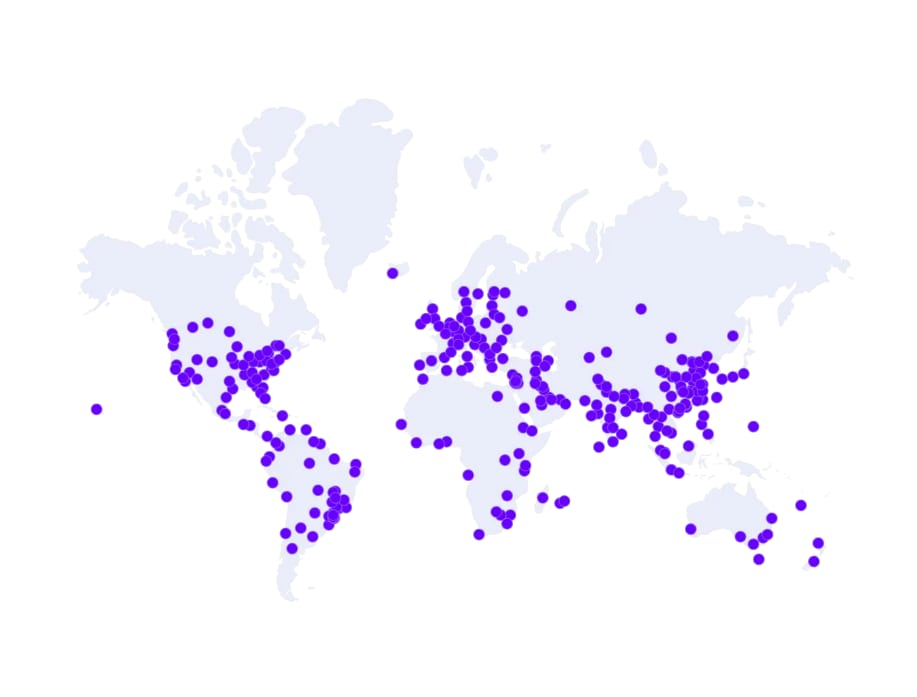
Indeed, you can speed up WordPress with Liquid Web:
It’s important to speed up WordPress if you want your site to rank well on Google, convert, and provide an excellent user experience. Utilize these advanced WordPress optimization techniques to speed up your site and boost performance.
If your WordPress host is not providing you with the speed you need, consider Fully Managed WordPress Hosting from Liquid Web.
Nexcess can make your WordPress site faster with:
– A built-in CDN with 280+ locations.
– Advanced caching for ultra-fast loading.
– Image compression to lower browser load times.
– And much more.
Review our Manage WordPress Hosting Plans and Manage WooCommerce Hosting Plans to get started. In the process remember to consider the different Caching for WordPress options and how to improve website performance in WordPress.
How Does a CDN Work: Origin Servers
An origin server is the server where your assets are stored. Before you can access server assets from the CDN, assets must be retrieved from their origin server. There are two types of origin servers: Customer/Client Origin Servers and CDN Origin
Servers. You can take advantage of multiple origin servers to fulfill your CDN data delivery needs. Each type of origin server is described below.
Origin Servers: Customer/Client Origin Servers
A Customer/Client Origin Server is a web server that is external to the CDN, while a CDN Origin Server is a dedicated CDN storage server from which we allow customers to serve assets. The Customer/Client Origin Server stores content on the web server where your service with Liquid Web resides. The main advantage of a Customer/Client Origin Server is that you do not have to transfer data to another server. All of your data will remain on your Liquid Web server and the CDN will do the rest of the work. This saves you the time it takes to manually upload and maintain data on the CDN.
Origin Servers: CDN Origin Servers
CDN Origin Server refers to the content stored on the storage server inside the CDN network and served to customers by a CDN edge server. The main advantage of a CDN Origin Sever is the data is stored on a server inside the CDN network, which can offer quicker load times initially, but requires more maintenance as you have to upload data to the CDN manually with FTP.
How Does a CDN Work: Edge Servers with Cached Assets & Data
A server on a CDN network that resides in a strategically placed geographic location, and requests data or assets from an CDN Origin Server, and then serves the assets to the client requesting them.
How Does a CDN Work: Purging the CDN
As your original content is refreshed, you will need to learn more about What Does Purge the CDN Mean? Purging the Nexcess CDN, so that your updates are distributed well across the cache on the CDN:
What is Cache on a CDN?
Asset: A resource that contains header information and a body that can be served to a client. Examples of assets are an image, a video, JavaScript, or a CSS file.
A cache is the collection of static files (assets) stored on the edge servers that deliver content to your end users.
So, what do you do if you uploaded new content and need the edge servers to get the latest copy? You purge the CDN cache!
How Does a CDN Work: Bottom Line: CDNs are Essential
As you explore What is a Content Delivery Network? CDN Benefits & Feature, you will understand that CDNs are essential for ecommerce website to have success.