

◦ Fast and secure
◦ GPU options
Gaming GPU preferences in 2025: Budget limits, brand trust, and cloud
As the GPU market evolves, so do gamers’ preferences and expectations. Amid supply shortages, brand rivalries, and the rise of cloud gaming, Liquid Web surveyed 1,000 PC gamers to uncover what drives today’s graphics card decisions.
This study explores how price, performance, and platform shifts like AI and cloud computing are affecting loyalty, value perception, and the future role of high-end GPUs.
AI upscaling is one such shift. This machine learning technology enhances lower-resolution frames by predicting and generating higher-resolution detail in real time. Alongside cloud gaming, it’s changing how gamers evaluate upgrade needs.
From budgeting limits to brand trust, our findings offer actionable insights into the priorities and pain points of modern PC gamers.
Key findings
- Nearly 3 in 4 gamers (73%) would choose NVIDIA if all GPU brands performed equally.
- 57% of gamers have been blocked from buying a GPU due to price hikes or scalping, and 43% have delayed or canceled purchases due to other life expenses like rent and bills.
- Over 1 in 4 gamers (25%) say $500 is their maximum budget for a GPU today.
- Nearly 2 in 3 gamers (62%) would switch to cloud gaming full-time if latency were eliminated, and 42% would skip future GPU upgrades entirely if AI upscaling or cloud services met their performance needs.
Performance, price, and brand loyalty drive decisions
Gamers aren’t just buying GPUs based on brand loyalty. They’re also weighing performance, price, and trust. Among respondents, 36% had switched brands during a GPU upgrade, with 78% citing performance and 69% citing price as the top reasons.
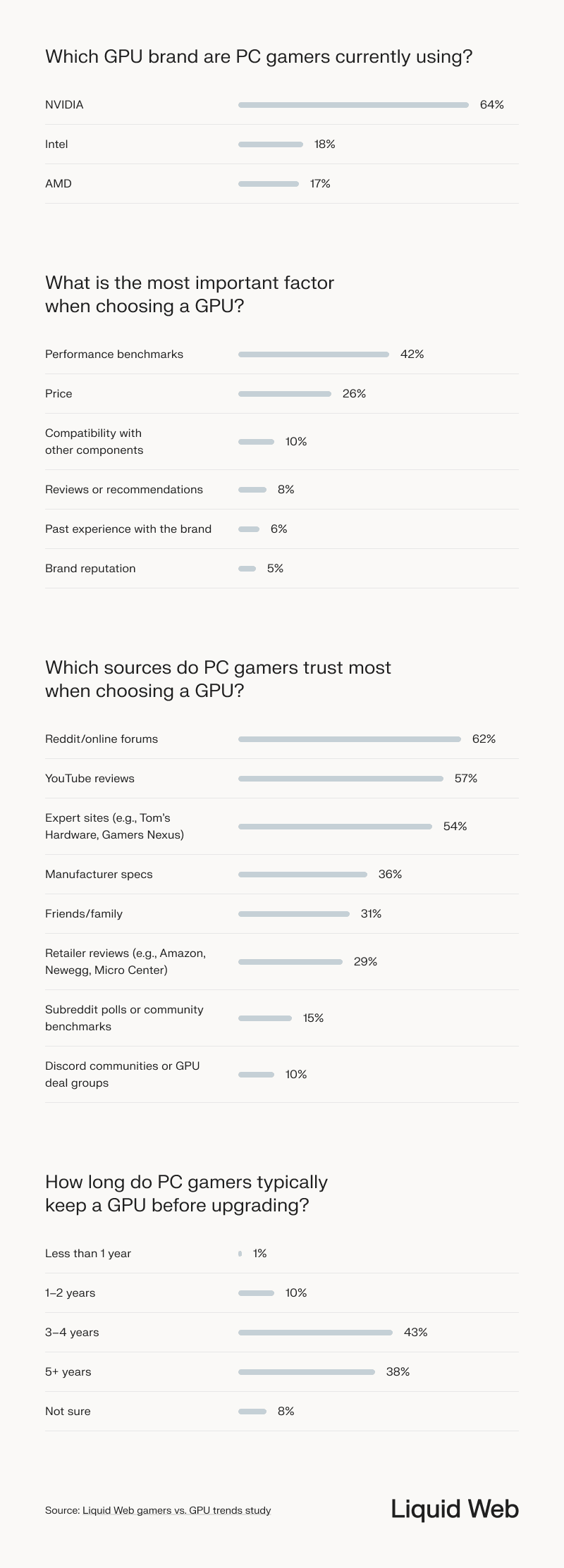
NVIDIA remained the brand of choice for the majority, with 73% of gamers selecting it as their preferred GPU if all brands performed equally. This preference was especially strong among power users: 76% of ultrawide monitor users and 66% of 4K gamers relied on NVIDIA.
However, sentiment isn’t set in stone. Around a quarter (23%) said recent controversies or business decisions made them less likely to support a brand. Influencers also played a role, with 35% of gamers saying reviews or tech personalities have swayed them away from certain manufacturers.
Nearly 1 in 10 gamers (8%) reported regretting a GPU purchase. These feelings were most often due to issues like:
- Driver problems (especially for AMD users)
- Overheating or loud cooling solutions
- Underwhelming performance for the price paid
- Incompatibility with VR or specific games
- Short-lived performance gains
“Gamers are pragmatic: value, reliability, and innovation matter more than brand loyalty. Brands that embrace these shifts will stand out in an increasingly discerning market.”
Brooke Oates
Product Manager at Liquid Web

Affordable wins over specs for many gamers
As GPU prices continue to rise, budget constraints are pushing gamers toward secondhand markets and upgrade delays. Still, a GPU remains the most desirable upgrade for some.
Nearly 1 in 4 (23%) said it would be their top pick if they could invest in just one component right now.

Over half of PC gamers (57%) have been prevented from buying a GPU due to price hikes or scalping. Another 43% have delayed or canceled a GPU upgrade because of financial obligations like rent or bills.
If they had to buy a new GPU today, 25% of gamers said $500 would be their spending limit, and 27% were only willing to spend up to $699.
Buying behavior reflects gamers’ tight budgets. Nearly half (45%) have opted for used or older models, and 22% said they use drop trackers or alert services to monitor price changes.
Even for gamers ready to upgrade, 39% plan to wait 1–2 years, while another 37% said they’d only replace it if their current GPU fails.
Access may also be an issue in the marketplace:
- 1 in 7 gamers reported that GPU shortages have impacted their gaming or productivity in the past year.
Gamers are divided on whether new features are worth it. About half believe GPUs have hit diminishing returns, while half do not. Topping the list of overrated features were 8K gaming (47%), ray tracing (17%), and frame generation (11%).
Cloud gaming is reshaping future demand
GPU demand among gamers in the future may look very different as cloud services and AI technologies improve. Many PC gamers are already reconsidering the need for hardware upgrades.

More than 2 in 5 PC gamers (42%) said they would skip a future GPU upgrade entirely if AI upscaling or cloud services met their needs. Nearly two-thirds (62%), including 62% of millennial and 61% of Gen Z gamers, would switch to cloud gaming full-time if latency were eliminated.
Younger gamers showed the strongest inclination. Among Gen Z and millennials, 21% believed high-end GPUs would become less essential in the next 3 years. Over a third of respondents (36%) reported already using cloud gaming like GeForce NOW or xCloud occasionally.
If these trends continue, cloud performance may become a decisive factor in the GPU market, altering not just how games are played but also whether expensive hardware remains relevant.
Even for gamers ready to upgrade, 39% plan to wait 1–2 years, while another 37% said they’d only replace it if their current GPU fails.
“With gamers increasingly open to cloud and AI-powered solutions, partnerships or innovation in these areas could position brands for the future.”
Brooke Oates
Product Manager at Liquid Web
The next era of gaming power
Gamers want power, but they also want flexibility and value. NVIDIA still leads in preference, yet a growing number of players are reevaluating traditional upgrade cycles.
With 42% willing to skip future GPU upgrades if AI upscaling or cloud gaming meets their needs, and 62% ready to switch to cloud gaming if latency improves, the next generation of gaming may rely less on hardware and more on smart alternatives.
Economic constraints are pushing gamers to make more calculated choices. Tight budgets, secondhand markets, and skepticism toward features like 8K gaming signal a shift from prestige performance toward practical solutions.
At the same time, emerging technologies like AI upscaling and cloud gaming services are reshaping expectations.
As hardware and software continue to evolve, the companies that win will be those that deliver value-first innovation, solving real pain points around access, longevity, and performance without breaking the bank.
“GPU and gaming providers must rethink and address their value propositions. Accessible pricing, trade-in programs, or cloud gaming integrations could build long-term loyalty.”
Brooke Oates
Product Manager at Liquid Web
Fair use statement
This content is based on proprietary research conducted by Liquid Web and is shared here under fair use for educational and informational purposes. If you reference any part of this article, please provide proper attribution with a link back to the study so your readers can see the findings in their entirety.
Share this content
<a href="https://www.liquidweb.com/white-papers/gamer-gpu-trends-study/" target="_blank" rel="noopener noreferrer">Liquid Web AI web scraping study</a>
Learn more about this study
Game without limits
Host faster. Play harder. Our dedicated game servers are built for elite performance and uptime.
