

◦ Root access
◦ Fast deployment
Web hosting pain points in 2025: What businesses are doing about it
Website infrastructure plays a bigger role than ever in business operations, but many teams still face persistent issues tied to hosting.
To better understand how businesses are navigating hosting challenges in 2025, Liquid Web surveyed over 500 business owners, developers, and IT decision-makers across industries and company sizes to uncover the year’s biggest web hosting pain points.
From rising costs and frequent downtime to AI adoption and security failures, this report reveals the top hosting headaches businesses face today, the consequences of unreliable infrastructure, and what companies plan to prioritize as they upgrade their stacks.
The findings point to a hosting landscape shaped by budget increases, AI-powered tools, and growing expectations for security and support.
Whether you’re evaluating your current provider or planning your next infrastructure move, these insights can help you make smarter decisions.
Key findings
- Cost remains the #1 challenge:
- 57% of businesses cite high costs as their biggest hosting challenge in 2025.
- Businesses waste an average of $418 per month resolving hosting-related problems, adding up to over $5,000 a year.
- Provider loyalty vs satisfaction:
- 42% of businesses have been with their hosting provider for 1–3 years.
- Despite long-term use, 41% reported regret after switching providers.
- Security threats are common:
- Nearly 50% of businesses faced hacking attempts in the past year.
- 32% suffered data breaches due to poor hosting security.
- Downtime is costing real money:
- 1 in 5 businesses lose over $2,500/month due to downtime.
- Downtime affects nearly half of all businesses, with some hit monthly.
- Future hosting investments:
- 47% of hosting teams expect budgets to rise in 2025.
- 49% plan to invest in AI-based tools to optimize hosting performance.
Top hosting headaches businesses face
Website hosting satisfaction in 2025 depends heavily on cost, performance, and reliability. As more businesses prioritize hosting as a strategic investment, the factors that drive loyalty (or motivate a switch) are becoming clearer.

Across all company sizes, high cost and slow website performance consistently ranked among the top 3 challenges with current hosting providers.
Even large businesses with greater resources pointed to slow performance, frequent downtime, and high costs as major issues. As Sachin Puri, President of Liquid Web, explains:
“You can’t scale a business on shaky infrastructure. Fast, reliable hosting ensures your website keeps up as your traffic, customers, and operations grow. It’s the engine behind sustainable digital growth.”
Sachin Puri

Most respondents (72%) were just somewhat or slightly satisfied with current hosting providers, with 3% not satisfied at all. Only 26% were extremely or very satisfied.
Among highly satisfied users, certain strengths stood out, but some also mentioned high costs and wanting even more flexibility:
“While the cost is high, the hosting provider offers some of the best security in the industry. I don’t experience downtime like I did with my previous provider, so yes, I’m very satisfied.”
Consultant / Advisor
“The server I use offers great flexibility, especially when integrating with other tools and AI applications. The website features are extensive, and the customer support is consistently helpful.”
Company owner / Founder
“My hosting provider’s service meets my needs efficiently and reliably. They’ve also implemented strong security measures.”
IT professional / Technical lead
“The hosting provider allows for a good level of customization, but I’d love to see even more flexibility.”
Company owner / Founder
When asked what would make them leave their provider, 43% pointed to high costs, followed by 28% who said slow website performance and 26% who flagged frequent downtime.
Beyond dealbreakers, many businesses also shared what they’d like to see improved.

Most businesses have stayed with their current hosting provider for a while. The most common duration was 1 to 3 years, reported by 42% of respondents.
Another 25% have been with their provider for less than a year, while 23% have stayed for more than 3 years. One in 10 have never switched providers.
But sticking with the same provider doesn’t always mean a business is happy. In fact, 41% said they regretted switching at some point. This suggests web hosting provider transitions often fall short of expectations around cost, performance, or support.
How to avoid switching regret: 3 tips from Liquid Web
Not all hosting transitions go smoothly—2 in 5 businesses say they’ve regretted switching providers.
To avoid falling into that trap, here’s what to consider before you make a move:
- Benchmark more than just price. Don’t switch providers based solely on a cheaper monthly rate. Factor in hidden costs like downtime, support responsiveness, and time spent troubleshooting. The cheapest option upfront often costs more in the long run.
- Request a pre-migration assessment. A quality hosting provider will offer tools or consultations to help you assess whether the move makes sense based on your performance, traffic, and growth needs. Ask what migration support is included, and what happens if something goes wrong.
- Prioritize transparent, tiered support. Many regrets stem from poor support after switching. Look for a provider that offers 24/7 support with clearly defined SLAs (service level agreements), escalation paths, and human help, especially if your site is revenue-critical.
“Hosting isn’t just backend tech—it’s your brand’s foundation online. Choosing the right infrastructure partner is one of the most strategic moves you can make this year or any year.”
Ryan MacDonald
Chief Technology Officer at Liquid Web

Troubleshooting and tech woes
Hosting-related issues are costing businesses more than just time. They’re also exposing companies to security risks and draining IT budgets.

Due to poor hosting, 51% of businesses dealt with security vulnerabilities in the past year. Nearly half (48%) faced hacking attempts, while 32% experienced a data breach. The risk of data loss runs throughout all these issues, making reliable disaster recovery solutions more important than ever.
Companies also spent heavily on fixing technical issues. On average, businesses lost $418 per month (more than $5,000 annually) on hosting-related troubleshooting. Education reported the highest average losses at $663 per month, followed by:
- Healthcare: $478
- Finance: $458
- Information technology: $447
- Marketing and advertising: $441
Time spent dealing with hosting issues depends on the type of platform businesses use. Here’s how it breaks down by hours per month:
- Managed WordPress hosting: 6 hours
- Dedicated servers: 5 hours
- Shared hosting: 5 hours
- WordPress hosting: 5 hours
- Managed hosting: 5 hours
- VPS (Virtual Private Server): 4 hours
In addition to time spent troubleshooting, many businesses face costly downtime that cuts into productivity and revenue.

Roughly half of businesses experienced downtime due to hosting problems at least a few times per year, with some industries being hit harder than others:
- Marketing and advertising: 61%
- Information technology: 56%
- Professional services: 52%
- Manufacturing: 52%
- Finance: 51%
- Healthcare: 51%
About 1 in 10 businesses experienced downtime monthly, and this was most common among large companies (14%). For many, these outages represent ongoing reliability concerns and measurable revenue loss. Over 1 in 5 reported losing more than $2,500 per month due to hosting-related downtime.
Future plans and hosting investments
As digital demands grow, many businesses plan to expand their hosting capabilities. Here’s where they expect to invest in 2025 and how priorities shift by size and industry.
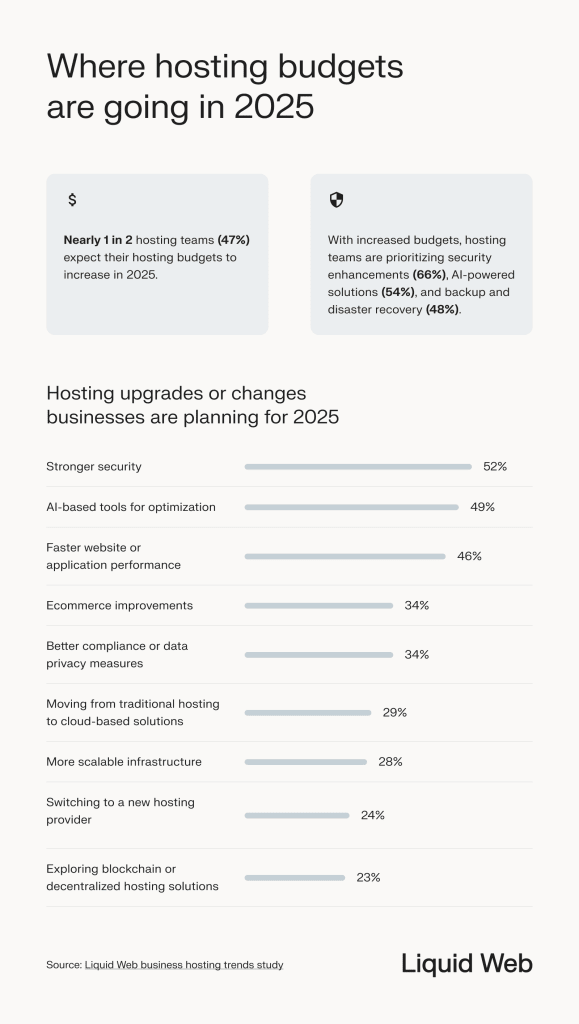
Nearly 1 in 2 hosting teams (47%) expect their hosting budgets to increase this year. The trend is strongest in information technology (55%), followed by finance (51%), healthcare (49%), and marketing and advertising (48%).
Across the board, 49% of businesses said they plan to invest in AI tools for web hosting optimization in 2025.
- Among large companies, 62% are planning stronger security, 59% are prioritizing AI, and 45% want more scalable infrastructure.
- Medium-sized businesses showed similar interests, with 56% focusing on AI, 53% on security, and 50% on faster website or app performance.
- Small businesses reported top investments in stronger security (59%), AI tools (54%), and faster performance (51%).
Micro businesses, while more conservative, still reported 42% investing in security and over a third planning to adopt AI-based optimization.
The state of web hosting in 2025
Hosting is becoming a bigger part of how businesses run and grow.
Many are rethinking what they need from their providers, with a focus on reliability, flexibility, and strong security. Downtime and security problems continue to cause real losses.
As more teams plan to invest in better tools and performance, 2025 is shaping up to be a year of smarter hosting decisions.
“In 2025, businesses should stop viewing hosting as a commodity and start treating it as a critical investment in security, performance, and growth.”
Ryan MacDonald
Chief Technology Officer at Liquid Web
Fair use statement
This content is based on proprietary research conducted by Liquid Web and is shared here under fair use for educational and informational purposes. If you reference any part of this article, please provide proper attribution with a link as the original source.
Share this content
https://www.liquidweb.com/white-papers/web-hosting-pain-points-study/Learn more about this study
Reduce risk with VPS hosting
For companies that can’t afford downtime or data loss, Liquid Web’s VPS delivers.
