


 Maddy Osman
 Just like the internet in the late 1990s, the cloud is the key to success for contemporary businesses — Gartner expects 70 percent of enterprises to use cloud platforms in 2027 to accelerate their business operations, up from 15 percent in 2023.
With the cloud’s scalability, flexibility, and high availability, you can meet your global customers where they are and enrich their experiences. Plus, you can leverage on-demand resources to continue your business operations without any downtime.
That said, the journey to cloud adoption isn’t without its challenges. In particular, excessive cloud bills seem to be a nightmare for businesses transitioning to the cloud. A 2023 Flexera report found that 82 percent of businesses are struggling to keep their cloud spend under control.
Still, you can navigate these cloud challenges and benefit from the cloud without breaking the bank if you opt for a suitable cloud service provider.
Let’s dig in to find out how to do that and more.
- What is a cloud service provider?
- What are the benefits of using a cloud service provider?
- How to choose a cloud service provider
- Top cloud service providers
- Final thoughts: Top cloud service providers of 2025
What is a cloud service provider?
A cloud service provider (CSP) is a company that offers computing services over the internet — including virtual machines (VMs), storage space, and other IT services. In other words, CSPs help businesses run their IT operations without physical hardware.
As a result, a cloud service provider helps a company reduce its capital expenditure. Instead, they just have to pay the CSP a fee — or subscription — to avail of its services. For example, Netflix uses a public cloud service provider to let global customers watch TV shows and movies on demand.

What are the benefits of using a cloud service provider?
What exactly do Netflix and other companies get by opting for a cloud service provider? Let’s find out.
Easier scalability
The cloud offers quick scalability compared to on-premises infrastructure and other internet hosting solutions. As a result, if your ecommerce website expects a higher number of users on a specific sales day or during a holiday season, you can just scale up your resources by heading to the cloud dashboard.
Once the peak time is over, you can also instantly scale down the server. In fact, if you’re using a cloud service provider with auto-scaling, the provider will dynamically size the server up and down as per the requirements without requiring any input from you.
In comparison, if you’re working with an on-premises server, you’ll need to migrate your ecommerce website to a bigger server to enjoy the same stability — which comes with additional equipment. Not to mention, you can’t scale back by sending that equipment back to the seller.
Business continuity
Since the cloud lets you scale the server up and down as required, you’ll be better equipped to handle the varying resource demands to continue business operations.
It’s what lets companies like Netflix not have to worry about a server slowing down during a film premiere. Even if all its customers turn up to watch the film, the cloud provider will scale up the capacity to offer a smooth viewing experience.
Beyond that, cloud service providers typically have redundant IT infrastructure to keep your business running even in case of hardware failures, network outages, and local disasters.
Cost savings
Cloud service providers benefit from economies of scale to let you use computing resources at low costs. You pay a fraction of what you’d have to invest for an on-premises server to get the equivalent IT resources.
Plus, since the cloud lets you instantly scale up and down as required, you don’t need to pay for all that extra hardware just for emergencies. Instead, you only pay for the resources you need and can use that cash elsewhere in the business.
Finally, by opting for a cloud service provider, you save much of the labor costs spent on maintaining the server. Instead, you can use those IT hours on needle-moving tasks to increase your business’s bottom line.
Robust security
Compared to small and medium enterprises, cloud service providers typically have dedicated security experts specialized in different domains, including data protection, network security, and relevant compliance. As a result, cloud providers are well-equipped to deal with a host of security challenges.
Moreover, cloud providers have an identity and access management (IAM) system in place to restrict access to data centers on a need basis. So, you don’t have to worry about a malicious USB infecting your system and bringing your business to a halt.
Global presence
If your system lives in your on-premises server in Frankfurt, you cannot expect to offer a seamless experience to your customers from Oceania. With your server taking one-fourth of a second to communicate with them, it’ll end up in a jagged interaction.

Cloud providers typically offer multiple servers worldwide to let you connect with customers from the servers closest to them.
Beyond the performance boost, the global presence of cloud infrastructure also helps you with business continuity because even if a major disaster affects a data center, you can continue doing business with the remaining data centers.
How to choose a cloud service provider
While cloud hosting offers many benefits, the quality of your cloud experience will heavily depend on your cloud service provider. Here are a few factors you must consider while choosing a cloud provider.
Pricing model
You can find cloud hosting with pay-as-you-go and fixed-fee models. In the pay-as-you-go model, you only pay for what you use — the way you pay for utilities. So, if your applications consume more resources in a month, you pay more — and vice versa.
On the other hand, in a fixed fee model, you typically get a specific amount of computing resources, storage space, and network bandwidth, depending on your plan. And if you need more resources for peak times, you can scale up with autoscaling.
A pay-as-you-go solution suits you if you have unpredictable demand. For example, if you provision cloud instances from time to time for testing software or deploying applications.
That said, the pay-as-you-go model can be expensive for relatively consistent workloads due to higher hourly costs. In that case, you might be better off with fixed-fee subscription models with lower hourly costs since you can rely on auto-scaling to meet peak demand.
Customer support
While the cloud is a gateway to growth for modern companies, it’s rarely a walk in the park due to how complicated cloud technologies are. In fact, a 2023 SoftwareOne survey of 500 IT decision-makers found that 32 percent of organizations missed a business opportunity due to a lack of cloud skills.
To compensate for the gap in cloud skills, 93 percent of respondents shared that they prioritize partnering with a managed cloud provider that can handle many of the cloud problems on its end.
If your company also lacks a dedicated cloud team, consider partnering with a managed cloud provider that takes much of cloud work off your plate.
Plus, whether you opt for managed or unmanaged, consider the customer support options the cloud service provider offers. Besides the live chat and support tickets, does the provider offer phone support?
Compliance requirements
You also have to consider how you will comply with the relevant data security standards — HIPAA, GDPR, and PCI-DSS — as you move to the cloud.
To start, ensure the cloud service provider meets the industry-specific regulations and standards. Plus, check if it has the relevant compliance certificates you require for hosting your data on its servers.
For instance, if you’re looking to host your eCommerce website, Nexcess is a PCI-DSS-compliant host. Plus, it also complies with SSAE-18 and GDPR.
Service offerings
The cloud offers limitless options. You can get enterprise-grade infrastructure to host your ecommerce website or streamline your continuous integration and continuous deployment (CI/CD) pipelines.
That said, the options available to you depend on your cloud service provider. If the provider deals with enterprises like Liquid Web does, it’ll have the infrastructure — in terms of processors, RAM, storage, and bandwidth — to address your enterprise workloads. Otherwise, you’ll have a difficult time.
To ensure you don’t end up with an incompatible cloud provider, consider the following factors:
- Management style: Does the provider offer unmanaged or managed services? If you have a small IT team or want your IT professionals to focus on needle-moving tasks, consider a provider with managed cloud operations.
- General vs specific: Does the provider offer solutions for everybody or your specific market segment? A provider with a specific market segment typically has a support team that’s well-versed in your particular challenges.
- Type of service: Does the provider offer Platform as a Service (PaaS), Infrastructure as a Service (IaaS), or Software as a Service (SaaS)?
Reliability
Accidents happen. Even with the latest IT solutions, the cloud isn’t resistant to hardware failures. In fact, Microsoft Azure had three outages within a span of four days in January 2024.

To ensure your business stays operational despite these hardware failures, opt for a cloud provider with redundant IT infrastructure. So, even if one of the data centers goes down, you can serve your customers from the other data centers.
Beyond that, note the historical uptime performance of the cloud provider. Ideally, it should be 99.99 percent or better.
Top cloud service providers
The cloud landscape has plenty of great service providers with a range of service offerings. Let’s discuss these prominent providers one by one to see which one is right for you.
1. Liquid Web

Liquid Web offers a cloud solution that’s perfect for you. You get a configurable cloud solution to build up based on your business needs. If you have a dedicated cloud team, you can go unmanaged.
Otherwise, you can let Liquid Web’s team handle it for you. Similarly, you can choose your preferred operating system, hardware specs, and control panel.
Besides the configurable bundle, cloud hosting from Liquid Web also comes with API to automate workflows, implement integrations, and streamline CI/CD processes.
Additionally, if you work with sensitive data, as in healthcare, you can use Liquid Web’s VMware private cloud to benefit from the cloud features without losing the air gap to breeze through relevant audits.
And moving over is easy thanks to Liquid Web’s experienced migration specialists who handle the entire migration process for you.
Key features:
- Customizable base to let you design your cloud solution as you want.
- Flexible management gives you freedom of choice.
- Powerful API.
- Compliance-focused data centers.
- Predictable bills with monthly subscription fees.
Best cloud service provider for: Enterprises looking for an affordable cloud provider for their SaaS applications, development workflows, or compliant solutions.
2. Amazon Web Services
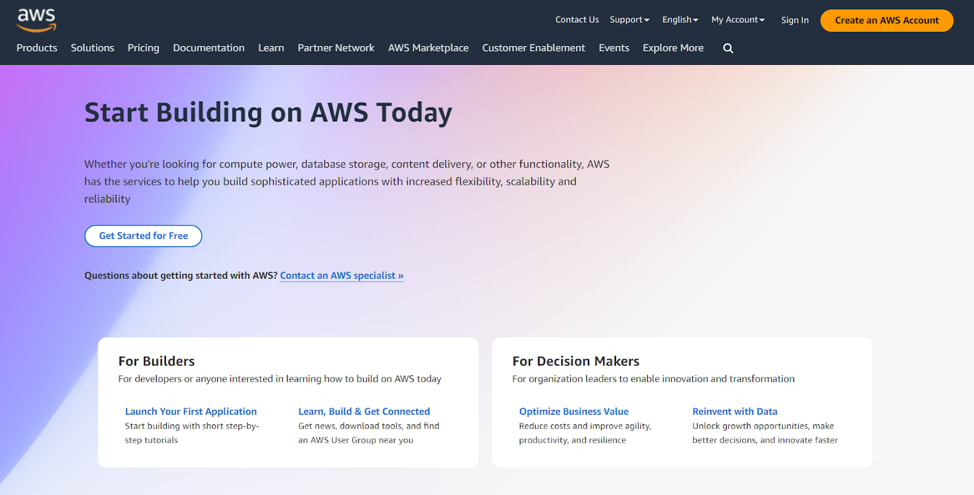
Amazon Web Services (AWS) is the leading cloud computing platform with an extensive suite of cloud services for managing applications on the cloud. With its global network of data centers, AWS suits businesses of all sizes looking for on-demand computing resources.
As one of the oldest cloud hosting providers, AWS offers a rich cloud ecosystem — it has 200+ cloud-native applications you can use to have a head start while building a software application.
Key features:
- Pay-as-you-go pricing model to let users pay only for the resources they use.
- Integration with a wide range of third-party tools and services.
- Amazon SageMaker, Amazon Rekognition, and Amazon Lex to help users with artificial intelligence and machine learning workloads.
Best cloud service provider for: Businesses with dedicated cloud teams.
3. Microsoft Azure
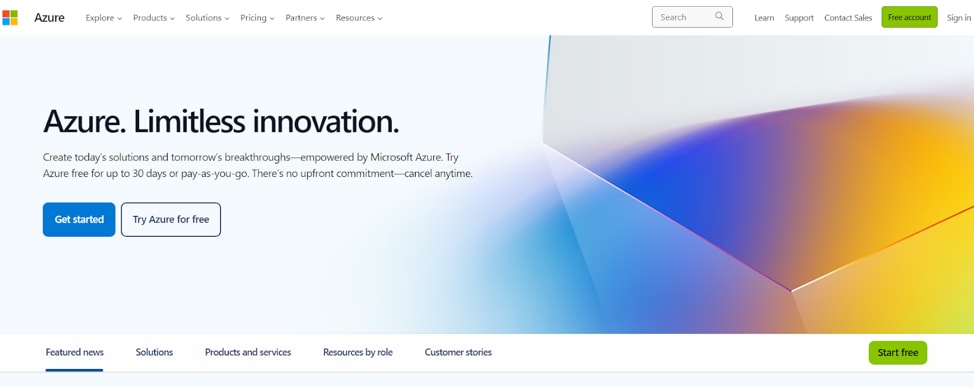
If your enterprise relies on Microsoft products like Windows, Office, and Dynamics, you might find more benefits in Microsoft Azure. With its powerful integration with the Microsoft ecosystem, Azure streamlines the migration process for businesses reliant on Microsoft.
Beyond that, Microsoft Azure also suits large businesses that want to opt for a hybrid cloud instead of a full migration. As a result, businesses using Microsoft Azure can transition to the cloud over time instead of in a single go.
Key features:
- Azure AI services to help businesses build intelligent apps.
- Support for open source technologies — Docker, Linux, and Kubernetes.
- Hybrid cloud capabilities to enable gradual cloud transition.
Best cloud service provider for: Businesses of all sizes reliant on the Microsoft ecosystem.
4. Google Cloud Platform

Given the shift towards artificial intelligence in recent years, most cloud providers possess specific services suited for AI workloads. That said, if you’re looking for the best cloud provider for AI and machine learning, Google Cloud Platform (GCP) is the answer — with its support for TensorFlow, BigQuery, and AutoML.
Besides that, like Microsoft Azure for the Microsoft ecosystem, GCP also lets you benefit from the existing Google tools, such as Gmail, Google Drive, and Google Docs.
Key features:
- Advanced support for machine learning and artificial intelligence.
- Cost-effective computing resources with pay-as-you-go pricing.
- Robust disaster recovery with global data centers.
Best cloud service provider for: Businesses looking for a cloud provider for running their artificial intelligence or machine learning workloads.
5. IBM Cloud

If you’re looking for an enterprise-first cloud service provider for your large enterprise, IBM Cloud might be what you need. With its advanced encryption, centralized access controls, and secure containers, IBM Cloud offers the out-of-the-box security you need to comply with relevant security regulations.
IBM Cloud also supports hybrid and multi-cloud environments. So, you can use a mix of on-premises and cloud infrastructure and even add other cloud providers into the mix to benefit from their functionalities.
Key features:
- Industry-specific solutions for healthcare, financial services, and retail.
- Extensive support for open source solutions, including Docker and Kubernetes.
- Integration for other clouds via multi-cloud.
Best cloud service provider for: Businesses looking for an enterprise-first cloud provider with multi-cloud functionality.
Final thoughts: Top cloud service providers of 2025
While you can go with any of the five cloud providers discussed, you must consider your business requirements, internal team capabilities, and budget limits to find the best fit.
If you lack a dedicated cloud team, you may be better off avoiding an unmanaged public cloud as their pay-as-you-go pricing can turn into pay-everything-you-have real quick. Instead, consider managed cloud hosting services, as they free up your IT team to work on other business tasks.
If you’re looking for a reliable cloud hosting solution, check out Liquid Web’s cloud hosting plans. It offers everything you need and more with global data centers, 24/7/365 dedicated support, and auto-scaling.