


 Maddy Osman
 Modern businesses are migrating to the cloud due to its scalability, cost savings, and high availability. But to reap these benefits, you must optimize your cloud environment for better performance.
Optimizing your cloud environment requires time and resources, especially in a multi or hybrid cloud setup where you have to manage different cloud environments with unique requirements and configurations. That’s where managed cloud services come into play.
With managed cloud services, you can outsource cloud management tasks to an expert and focus on growing your business. A survey by Parallels reveals that 62 percent of organizations lack in-house cloud management skills, which makes cloud optimization a global challenge.
In this guide, we’ll walk you through the benefits of a managed cloud service, its challenges, and factors to consider when choosing a service provider.
- What are cloud managed services?
- Types of managed cloud services
- Benefits of managed cloud services
- Challenges of managed cloud services
- Factors to consider when selecting a cloud managed service provider
- Final thoughts: Cloud managed services — a beginner’s guide
Key points
- Managed cloud service providers are a one-stop solution for all your cloud computing needs, from configuration to updates and backups.
- Cloud managed services offer partial or complete management of your cloud infrastructure, depending on your needs.
- To get the most out of cloud managed services, you must work with an experienced provider that aligns with your goals.
- The best service providers offer custom cloud solutions to their clients, as businesses have varying needs.
- Working with a trusted provider will ensure your cloud infrastructure is secure, cost-efficient, and complies with regulatory requirements.
What are cloud managed services?
Cloud managed services involve delegating a business’s cloud management tasks to a third party. These tasks typically include cloud migration, configuration, security, optimization, and maintenance (e.g., upgrades and patching).
Managed cloud providers offer a one-stop solution for all your cloud needs. The goal is to get as much value from your cloud deployment as possible.
You can choose to outsource some or all of your cloud management tasks at any stage of your cloud journey. Either way, you’ll find that many cloud managed providers offer a comprehensive range of IT services.
It’s worth noting that you can have an internal team while outsourcing cloud management tasks. This gives you some control over your cloud environment and lets you leverage the vendor’s expertise and resources.
Types of managed cloud services

Now that you know what a managed cloud service entails, let’s look at its most common types.
Infrastructure-as-a-Service (IaaS)
This type of cloud managed service gives you access to virtualized computing resources through the internet, eliminating the need for expensive hardware. Plus, your chosen IaaS provider will manage the IT infrastructure, such as servers, storage, and networking.
One key advantage of IaaS solutions is scalability, as it lets you adjust cloud resources as required. Additionally, IaaS adopts a pay-as-you-go model, which means you’ll only pay for the resources you consume.
Microsoft Azure is a popular IaaS provider.
Platform-as-a-Service (PaaS)
Platform-as-a-Service is a cloud computing model that allows you to build, test, and deploy web applications over the internet. What’s more, multiple users can access the platform simultaneously.
A great example of a PaaS provider is Google App Engine.
Bare Metal-as-a-Service (BMaaS)
Bare Metal-as-a-Service is a cloud computing model that provides you with a dedicated physical IT infrastructure (i.e., bare metal), giving you full control over hardware resources.
This level of control is especially beneficial for businesses that handle sensitive information or those that must adhere to strict regulatory compliance. And since you won’t share resources with other users, you don’t have to worry about the noisy neighbor effect.
Software-as-a-Service (SaaS)
Software-as-a-Service lets you access software applications over the Internet for a monthly subscription fee. This payment model is one of SaaS’s main benefits since it makes budgeting easier and improves financial forecasting.
SaaS typically doesn’t require an installation or download. Examples of SaaS providers include CRM software and collaboration tools like Slack.
Benefits of managed cloud services
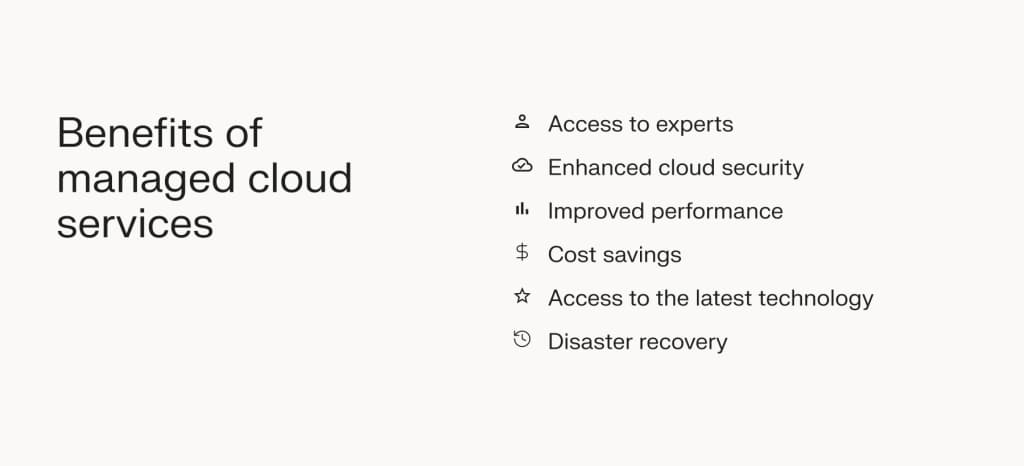
Managed cloud services enable enterprises to unlock various benefits, including the ability to customize their cloud solutions to fit their business needs and requirements.
Here are a few other benefits you should be aware of.
Access to experts
Cloud computing requires specialized skills, which is hard to come by. The Parallel report quoted earlier states that 33 percent of organizations lack in-house cloud expertise.
With cloud managed services, you’ll get access to a team of experts who know the intricacies of cloud technologies and can create contingency plans for any challenges you may face in future.
In addition, they’ll provide guidance and support throughout your cloud journey. For example, these experts can help you figure out how to migrate your data, apps and workloads to the cloud.
Managed cloud providers can also handle hybrid and multi-cloud complexities. So, you can rest easy knowing your cloud infrastructure is in good hands.
Cost savings
When you outsource your cloud operations, you won’t have to manage an internal IT team or increase headcount to gain access to specialized expertise. This helps you reduce operational expenses by leveraging the expertise of cloud professionals.
Working with an external team also eliminates the need to invest in hardware and software licenses.
However, cloud costs can quickly add up due to hidden fees and high resource consumption. In such situations, your cloud MSP can help you save costs by improving existing processes and providing visibility into your resource utilization.
Enhanced cloud security
Although the cloud offers a host of benefits, protecting sensitive data and digital assets can be a tall order. In a 2023 survey, Palo Alto Networks found that 68 percent of organizations couldn’t detect a security threat in under an hour.
Cloud managed service providers develop and implement robust security mechanisms, including proactive threat monitoring and multi-factor authentication. They also follow best practices and trends to keep pace with the constantly changing cybersecurity landscape.
This adds a layer of security to your cloud infrastructure, protecting you from malicious actors.
Access to the latest technology
Cloud managed service providers stay updated on technological advancements and news. By partnering with an external IT team, you’ll get access to the latest technologies and tools, including AI-powered data analytics and machine learning.
Your cloud partner can also help you put such technologies to work, freeing up time and resources so your in-house team can focus on other tasks. With an external IT team, you won’t need to train existing staff each time a new cloud technology is introduced.
Improved performance
To get the most out of your cloud environment, you must optimize it for better performance. A cloud MSP uses performance-enhancing techniques like caching, auto-scaling, and load balancing to help you do exactly that.
These providers continuously monitor cloud environments to identify bottlenecks or performance issues and take corrective action before they escalate.
Disaster recovery
Given that a disruptive event like a cyber attack can occur at any time, it’s essential to create a disaster recovery plan that allows you to restore lost data. A cloud managed service provider can help you develop a robust cloud strategy and train your staff to execute it, ensuring business continuity.

Disaster recovery is often confused with high availability. But they’re not the same. High availability involves keeping your business online as much as possible, while disaster recovery aims to get you back to productivity in the shortest period of time.
Challenges of managed cloud services
Here are some challenges you might encounter when outsourcing cloud management tasks:
- Poor response times — If the managed service provider is slow to render assistance when needed, it may lead to financial losses, lost productivity, and prolonged downtime. Not to mention, downtime can cause people to form negative opinions about your business, causing reputational damage.
- Hidden costs — While outsourcing cloud management tasks can save costs, there may be hidden costs down the road. To tackle this, choose a provider that offers a transparent pricing model — or even better, one that customizes its pricing plan to fit your needs.
- Data security and privacy concerns — Outsourcing means entrusting sensitive information to a third party. Therefore, your chosen cloud MSP must follow strict security protocols and adhere to industry-specific regulations like HIPAA and GDPR to reduce the risk of data breaches.
- Vendor lock-in — Although outsourcing simplifies cloud management, there’s a risk of lock-in. For instance, if the cloud MSP no longer meets your needs, switching to a different vendor may be difficult and expensive. To overcome this, adopt a hybrid cloud approach, as it allows you to retain control over your data.
Factors to consider when selecting a cloud managed service provider
Below are a few factors to consider when researching and vetting managed cloud providers.
Expertise and experience
The cloud MSP you choose must be knowledgeable about the services you wish to outsource. You can assess the vendor’s expertise and experience by reviewing their certifications and reading customer reviews on unaffiliated platforms.
Also, verify if the provider has experience working with businesses similar to yours (and how long they’ve been at it).
Choosing a cloud MSP with relevant industry experience can help you optimize your cloud operations, reduce financial risks, and improve security.
Security measures
When engaging with a cloud MSP, ask about the security measures they have in place to protect your systems and apps from cyber attacks. For instance, do they provide encryption for data in transit and at rest?
Adherence to security standards like ISO-27002 is also essential, as it reduces the risk of legal penalties.
The provider’s physical security measures also play a crucial role in safeguarding your enterprise’s digital ecosystem. Physical security methods include tools like motion-detecting security cameras and alarm systems.
Customization
Choose a service provider that tailors their cloud solution to meet your needs and objectives. A customized cloud solution ensures efficient resource allocation and helps you optimize performance.
Customization also allows you to include specific security protocols, integrate your cloud solution with existing infrastructure, and scale your business as needed.
Without customization, you might end up paying for services you don’t need, leading to resource wastage and increased costs.
24/7 customer support
Partnering with a cloud MSP that provides reliable customer support is crucial for optimal performance. Before choosing a provider, confirm their support delivery medium (e.g., phone, live chat, and email) and availability to ensure prompt assistance whenever you need it.
At Liquid Web, you’ll get assistance via multiple channels and enjoy a 59-second response time.
Service level agreement (SLA)
Thoroughly review the SLA before committing to a cloud managed service provider. An SLA defines the provider’s service management obligations and includes agreed-upon penalties that will be enforced if they default.
It also includes service level indicators (SLIs), which are key metrics you can use to measure the provider’s performance. This contractual agreement improves communication between you and the service provider and makes it easier to resolve conflicts.
Here are vital factors to consider when reviewing an SLA:
- Uptime guarantee (e.g., 99.99 percent or five nines).
- Cybersecurity protocols.
- Compliance with relevant regulations.
Considering these factors provides insights into the provider’s reliability and trust levels, helping you decide whether or not to collaborate with them.
Final thoughts: Cloud managed services — a beginner’s guide
Managed cloud services can reduce costs, enhance performance, and safeguard your cloud assets and systems. Remember, you’ll need to conduct thorough research to find a reliable provider that fits your needs and budget.
At Liquid Web, we offer fully managed cloud dedicated servers with on-demand flexibility and scalability. We also provide multiple management panels, including Plesk and InterWorx.
Our cloud-hosted dedicated servers include DDoS protection, shielding your website from cyberattacks. Plus, our expert team provides real-time support to help you choose the right hosting solution for your enterprise.
Contact us today to learn more about our managed cloud services.