


 Maddy Osman
 When people think of web hosting, what typically comes to mind are shared hosting, dedicated server hosting, and virtual private server (VPS) hosting. But there is more to web hosting than these three familiar choices.
Cloud hosting is increasingly popular because of its benefits and cost savings. However, you might not have heard of colocation. Colocation hosts your equipment instead of your data. For enterprises, colocation could be a strong option.
Let’s dig into what you need to know about cloud hosting and colocation, including how they operate, their unique benefits, and the key factors to consider when choosing between them.
What is cloud hosting?

Cloud hosting is a broad term for a number of web hosting services that provide access to a server, or network of servers, via remote access. Traditionally, cloud hosting referred to a network of connected servers, but now it also refers to cloud-based access to hosting resources on a single, remote server.
Whether connected to one physical server or many, cloud hosting provides easy, scalable access to computing resources without the expenses and complexities associated with maintaining physical servers and other hardware on-premises or at a third-party data center.
There are four main types of cloud solutions. These are:
- Public cloud: In a public cloud, resources are shared among different organizations on the same cloud platform or network. Public cloud is cost-effective due to the sharing of resources among many users, but it has higher security risks.
- Private cloud: A private cloud hosting model reserves an entire infrastructure for use by a single organization. There’s no sharing of resources here between firms, which means enhanced privacy and security.
- Hybrid cloud: The hybrid cloud approach combines public and private clouds, enabling businesses to leverage the benefits of both. For example, an organization may use a private cloud to host its most sensitive data and information while hosting the rest on a public cloud.
- Managed cloud: Managed cloud services can be public, private, or hybrid. The difference is that managed cloud service includes additional support and management services from the provider, eliminating the need for a large in-house IT department.
The demand for this service is surging, with a study by Zippia finding that 94% of all enterprises currently use cloud services. Furthermore, according to Fortune Business Insights, the cloud computing market is expected to grow to $2,432.87 billion by 2030.
Get cloud hosting that fits your needs
Liquid Web offers the most robust line of cloud server hosting options in the industry
What is a colocation service?
Colocation, sometimes called colo, means renting space for your data storage and networking equipment at a third-party data center, also known as a colocation facility or colocation data center.
Instead of housing your data, colocation houses your equipment.
You lease the space where your equipment is stored and pay for services such as power, cooling, fire protection, Internet connectivity, maintenance packages, and physical security from the colocation facility.
As of 2022, there were 1,489 colocation facilities in the US. But this number could increase in the future. In fact, according to Statista, the colocation data center market is expected to grow to over $136 billion by 2028.
Colocation is sometimes confused with dedicated server hosting, but they are very different. With colocation, you own a server housed in the colo facility, while with dedicated server hosting, the provider owns the server and leases it for your exclusive use.
Colocation vs cloud hosting: 5 key differences

Cloud hosting and colocation differ in cost, control, and security. Here’s how the two stack up against each other.
1. Cost
Cloud hosting
Cloud hosting and colocation share a cost advantage in that both help you avoid the real estate and personnel expenses of operating your own data center, which can range between $10 and $25 million per year. But that’s as far as the similarities in terms of costs go.
Cloud hosting initially comes with a low capital expenditure (CapEx) since you don’t need to buy your servers and other hardware. Additionally, the majority of cloud hosting service providers use a pay-as-you-go pricing model.
That means that you only pay for the resources you use and no more, but costs may fluctuate depending on traffic, bandwidth, and if you scale up during a period.
Colocation
Colocation initial investments depend on your situation. If you already have the hardware, costs include transport to the facility, space, and extra services. If you don’t already have the hardware, you must also invest in that. You’ll also need to budget for maintenance, upgrades, and eventual replacement of your hardware.
Once you’ve set up your infrastructure in a colocation provider’s facility, the operating expenditure (OpEx) is more predictable unless you need to scale up.
2. Scalability
Scalability refers to the ease of increasing or decreasing computing resources as needed. Scaling options vary between cloud hosting and colocation.
Cloud hosting
Scalability is one of the hallmark features of cloud hosting. With cloud hosting, you can scale resources like CPU, RAM, and storage up or down almost instantly to meet your website or app’s fluctuating demands with a few clicks on your control panel.
Colocation
Conversely, scaling in colocation is more challenging. It’s constrained by the capacity of your hardware and the physical space available at the colocation center.
Upscaling in colocation hosting involves investing in more hardware and possibly more space in the data center. This process requires careful logistical planning and may include downtime during setup, which could impact business operations.
3. Security
Cloud hosting
In cloud hosting, security is a shared responsibility between you and the cloud service provider. The extent of each party’s responsibility depends on whether you’re on a managed or unmanaged service plan.
In both instances, the provider is responsible for securing the underlying cloud infrastructure, including hardware, software, and networks.
If you are on a managed cloud hosting plan, the provider also takes on the role of ensuring the security of your data and applications that are within the cloud — typically through measures like firewall, DDoS protection, and malware scanning.
On an unmanaged cloud hosting plan, the responsibility for securing your cloud-hosted data and applications lies with you.
Colocation
In colocation, the data center provides physical security measures just like a cloud host, such as surveillance, controlled access, and on-site security personnel, ensuring the physical safety of your servers and other equipment. However, you are responsible for all digital security.
4. Control and customization
Cloud hosting
Sometimes, cloud hosting offers less access and direct control over the hardware components of your hosting environment since these are owned and managed by your provider.
However, quality hosts like Liquid Web offer cloud hosting package options that give you strong hardware choices plus root-level access to your server for unrestricted management.
Colocation
On the other hand, colocation grants you full and unrestricted access to both the hardware and software components of your system. However, that also means you’ll need a full IT team to manage your systems at an additional cost.
5. Reliability
Cloud hosting
Cloud hosting is renowned for its high uptime and reliability. Its distributed nature means it’s unlikely for a single point of failure to cause significant downtime.
Data is replicated across multiple systems, so if one server experiences issues, another one can seamlessly take over with minimal to no disruption to your business operations.
Leading cloud hosting providers, such as Liquid Web, offer substantial Service Level Agreements (SLAs) that guarantee 100% uptime.
Colocation
With colocation, reliability is dependent on your IT team, the quality of your infrastructure, and the redundancy measures of the chosen colocation services provider, such as backup power and cooling systems.
Cloud hosting vs. colocation: Factors to consider when choosing a solution
When deciding between colocation and cloud hosting, there are several factors you should consider to help you make the best decision and ensure your needs are met.
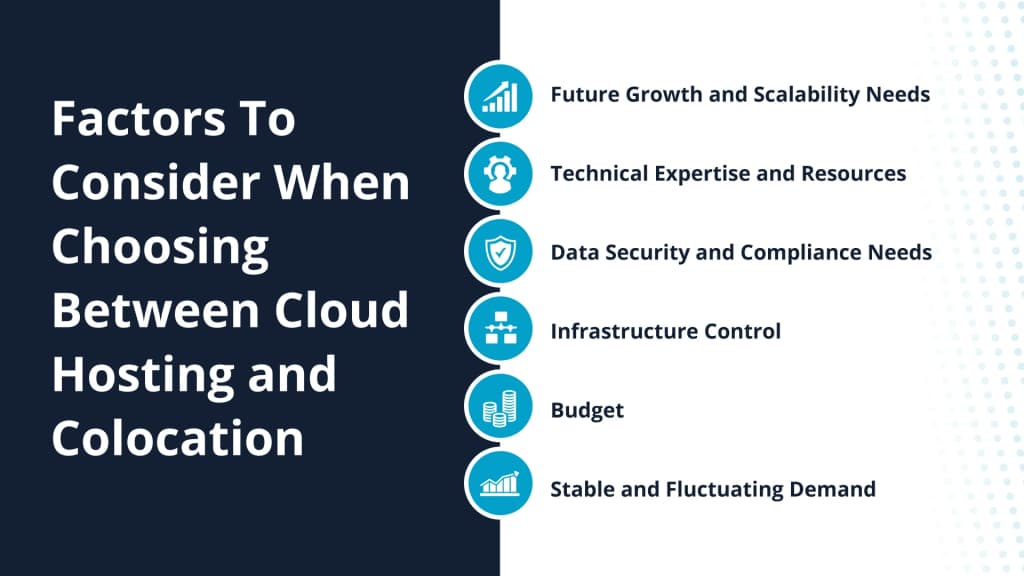
Future growth and scalability needs
Consider the expected growth trajectory of your business. For example, do you expect your business to expand rapidly in a short time, or do you foresee slow, steady, and predictable growth?
Cloud hosting is ideal for businesses with a rapid growth trajectory, thanks to its nearly instant scalability. You can easily increase computing resources to match your growing business needs.
Colocation, on the other hand, whose scaling process is more time- and cost-intensive, may be better suited to businesses with slower growth or those that have reached stable resource needs.
These businesses can strategically invest in a specific number of resources, like servers and storage, knowing they will be able to sustain them for an extended time period before they need to scale.
Technical expertise and resources
Generally, cloud hosting requires less technical expertise and fewer IT resources.
The cloud service provider is responsible for maintaining, upgrading, and fixing any issues with the physical components of your hosting environment.
Plus, if you are on a managed service plan with a provider like Liquid Web, the provider also handles and oversees other tasks like server setup and configuration, security management, monitoring, support, software updates, performance optimization, and compliance management.
These characteristics make cloud hosting particularly appealing for smaller businesses or those without a dedicated IT department, as well as enterprises looking to save costs by reducing their IT department.
On the flip side, colocation demands a higher degree of technical know-how to manage complex IT infrastructures. Since you own the hardware and software, the responsibility of setting up, maintaining, and managing these components falls squarely on your shoulders.
This demands a skilled in-house IT team or the willingness and budget to hire external experts. Large organizations with strong IT teams might opt for colocation to fully leverage their in-house expertise while maintaining direct oversight and control over their hosting infrastructure.
However, depending on the location of your colocation facility, you might also have travel costs for your IT team.
Data security and compliance needs
Many businesses find it practical to outsource security monitoring to specialized web hosting providers. For example, leading cloud hosting services like Liquid Web are well-versed in navigating the ever-evolving landscape of data protection regulations and standards, such as HIPAA for healthcare or PCI DSS for payment processing.
By leveraging your hosting provider’s expertise, you can ensure your business meets the compliance standards of your industry without substantial investment in training, staff, or technology.
With colocation, on the other hand, you have complete access to and control over your hardware and software — including the responsibility of ensuring security and compliance with any data or privacy regulations in your industry.
That total control is great in some regards, but can also be a problem. The ongoing management of these systems can be resource-intensive, often diverting focus and resources away from core business activities. It requires significant investment in aspects like continuous monitoring, regular security audits, technology, and training.
Infrastructure control
In many instances, the flexibility and ease of use that cloud hosting offers is more advantageous than the total control offered by owning your own hardware. It allows you to focus on core operations while still maintaining a dependable and efficient IT setup.
Colocation is advantageous in situations where direct access and oversight over the physical components of your hosting infrastructure are critical or where you wish to deploy custom hardware solutions. But it’s important to recognize that most companies don’t need that level of control.
Budget
Your financial capabilities are another important element to consider when deciding between cloud hosting and colocation.
With cloud hosting, there is less upfront investment since you don’t need to buy physical hardware or infrastructure. This makes it a great option for small and medium-sized businesses or startups that need to deploy quickly but don’t have sufficient budget to invest in their own servers and other hardware.
Plus, the long-term cost-effectiveness for enterprises is very attractive.
Colocation requires a higher initial investment and higher continued maintenance costs. Scaling and other upgrades require fresh new investments as well.
If your business already owns server equipment, it can be more economical in the short term to colocate until your servers need updating, at which point you can transition to cloud hosting. This approach also helps you avoid disposing of still-useful equipment prematurely.
Stable and fluctuating demand
Cloud hosting is the better option for businesses that encounter fluctuating or unpredictable demand. Ecommerce sites are a prime example, often experiencing traffic surges during holiday seasons or sales events.
The scalable nature of cloud hosting allows for swift adaptation to these changes, providing more resources during peak times and scaling down during slower periods. This helps in optimizing operational costs, as you pay only for the resources used.
Scaling infrastructure in a colocation setup involves physical hardware adjustments, which makes this type of hosting less flexible in responding to sudden spikes or drops in demand. It’s more of an option for businesses with stable and consistent demand.
Next steps for colocation or cloud hosting
Both cloud hosting and colocation bring unique strengths and challenges to the table. The best choice for you depends on your specific business requirements and circumstances, including your financial capacity, growth prospects, scalability needs, and desired level of access to and control over the hosting environment.
For most businesses, cloud hosting provides more flexibility, easier scalability, and lower upfront costs. Colocation offers more control over your infrastructure and allows companies to transition into the cloud as existing equipment ages out of service.
With Liquid Web, you don’t have to choose between cloud hosting and colocation. We have a solution that provides the best of both worlds. Our cloud dedicated servers combine the dedicated resources and security often associated with colocation hosting with the flexibility and instant scalability of cloud technology, all without the added equipment and maintenance costs.
Contact us today and see how we can save you money while delivering the best performance.