


 Liquid Web
 Many digital-forward businesses have moved some or all of their computing resources to cloud hosting, and plenty more are weighing up their options between cloud computing and on-premises infrastructure.
In fact, Gartner expects public cloud spending to reach $675.4 billion in 2024, which would be a massive 20.4 percent increase from 2023.
And that doesn’t even account for the level of private cloud spending. According to Flexera’s State of the Cloud Report, 73 percent of organizations are using a mix of public and private cloud services, meaning overall cloud spending is much higher.
So, what do you stand to gain from cloud technology, and what pitfalls should you look out for? That’ll all depend on your budget and business needs. To help you make a decision that’s right for you, we’ve weighed up the advantages and disadvantages of cloud computing.
Here’s what we’ll cover:
- Introduction to cloud computing
- Advantages and disadvantages of cloud computing
- How top-tier cloud service providers help you manage risks
- Final thoughts: Advantages and disadvantages of cloud computing
Key points
- Cloud adaptation is increasing among businesses, and many firms who haven’t moved at least some resources to the cloud are considering their options.
- Your main options for cloud type are public, private, hybrid, and multi-cloud, and your service choices are SaaS, IaaS, and PaaS.
- Some key advantages of cloud computing are price flexibility, rapid scalability, and robust availability.
- You may need to deal with shortcomings, like a lack of server control, compliance concerns, and security issues.
- Most, if not all, of the key cloud computing concerns can be mitigated by choosing a cloud service provider that puts security and customer service at the forefront.
Introduction to cloud computing
Before we focus on the advantages and disadvantages of cloud computing, a brief explainer of cloud computing is necessary: It’s the provision of computing resources or services over the internet. These resources can include software, servers (physical or virtual), and applications.
The most prominent types of cloud computing are private cloud, public cloud, multi-cloud, and hybrid cloud. Private cloud computing services are reserved for one customer only, and public cloud users share a provider’s resources. When a business has a hybrid cloud solution, this means it’s using both public and private cloud, while multi-cloud is using cloud services from two or more providers.
The most common cloud services are:
- Infrastructure-as-a-Service (IaaS): In this model, computing resources like server space are supplied by cloud providers.
- Software-as-a-Service(SaaS): In SaaS, software or applications, such as cloud-based calling or team messaging, are delivered through the cloud. In some cases, these services are accessed through a web browser.
- Platform-as-a-Service (PaaS): In this cloud service type, developers get a cloud platform for building and managing applications.
Advantages and disadvantages of cloud computing
Some key benefits of cloud computing are scalability, high availability, accessibility, and cost savings. Notable disadvantages include a lack of control, potential vendor lock-in, and a dependence on the internet.
Granted, some of the advantages may not apply to every business. And with the right approach, many of the disadvantages of cloud computing can be alleviated — or even overcome.
Advantages of cloud computing
If you’ve already begun your search for a cloud computing solution, you may have some specific benefits in mind. Here, we’ll take a detailed look at some selling points to aid your decision-making and ensure your potential cloud solution ticks all the right boxes.
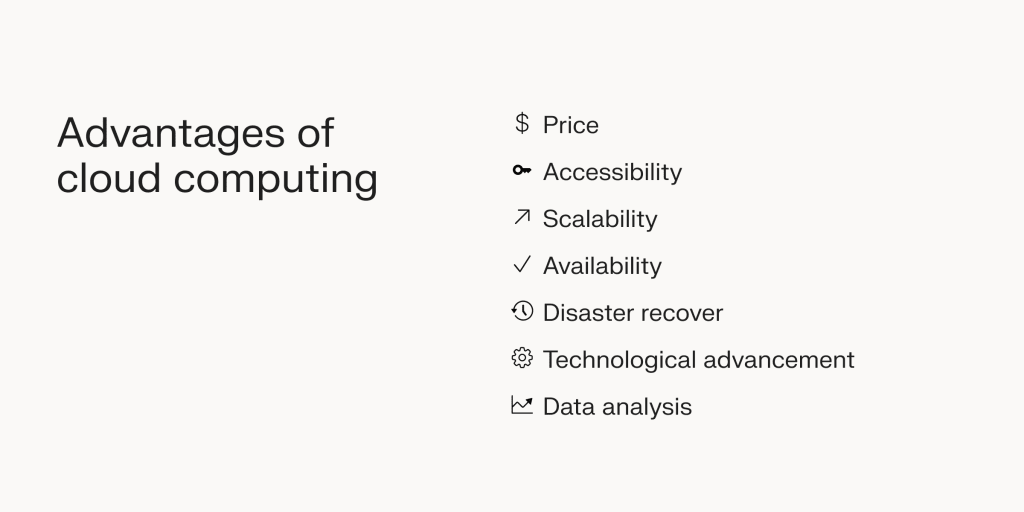
Price
Physical servers, whether they’re hosted on-premises or in third-party data centers, can incur various upfront and ongoing costs, such as hardware purchases, server maintenance, and a year-long subscription to a hosting plan.
And if you purchase dedicated server hosting via a physical server, you’ll pay for the entire server, including storage space, RAM, and bandwidth, even if you only use a fraction of it.
With cloud computing, you only pay for the resources you need when you need them, so it’s cost effective compared to some other options.
Accessibility
Generally, cloud services are available on demand wherever you have an internet connection. Rather than relying on physical storage devices, like computer hard drives, you can benefit from seamless data storage via the cloud.
For example, cloud services let you access data through various means, such as email and cloud-based applications, wherever you are in the world. This level of accessibility fosters easy collaboration among distributed teams, such as in-office and remote working staff.
Scalability
For many businesses, such as startups, the ability to scale quickly is a major factor in their choice of technology. Depending on your company’s dependence on computing resources, easy scalability could determine whether you reach growth targets.
Often, you can scale cloud-based services up or down at a moment’s notice, which is great for both high-growth companies with uneven workloads and small businesses that need to reduce expenses during quiet periods (e.g., changing economic circumstances or seasonality). In fact, Liquid Web lets you adjust your resources with just one click.
Availability
Because of the distributed nature of cloud infrastructure, you can minimize server downtime and disruption to your business. Some cloud providers have service-level agreements that promise a certain amount of uptime or appropriate compensation. For example, Liquid Web has a 100 percent network and power assurance for cloud customers.
Disaster recovery
If all your valuable data is stored on a single physical server on premises or in a data center, then you could lose access to it in the event of an outage or hardware failure. But if you’re storing your data in the cloud, features like automatic backups and disaster recovery services allow you to quickly recover from service interruptions.
For many businesses, cloud computing is an essential means of alleviating risks to their IT infrastructure.
Technological advancement
If you purchase servers and host them on premises, your servers may experience performance degradation over time, and the technology may eventually become obsolete.
By making cloud computing part of your digital transformation, you’ll get access to top-of-the-line hardware and features from service providers, who continually update their offerings as new cloud technologies are developed.
Data analysis
With cloud computing, you can capture data from various cloud sources, access it easily, and combine it in a cloud analytics solution. This allows you to get in-depth insights into your cloud performance, usage, security, and more.
Disadvantages of cloud computing
For some businesses, like those that handle highly sensitive data, the cloud may not be a tempting option. Here are some potential downsides of migrating to the cloud.

Control
Since cloud computing services are generally managed by the service provider, you won’t have any responsibility for maintaining and updating the cloud infrastructure. However, this also means you’ll have limited control over the infrastructure and may lack customization options.
If you require a high level of control, such as full root access, then a more customizable service might be a better fit, like bare metal hosting.
Potential vendor lock-in
Some cloud providers have proprietary solutions that aren’t compatible with other software and systems. This can make migration challenging and prevent businesses from switching to better, cheaper cloud services.
In a study by Flexera, the top challenge of migrating workloads to the public cloud was understanding application dependencies, which was noted by 53 percent of small and medium-sized businesses and 54 percent of enterprises.
To avoid any migration issues, you should choose a web host with free expert migrations, like Liquid Web.
Dependence on the internet
Without internet connectivity, your cloud resources are completely unavailable. If you depend on physical access to your resources, then physical servers on-site, combined with multiple backups stored in different locations, may be a better choice.
Security
Some cloud computing services, such as the public cloud, have experienced high-profile security breaches, which are a huge concern for businesses. Some public cloud customers have assumed that big-name providers are fully protecting their data, but in reality, they’re operating under a shared responsibility model.
If security is a significant concern for your business (and it should be), then consider storing sensitive data in the private cloud, which offers a much higher level of security than the public cloud.
Furthermore, top-tier cloud providers like Liquid Web have robust security measures in place and are constantly updating their practices in response to evolving threats.
Compliance
Depending on the cloud service you choose, it may not comply with regulatory data protection standards, like the Health Insurance Portability and Accountability Act (HIPAA). If data privacy is paramount for legal or operational reasons, choose a hosting service that provides Payment Card Industry Data Security Standard (PCI-DSS)- and HIPAA-compliant solutions, like Liquid Web.
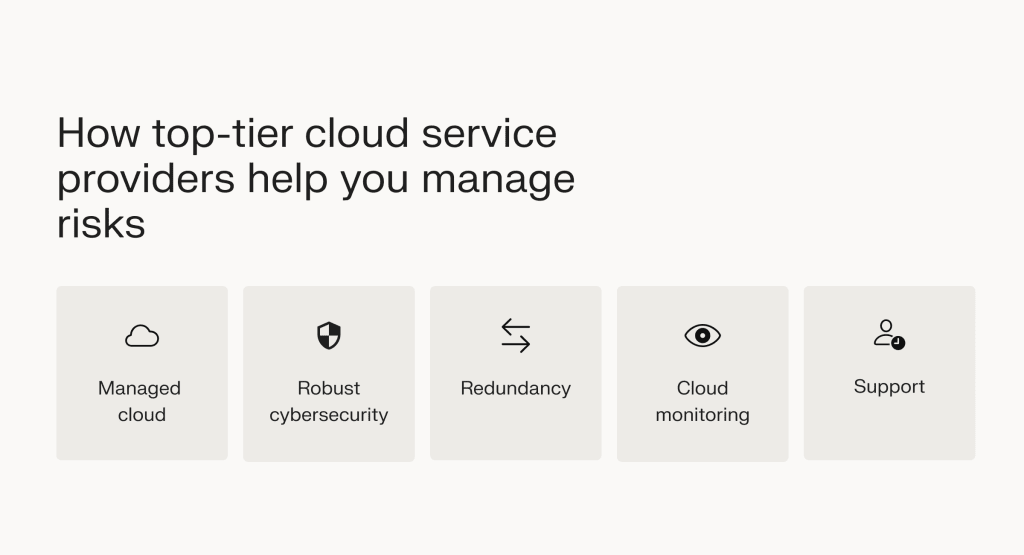
How top-tier cloud service providers help you manage risks
Are the challenges of cloud computing discouraging you from making a cloud-based digital transformation? Don’t make up your mind just yet.
With the right cloud service provider, you can avoid these concerns while making the most of your setup, whether it’s public, private, or hybrid cloud. Here’s how cloud providers can help:
Managed cloud
Even if you have a strong IT team in place, managing your own cloud computing infrastructure can pose considerable challenges. For this reason, it’s advisable to choose a managed cloud service provider, like Liquid Web, which maintains and updates the cloud infrastructure, allowing your IT team to focus on other crucial tasks.
Robust cybersecurity
Cybersecurity is a risk with any digital process, and absolutely ironclad computing resources could be prohibitively expensive for many businesses.
If you value the benefits of the cloud but want added security protection, make it a key focus of your search for the perfect cloud computing provider.
High-level cloud service providers often offer strong security measures to protect your resources, such as firewalls and regular patches. With Liquid Web, cloud customers get firewalls, distributed denial-of-service (DDoS) protection, Cloudflare CDN, Server Secure Plus, and more.
Redundancy
In cloud computing, many service providers duplicate data and systems to mitigate the effects of downtime and prevent data loss from a hardware failure. If data and service availability are vital to your business operations, then choose a service provider that has advanced redundancy measures, such as automated failover and backups.
Cloud monitoring
Cloud monitoring is no easy task, and any potential blind spots or oversights can have a damaging effect on your business operations. To benefit from cloud computing while removing time-consuming tasks from your IT workflow, leave the cloud monitoring and maintenance to the experts, like Liquid Web.
If you choose managed cloud hosting, the Liquid Web team monitors your cloud infrastructure for health, performance, and availability and steps in to handle maintenance whenever it’s required.
Support
If you encounter a major issue or have a service question, your cloud provider should be on call to help you get to the bottom of it. Liquid Web provides 24/7 heroic support that helps novices and pros alike get the most from their cloud services.

Final thoughts: Advantages and disadvantages of cloud computing
Now that you’ve gone over the pros and cons of cloud computing, you should make a checklist to find out which service and provider can meet your business needs.
Liquid Web has a range of cloud hosting solutions, such as cloud dedicated, cloud VPS, custom cloud, and private cloud (powered by VMware). With fully managed hosting as standard with many of our solutions, you can get help every step of the way, all while getting the performance and availability benefits your business deserves.
Can’t decide which type to choose or what resources you need? With many custom plan options available and endless scalability, you’re sure to find something that fits. But in case you need some guidance, you can contact our sales team today.