Skip to content
Search our site for answers
Login
  • Help Docs
  • API Docs
  • liquidweb.com
  • Hosting Services
    • Cloud VPS Hosting
    • Dedicated Servers
    • GPU Hosting
    • Hosting For WordPress
    • Hosting For WooCommerce
    • Email Hosting
    • VMware Hosting
    • Add-ons
  • Security & Compliance
    • SSL Certificates
    • Firewalls
    • Cloud Hosting
    • Two Factor Authentication
    • DDoS Protection
    • Compliance
    • Malware Protection
  • Domain & DNS
    • Domain Registration
    • DNS Settings
    • Nameservers
    • Subdomains
    • Domain Forwarding
    • Email DNS Setup
  • Account & Billing
    • Account Setup
    • Payment Methods
    • Billing Cycles
    • Refunds Cancellations
    • Invoices Receipts
    • Account Security
  • Email Hosting
    • Email Setup
    • Email Forwarding
    • Spam Protection
    • Microsoft 365
    • G Suite Setup
    • Account Security
    • Email Troubleshooting
  • Performance & Optimization
    • Server Optimization
    • Caching Strategies
    • Content Delivery Network
    • Database Performance
    • Image Optimization
  • Server Administration
    • Server Setup
    • SSH Access
    • Command Line Basics
    • Database Management
    • CRON Jobs
    • Apache Nginx Setup
    • Log Analysis
  • CMS & Applications
    • WordPress
    • WooCommerce
    • Magento
    • Joomla
    • Drupal
  • Backups & Recovery
    • Backup Strategies
    • Cloud Backups
    • Disaster Recovery
    • Restoring Backups
    • Raid Configurations
  • Reseller & Partner Support
    • Reseller Program
    • White Label Hosting
    • Partner Portal
    • Client Management
  • Policies & Compliance
    • Terms Of Service
    • Privacy Policy
    • GDPR Compliance
    • Acceptable Use Policy
Help Docs Email Mail Clients What is The Best Way to Set Up Email in Outlook 2016?

What is The Best Way to Set Up Email in Outlook 2016?

In this article, we discuss how to set up and configure Outlook 2016. We also cover adding an email account, modifying an existing account, configure outgoing server settings, ports and encryption, IMAP, POP3, SSL/TLS and then, test our configuration.
Email Hosting
7 min read

Pre-Flight Check

  • These instructions are intended specifically for setting up an email account in Microsoft Outlook 2016.
  • If these instructions don’t quite work for you, check out our tutorial on setting up other e-mail clients.
  • Not the right version of Microsoft Outlook? Check out How To Set up Email on Microsoft Outlook 2010.

Outlook 2016 Configuration

Step #1: Add or Edit the Email Account

  1. Account Information screenTo set up a new email account, click the File tab and then click Add Account.
  2. If you’re modifying the settings on an existing account already configured in Outlook, click on Account Settings and then click on Change settings for this account or set up more connections and skip ahead to Step #4: Modifying an Existing Account.

Step #2: Manual Setup for a New Email Account

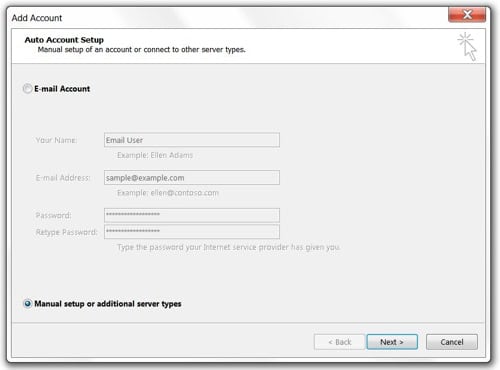
  1. Select the radio button for Manual setup or additional server types.Add Account Setup screen
  2. Then click Next.

Step #3: Select Email Account Type

  1. Select the radio button for POP or IMAP.Choose Service screen
  2. And then click Next.

Step #4: Modifying an Existing Account

  1. If you’re editing an email account that already has been configured in Outlook, click on the account name and then click on the Change button. Otherwise, skip ahead to Step #5: Configure General Settings.
    Account Settings edit
  2. WARNING: To avoid data loss, please use caution any time you change an email account’s connection type or delete an email account.
    Removing an email account from a mail client also will remove all messages associated with it on the device and, specifically for POP accounts that are not configured to retain mail on the server, there may be no way to recover those messages.

Note that you cannot edit an existing email account to switch its account type from POP3 to IMAP or vice versa. To change the account type, you must add a new account of the desired type (POP3 or IMAP) per the Add or edit the email account instructions above. Adding a new account with a different connection type should not require you to delete the old one in most mail clients.

Step #5: Configure General Settings

Non-SSL Account Settings
  • Your Name is your name as you want it to appear in emails that you send
  • Email Address should be the full email address
  • Account Type will be POP3 or IMAP, depending on your preference. For its ability to keep email in sync across multiple devices (desktop, laptop, phones and tablets), IMAP generally is recommended.
  • Incoming mail server
    • When using standard (non-SSL) settings, use mail.yourdomainname.com
    • When using secure (SSL) settings, use the server’s hostname (host.yourdomainname.com)
  • Outgoing mail server (SMTP)
    • When using standard (non-SSL) settings, use mail.yourdomainname.com
    • When using secure (SSL) settings, use the server’s hostname (host.yourdomainname.com)
  • Username is your full email address, not just the part before the at symbol.
  • Password is the email account password.
  • Require logon using Secure Password Authentication (SPA) must not be checked. SPA is not the same as SMTP authentication, which is used on cPanel servers.

Step #6: Configure Outgoing Server Settings

  1. Click the More Settings button, and select the Outgoing Server tab.Outgoing Server Settings - SMTP Authentication
    • My outgoing server (SMTP) requires authentication should be checked
    • Use same settings as my incoming mail server should be enabled
    • Log on to incoming mail server before sending mail (POP3 only) should not be enabled. That setting applies only to servers configured to allow POP Before SMTP authentication, in which a successful login to retrieve mail allows a user from the same IP address to also send mail for a period of time. It is not compatible with servers requiring SMTP authentication.
  2. Now select the Advanced tab at the top of the More Settings window.

Step #7: Configure Ports and Encryption

  1. Fill in the Advanced settings using the images and instructions below.
  2. Once complete, click OK to return to the previous window.
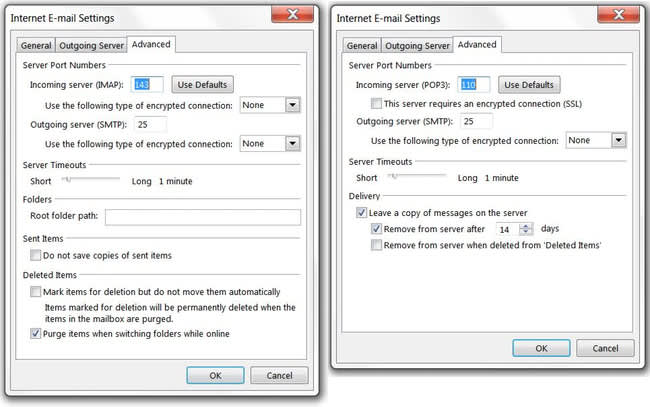
Non-SSL Ports and Encryption
Advanced Internet E-mail Settings screens for email accounts using IMAP (left) and POP3 (right) connection methods over a standard (non-SSL) network connection.

Standard (Non-SSL) IMAP Settings

Standard (Non-SSL) POP3 Settings

  • Incoming server (IMAP) is port 143
  • Use the following type of encrypted connection is “None”
  • Outgoing server (SMTP) is port 25 (587 also can be used if needed)
  • Use the following type of encrypted connection is “None”
  • Incoming server (POP3) is port 110
  • This server requires an encrypted connection (SSL) is not checked
  • Outgoing server (SMTP) is port 25 (587 also can be used if needed)
  • Use the following type of encrypted connection is “None”
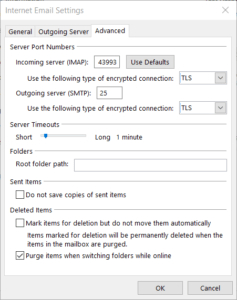
Advanced E-mail screen settings
Advanced Internet E-mail Settings screens for email accounts using IMAP.
pop-email-setup
POP3 connection methods over a secure (SSL) network connection.

Secure (SSL/TLS) IMAP Settings

Secure (SSL/TLS) POP3 Settings

  • Incoming server (IMAP) is port 993
  • Use the following type of encrypted connection is “TLS”
  • Outgoing server (SMTP) is port 465
  • Use the following type of encrypted connection is “TLS”
  • Incoming server (POP3) is port 995
  • This server requires an encrypted connection (SSL) is checked
  • Outgoing server (SMTP) is port 465
  • Use the following type of encrypted connection is “TLS”

Step #8: Test Settings

Self-Signed SSL Popup
  1. Click the Next button to make a connection to the server and test the configuration.
  2. If you’re using SSL settings and your server has a self-signed (free) SSL certificate installed on the mail server, you may get a popup warning. If so, you will need to click the Yes button to accept the certificate and proceed. Alternatively, you may select View Certificate and then click Install Certificate on the next screen to install the certificate locally and prevent the notice on subsequent connections.
  3. Once you click Yes, Outlook will test the connection settings.
  4. When you see the success message, you’re ready to start using your email address with Outlook 2016.

Note that a self-signed certificate uses the same level of encryption as a verified certificate, except that it is you who are verifying your server’s identity, rather than a third party. However, if you would prefer to use a third party verified SSL certificate to cover core services (cPanel/WHM, POP3, IMAP, SMTP, and FTP) on your server, you can find instructions for ordering and installing an SSL certificate at Install an SSL Certificate on a Domain using cPanel, and you’ll find a guide to installing your certificate on email and other core server services at Installing Service SSLs in cPanel.

Bonus for IMAP Users: Choose Which Folders to Display in Outlook

Select IMAP Folders

When connecting to your email server using the IMAP protocol, you can choose the specific mail folders to which you wish to subscribe.

To do so, right-click on your email account’s Inbox in Outlook 2016 (some older versions of Outlook may require you to right-click on the email address itself) and then select IMAP Folders from the popup list.

In the IMAP Folders window, click on the Query button in the top right of the window to get the current list of folders in your email account from your server.

Once the list has downloaded from the server, you will see each of your account’s folders on the server listed in the All tab, which should be selected by default, you will see a list of all the email folders in your account on the server. Folders to which you already are subscribed will appear with a folder icon, while folders to which you are not subscribed will have no icon next to their names.
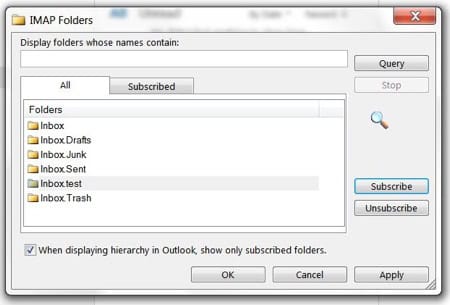
Outlook 2016 IMAP folder Query

You can manage your folder subscriptions by clicking on the folder name in the All list and using the Subscribe or Unsubscribe buttons.

Once you’ve finished making changes, click the Apply button and then select OK if needed. It will take a few moments for the folder list to update in your Mail pane.

Note that when subscribing to filtered mail folders such as Spam or Junk, all the mail coming into those folders on the server also will be downloaded and synced to your selected local mail client as well. If you are using a metered Internet connection or have limited bandwidth, please be aware that the transfer of email does count toward your data usage. If you typically receive a large volume of such filtered mail, subscribing to spam and junk folders is not recommended.

Find Detailed Information in Our Knowledge Base


Find instructions to set up your email account in any email client at How to Set up any Email Client.
For detailed instructions to set up your email account in popular email clients, visit:

  • How to Set up Email in Outlook 2010
Was this article helpful?
Thank you for your input.
Thank you for your feedback.
Table of Contents
  • Pre-Flight Check
  • Outlook 2016 Configuration
Essential hosting resources to help your business stay ahead
Get the guides
Related hosting content
  • How to set up a Palworld dedicated server
  • Setting Up Email in Thunderbird
  • Exporting Emails from cPanel

Hosting

  • Cloud Hosting
  • Dedicated Hosting
  • Email Hosting
  • GPU Hosting
  • Magento Hosting
  • Reseller Hosting
  • VPS Hosting
  • Hosting for WordPress

Additional Hosting

  • Add-ons
  • Agency Hosting
  • Application Hosting
  • Database Hosting
  • Ecommerce Hosting
  • Enterprise Hosting
  • Freelancer Hosting
  • High Availability
  • High Performance
  • HIPAA Hosting
  • PCI Compliant Hosting
  • Private Cloud Hosting
  • Server Clusters
  • Small Business Hosting
  • VPS Reseller Hosting
  • Windows Hosting
  • Windows VPS Hosting
  • Linux VPS Hosting
  • Ubuntu VPS Hosting
  • cPanel VPS Hosting
  • KVM VPS Hosting
  • WooCommerce Hosting

Servers

  • Bare Metal Servers
  • Cloud Dedicated Servers
  • Cloud VPS
  • Custom Servers
  • Dedicated Servers
  • Managed Cloud
  • Gaming Server
  • Windows Servers

Managed Hosting

  • Managed ExpressionEngine
  • Managed Craft CMS
  • Managed Cloud
  • Managed Hosting
  • Managed Hosting for WordPress
  • Managed Magento
  • Managed Servers
  • Managed VPS
  • Managed WooCommerce

Studies

  • Every Second Counts
  • Impact of Downtime
  • Hypergrowth Hosting

Resources

  • API
  • Hosting Coupons
  • Blog
  • Customer Stories
  • Ebooks
  • Help Docs
  • Migrations
  • Sitemap
  • SSL Checker
  • Webinars
  • Web Hosting Tools
  • White Papers
  • What is my IP

Hosting Basics

  • Bare Metal
  • Cloud Hosting
  • Dedicated Servers
  • Gaming VPS
  • GPUs
  • Private Cloud
  • VPS
  • Web Hosting

Partnerships

  • Hosting Affiliate Program
  • Partner Programs
  • Refer-a-Friend

Software & Design Solutions

  • GiveWP
  • IconicWP
  • Kadence WP
  • LearnDash
  • MemberDash
  • Modern Tribe
  • Restrict Content Pro
  • SolidWP
  • The Events Calendar

Get Help

  • Chat
  • Sales
  • Support

Company

  • About
  • Careers
  • Data Centers
  • Hosting Prices
  • News
  • Policies
  • Privacy Policy
  • Security
  • Terms and Conditions
  • Web Hosting Deals

Liquid Web, a web hosting company with 18 data centers globally

HostingAdvice.com logo
Liquid Web reviewLiquid Web review

© 2026 Liquid Web, LLC

Privacy Policy

* Promotions may be exclusively available to new customers and cannot be applied to existing accounts. Qualification is at the sole discretion of Liquid Web. Reach out with questions.

  • Solutions
    • Solutions by industry
      Ecommerce

      Secure, compliant infrastructure for regulated online sales

      Financial Services

      High-trust hosting built for security and compliance

      Agencies

      Fast, flexible hosting for high-traffic client projects

      Healthcare

      HIPAA-ready environments for protected health data

      Solutions by outcomes
      Compliance

      Hosting aligned with HIPAA, PCI, GDPR, and audit readiness

      Launch

      Configure a high-performance server in minutes

      Commerce Scale

      Infrastructure built to handle surges, orders, and growth

      Disaster Recovery

      Redundant, resilient systems for rapid recovery and uptime

  • VPS Hosting
    • VPS Packages
      Cloud VPS Hosting
      Windows VPS Hosting
      Linux VPS Hosting
      Add-ons & Backups
      View All VPS Hosting
  • Dedicated Servers
    • Bare Metal Packages
      Bare Metal Servers
      Cloud Metal Packages
      Managed Dedicated
      Gaming Servers
      View All Dedicated Servers

  • Managed Hosting
    • Managed Hosting
      Managed Servers
      Managed Applications
  • WordPress
    • Hosting for WordPress
      Managed Hosting for WordPress
      VPS for WordPress
      Dedicated WordPress
      WooCommerce Hosting
  • GPU Hosting
    • GPU Hosting
      NVIDIA GPU Hosting
      AI Training & Interface

  • Products
    • Compute
      Cloud Servers

      Scalable, high-speed compute

      Dedicated Servers

      Reliability, power, and control

      Private Cloud

      Isolated, enterprise-grade cloud

      GPU

      Accelerated for AI & ML

      Containers

      Portable workloads for any app

      Platform services
      Cloud Storage

      Storage for growing data needs

      Backups & DR

      Protection for critical workloads

      Global Private Fabric

      Unify networks across servers

      Security & Protection

      Advanced defense for data

      Load Balancing

      Optimized traffic distribution

      Applications
      WordPress

      Optimized for fast, secure sites

      WooCommerce

      Performance for scalable stores

      Magento

      Commerce-ready, built to scale

Log in
  • System status
  • Support | Get Help